Brussels Fines Musk’s X €120M, Firing Shot in Transatlantic Tech Showdown
Ramsha Jahangir / Dec 5, 2025
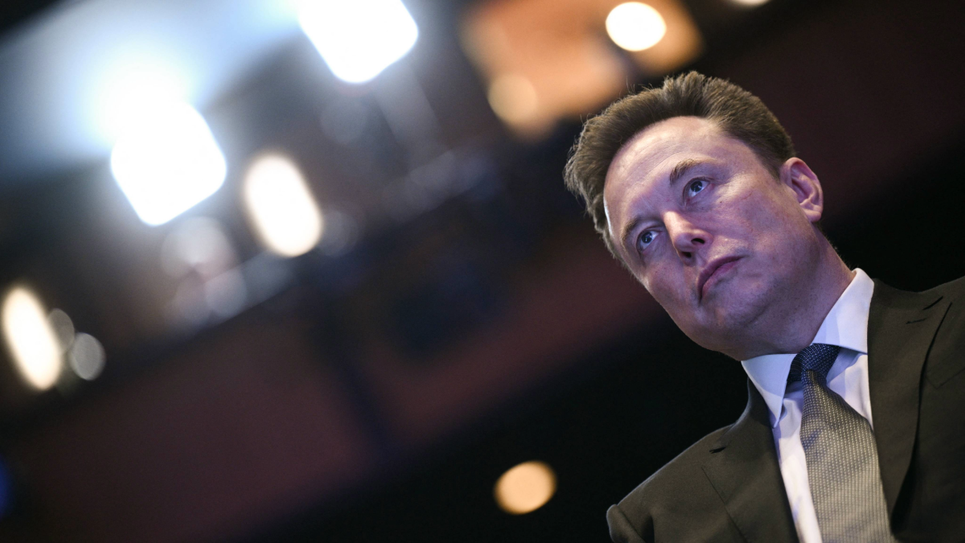
Elon Musk looks on as US President Donald Trump speaks at the US-Saudi Investment Forum at the John F. Kennedy Center for the Performing Arts in Washington, DC on November 19, 2025. (Photo by BRENDAN SMIALOWSKI/AFP via Getty Images)
The European Commission on Friday fined Elon Musk’s X €120 million for breaching multiple transparency rules under the Digital Services Act, delivering the first-ever non-compliance decision under the EU’s flagship tech regulation.
Friday’s decision comes nearly a year after the Commission opened formal proceedings against X. The Commission found X guilty of three core violations: deceiving users with its paid blue checkmark system, failing to maintain a functioning ad transparency repository, and blocking researchers from accessing public data on the platform. According to EU officials, the platform’s design choices “undermined accountability, obscured risks, and exposed users to manipulation and fraud.”
“The DSA protects users. The DSA gives researchers the way to uncover potential threats,” said European Digital Commissioner Henna Virkkunen. “With the DSA’s first non-compliance decision, we are holding X responsible for undermining users’ rights and evading accountability.”
Announcing the decision, Virkkunen said the €120 million fine was “proportionate” to the violations, emphasizing that it was calculated based on “the nature of these infringements, their gravity in terms of affected EU users, and their duration.”
Musk has 60 working days to detail how the company will address the deceptive use of blue checkmarks and 90 working days to submit a full action plan to fix its ad repository and research data access. Failure to comply could lead to periodic penalties.
Beyond the transparency violations addressed in Friday's enforcement decision, three additional investigations into X remain open. Two of these focus on how content—and the algorithms that promote it—have evolved since Elon Musk acquired Twitter and rebranded it as X in late 2022. The European Commission is also probing whether the platform has failed to comply with rules banning incitement to violence and terrorism, and whether its systems for reporting illegal content meet DSA standards.
TikTok, by contrast, avoided a penalty under the Commission’s ad library investigation as the company had offered to change the decision of its service. In her address to the European Council on Friday, Virkkunen confirmed that the Chinese-owned platform had taken steps to improve compliance, including upgrading its ad transparency tools and making its search and filter functions more accessible to researchers.
“The message is clear. We are not here to impose highest fines; we are here to make sure our digital legislation is enforced. If you comply, you don’t get a fine. Simple as that,” said Virkkunen.
DSA fine lands in a charged political moment
The decision intensifies a transatlantic rift over digital regulation, as US lawmakers and officials increasingly accuse Brussels of using the DSA to target American companies. X, backed by Musk’s vow to fight EU scrutiny in court, has been a lightning rod in the growing feud.
US Vice President JD Vance preemptively blasted the EU’s enforcement action on Thursday, accusing Brussels of “attacking American companies over garbage.” Musk responded directly on X, “much appreciated.” These comments follow other Trump administration actions meant to discourage regulation of online platforms. On Wednesday, the administration announced increased vetting of H-1B visa applications to look for signs that applicants were involved in activities such as content moderation or fact-checking, which the administration regards as “censorship.” Last week, US Commerce Secretary Howard Lutnick said the EU needs to change its digital regulations in order to get a deal to lower steel and aluminum tariffs.
“When the US Vice President attacks the EU, Elon Musk applauds him in public, and at the same time threats are made of visa harassment against fact-checkers and of using trade tariffs to blackmail Europe, this is no longer a debate about freedom of expression,” Germany’s Member of Parliament, Alexandra Geese, said in a press release.
“This is coordinated geopolitical pressure. It is about controlling algorithms as a political instrument of power in order to manipulate elections and prepare regime change in Europe,” the MEP said.
Brussels moves under mounting internal pressure
So far, only two companies—AliExpress and TikTok—have managed to avoid sanctions through negotiated commitments. Out of 14 formal DSA proceedings launched to date, the Commission has issued preliminary findings in six cases. Enforcement remains slow-moving, fueling criticism from within the bloc.
French President Emmanuel Macron recently voiced frustration over the pace of DSA action, warning that the EU risks losing credibility if it doesn’t start landing results. That urgency was echoed on Friday at a meeting of the European Council, where ministers held a discussion on tightening DSA enforcement amid mounting concerns over the spread of illegal content and unsafe products online. Officials cited recent discoveries of child sexual abuse material, weapons, and unregulated drugs on major platforms as evidence that current enforcement is falling short, and called for a more coordinated EU-wide response.
Last month, the EU’s enforcement position got a critical legal boost from the Court of Justice of the European Union, which dismissed Amazon’s challenge to its designation as a “very large online platform” (VLOP) under the DSA. The court backed the Commission’s authority to impose extra obligations on dominant digital platforms, rejecting Amazon’s argument that the rules were disproportionate or unfair. The ruling effectively reinforced Brussels’ legal footing to pursue enforcement, even if compliance comes with heavy operational costs for tech companies.
“The timing makes one thing clear: EU enforcement of the DSA is still primarily being driven by mounting pressure inside the EU, not by American politics,” Mathias Vermeulen, public policy director at AWO, told Tech Policy Press.
“The Commission had just secured legal backing from the Amazon ruling, and the European Parliament was aiming to set up a special inquiry committee to see whether the Commission has been sufficiently 'forceful' in its enforcement of the DSA,” he said, adding that “if there was ever a day to announce the X decision, it was today.”
Authors