Despite Using Iranian Meddling to Justify War, Trump Axes Election Defenses
Paul M. Barrett / Mar 9, 2026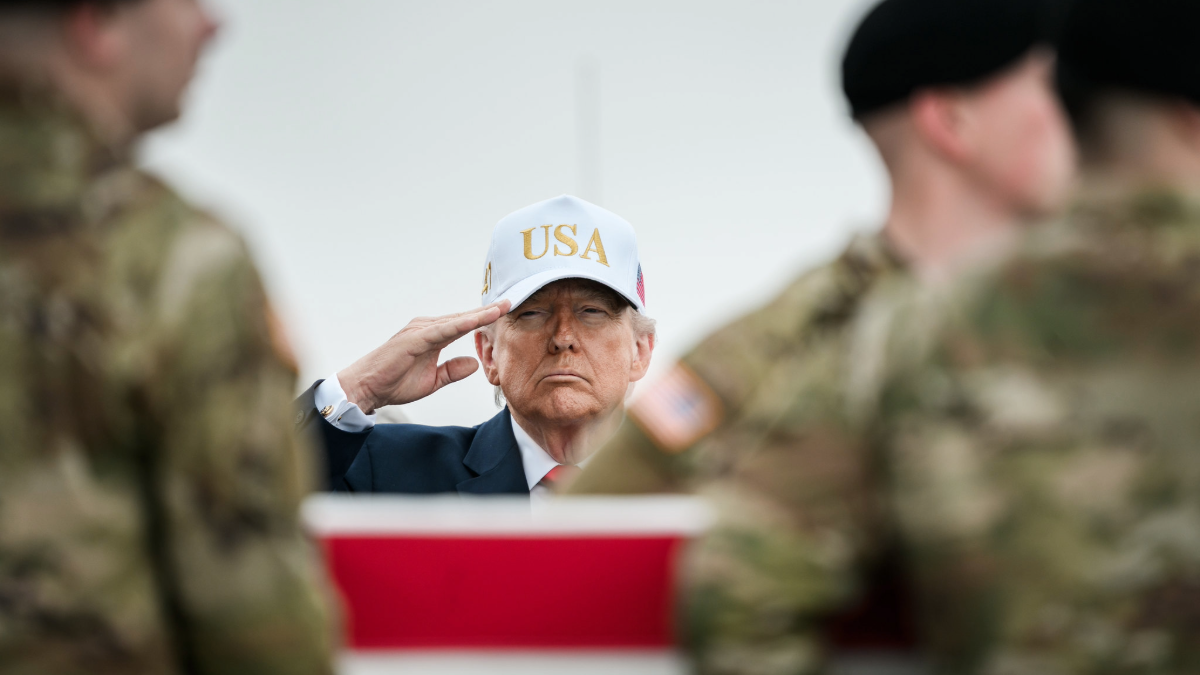
President Donald Trump attends the dignified transfer of remains of six US soldiers killed in an Iranian drone strike in Kuwait, Saturday, March 7, 2026, at Dover Air Force Base, Delaware. (Official White House photo by Daniel Torok)
President Donald Trump has cited many, sometimes-conflicting reasons for launching a war against Iran. Here, I want to focus on a particularly deceitful justification that demands close attention because it could become the basis for his efforts to undermine US elections in 2026.
Trump remains obsessed with the lie — core to his MAGA movement — that the 2020 presidential election was stolen from him. Now, he is linking the attack on Iran to that country’s online interference in the 2020 election.
In light of Trump’s separate explicit threats to restrict voting in 2026 and beyond, his tying Iran to US elections suggests that he and his minions may be cooking up a national security-based argument for limiting or suspending midterm polling. Free and fair elections would lead to Democratic victories and Republicans possibly losing control of one or both houses of Congress. Such a setback would undercut MAGA momentum and could lead to an effort to impeach Trump and key members of his cabinet.
One aspect of Trump’s deceitful attempt to tie the war to Iranian election interference ought to be particularly noteworthy to the audience of Tech Policy Press: The president pretends to care about foreign actors influencing US elections, when, in fact, he and his allies have aggressively and systematically undermined academic research and government oversight aimed at identifying and deterring online foreign interference.
The basic facts
There are several basic facts to understand about all of this and then some context and details to consider:
- Trump was legitimately defeated in 2020.
- Iran did run a marginal election-influence operation in 2020 (and 2024).
- Iran’s influence effort had no discernible effect on past elections.
- Trump and his MAGA allies have aggressively undermined government and academic capacity to detect and counter foreign election-influence operations.
- Trump’s nascent attempt to link the war on Iran to foreign election interference is both hypocritical and nonsensical. But it must be taken seriously because the Trump regime has demonstrated that it will stop at nothing to forward the president’s aim of accruing power at the expense of democracy and the rule of law.
The broader context and crucial details
Voluminous litigation, multiple investigations, and the assessments of prominent Republicans who reviewed the 2020 presidential results all come to the same conclusion: Trump lost to Joe Biden, fair and square. Nevertheless, Trump and many of his followers continue to insist that the election was stolen, and Trump’s Department of Justice is actively investigating that debunked conspiracy theory.
At 4:35 a.m. on February 28, as US bombs were beginning to drop on Iran, Trump posted to Truth Social that “Iran tried to interfere in 2020, 2024 elections to stop Trump, and now faces renewed war with United States.” The post provided a link to a right-wing media article connecting the war to past Iranian election interference and claiming, falsely, that Democrats had ignored the interference, which went “unnoticed” at the time.
Iran did mount a marginal election-influence operation in 2020. Hundreds of registered Democrats in Alaska and Florida received emails supposedly from members of the violent extremist organization the Proud Boys telling them to “vote for Trump on Election Day or we will come after you.” University of Washington disinformation researcher Kate Starbird described the episode in more detail in a recent post on her Substack newsletter, “Sensemaking Distortion.”
Academic researchers, as well as investigators with the Federal Bureau of Investigation (FBI) and the Cybersecurity and Infrastructure Security Agency (CISA), which is part of the US Department of Homeland Security, all determined — and said publicly — that the communication came from Iranian operatives. In 2021, under then-President Biden, the Justice Department indicted two Iranian nationals for engineering the “Proud Boys” caper. While it caused some consternation, the Iranian attempt to bully a limited number of Democrats to vote for Trump didn’t appear to influence the outcome in Alaska or Florida, both of which Trump won on his way to losing the overall election.
CISA and the FBI publicly called out renewed online Iranian interference in 2024 — specifically, online efforts to “stoke discord” and influence “individuals with direct access to the presidential campaigns of both political parties.”
The campaign to undermine election integrity monitoring
Since the January 6, 2021, insurrection at the US Capitol, which aimed to reverse Biden’s 2020 victory, Trump, his allies in Congress, and MAGA activists have collaborated to shut down the sort of academic research and government investigative activity that identified Iranian election-influence operations and more ambitious attempts by Russia and China to sow confusion among American voters.
The nominal motive for curtailing this analysis and enforcement was to prevent supposed “censorship.” The real explanation stems from attempts by Trump and some of his subordinates and backers to downplay the pro-Trump Russian interference in the 2016 presidential election, which was exhaustively documented by special counsel Robert Mueller and a bipartisan report by the Senate Select Committee on Intelligence. Angered by the prolific findings that Vladimir Putin’s operatives tried to help put him in the White House a decade ago, Trump and aides such as Attorney General Pam Bondi have attempted to stop inquiries into foreign election interference — by the Russians, Iran, and other countries.
As Starbird chronicled in her newsletter post, university-based researchers, including her, have been harassed, threatened, sued, defunded, and subjected to conspiracy-fueled interrogation by congressional Republicans. One prominent academic victim of this campaign was the Stanford Internet Observatory, a research team that focused heavily on election integrity and was dismantled in 2024 for lack of funding and institutional support.
The Trump administration, meanwhile, has decimated CISA and stopped the FBI from investigating foreign election interference. (In Silicon Valley, technology industry leaders who have aligned themselves politically with Trump have curtailed restrictions that were designed in part to deter foreign actors from spreading misinformation in the US.)
What phony concern about Iranian interference may actually represent
And yet Trump is pretending that his supposed concern about Iran’s past election intrusion is related to why US forces have decapitated the Iranian government and, with Israel as an ally, provoked a war that threatens to destabilize the entire Middle East.
Savvy observers see the assertion of this implausible connection as more than mere hypocrisy. They see Trump laying the groundwork for a potential domestic campaign to limit or suspend elections that could threaten his power and Republican control of Congress.
Timothy Snyder, a leading historian of fascism, has pointed out that, historically, fascist leaders start foreign conflicts as a strategy to inflame xenophobia, sow confusion, and justify entrenching their power at home. He sees that phenomenon at work in the US attack on Iran.
“Trump has argued that a purpose of this war was to respond to Iranian interference in American elections,” Snyder wrote on March 2 in his Substack newsletter, “Thinking About…” “It is patently obvious that this claim is meant to justify the suppression (‘federalization’) of US elections in November,” he added. “This is all so unutterably predictable that we are all to blame if it works.”
Just weeks before starting the war against Iran, Trump said on a right-wing podcast that his claims of a stolen election in 2020 would justify Republicans “nationalizing” certain elections in 2026. “The Republicans should say, ‘We want to take over. We should take over the voting in at least 15 places.’ The Republicans ought to nationalize the voting,” Trump told podcaster Dan Bongino, who recently stepped down as deputy director of the FBI.
The US Constitution clearly delegates the oversight of congressional elections to the states.
Marc Elias, a leading Democratic election litigator and pundit, has echoed Snyder: “Donald Trump started a war and quickly blamed Iran for his defeat in 2020,” he noted on Threads. “He is plotting to steal the 2026 election,” he surmised.
Elias and other activist lawyers doubtless would go to court to challenge on constitutional grounds any potential Trump attempt to undermine elections based on a contrived connection to past Iranian interference and the current war. But at least some federal judges might be inclined to defer to the president in this situation. That’s because, ordinarily, the judiciary affords the executive branch considerable leeway to protect national security without being second-guessed in court.
But these are not ordinary times. Trump is not an ordinary president. His war on Iran is based on lies. One of those lies is that the war has something to do with his other lies about past presidential elections.
If voters, and election lawyers, and judges — every able person — do not pay attention to the deceptions, we will, as Timothy Snyder warns, bear the blame for the consequences.
Authors