Ecuador Makes a National Security Case for Teen Social Media Restrictions
Gabriel Brito / Mar 20, 2026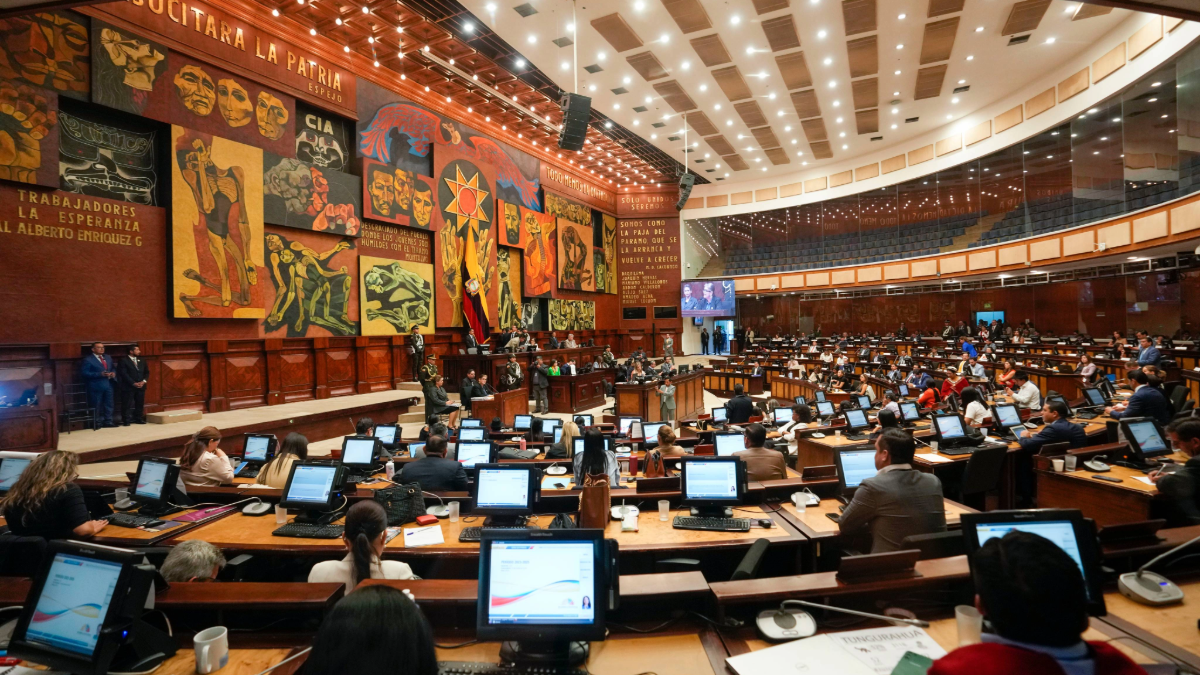
Lawmakers gathered at the National Assembly in Quito, Ecuador, Wednesday, Oct. 23, 2024. (AP Photo/Dolores Ochoa)
Ecuador has quietly entered the growing list of countries considering restrictions on minors’ access to social media. A recently introduced legislative proposal would prohibit children under 15 from using social media platforms, placing the country alongside jurisdictions such as Australia and several European Union member states debating similar age-based restrictions.
A proposal currently under discussion in Ecuador’s National Assembly seeks to prohibit children under the age of 15 from accessing social media platforms. The initiative, introduced by Assemblymember Katherine Pacheco Machuca, would amend the country’s Code of Childhood and Adolescence to restrict minors’ participation in platforms designed for public interaction, content sharing, and digital networking, according to reporting by Primicias. The proposal defines social networks broadly as services that allow users to create personal accounts, share content publicly, exchange messages, and establish visible connections with other users.
While it might be tempting to view Ecuador simply as the latest country swept up in a global trend, a closer look reveals it as a logical response to endemic issues. In fact, the unique political situation of the South American country has led local policymakers to think about the social media problem from a national security perspective.
Where most global debates center on youth mental health, screen addiction, or data privacy, Ecuador’s proposal emerges from a national security crisis. Over the past three years, the country has transformed from one of Latin America’s safest nations into a strategic hub for transnational drug trafficking. In less than a decade, homicide rates have surged to unprecedented figures, prison systems have fractured, and criminal organizations have expanded their territorial control.
In this context, social media is not framed primarily as a psychological risk, but as an operational tool for extortion and criminal recruitment.
According to a recent report published by Ecuador’s Organized Crime Observatory (OECO), approximately 27% of minors who report being approached by criminal groups indicate that the first contact occurred via social media platforms. Recent surveys by ChildFund Ecuador on digital technologies and youth suggest that vulnerable adolescents—particularly in low-income urban areas—face increasing exposure to online recruitment strategies that blend aspirational content, economic incentives, and normalized depictions of violence.
This shifts the normative foundation of the ban. The policy is not being justified primarily as child protection from harmful content, but as protection from criminal incorporation.
If Ecuador legislates a social media ban for under-15s, it will not simply be “another domino” to fall in a broader international trend. Instead, it will be an early example of how a Global South state under severe organized crime pressure is attempting to translate fear of offline violence into online regulation—and how quickly the project collides with enforcement realities, constitutional rights, and platform power.
This perspective has helped shape a broader regulatory agenda in Ecuador. The social media restriction proposal is not emerging in isolation but rather as part of a wider set of initiatives that treat digital environments as relevant to national security.
Social media platforms, in particular, have come under scrutiny as potential channels through which criminal organizations identify and approach vulnerable adolescents. The proposal to restrict access for minors reflects growing concern that digital platforms can facilitate the early stages of recruitment into criminal groups.
In early 2026, Ecuador approved a comprehensive cybersecurity law aimed at strengthening the protection of critical digital infrastructure, government systems, and personal data. Beyond technical cybersecurity concerns, the legislation also recognizes the need to promote safe digital practices among citizens. Among its provisions is a requirement that digital safety and responsible online behavior be incorporated into the national school curriculum, reflecting an effort to equip young people with tools to navigate online risks.
At the same time, Ecuador’s legislature is considering another initiative focused on organized crime: a draft law addressing criminal recruitment. According to coverage in Extra, the proposal recognizes that recruitment by criminal organizations increasingly occurs through digital channels, including social media and messaging applications. The legislation therefore seeks to establish mechanisms to prevent and sanction recruitment practices that originate online.
Taken together, these initiatives suggest that Ecuador is beginning to integrate the digital sphere into its broader security framework. Platforms that were once understood primarily as spaces for communication and entertainment are increasingly viewed as environments where criminal actors can identify, influence, and recruit vulnerable individuals.
Within this context, the proposed restriction on social media use by minors can be interpreted less as a moral reaction to digital technology and more as a preventive measure aimed at reducing exposure to organized crime.
Implementing such a measure, however, presents significant challenges for a relatively small economy compared to other countries leading the social media ban initiative. Ecuador has limited regulatory leverage over global technology companies, many of which do not maintain a substantial physical presence in the country. Enforcing age restrictions would likely require cooperation from platforms themselves, as well as mechanisms for verifying user age.
Legal questions also remain. Any policy restricting minors’ access to digital communication must be balanced against constitutional protections related to freedom of expression and access to information, as well as principles recognizing the evolving autonomy of young people. Experts cited by the newspaper Expreso have also raised concerns about whether Ecuador currently has the regulatory capacity to enforce such restrictions effectively.
The proposal is currently undergoing legislative scrutiny. Ecuador’s National Assembly Commission for the Comprehensive Protection of Children and Adolescents has begun analyzing the initiative as part of the legislative process, according to reporting by El Comercio.
Despite the uncertainties, Ecuador’s debate could have implications beyond the country itself. Many countries in the Global South are confronting a growing intersection between digital platforms and organized criminal activity. While policy discussions in wealthier democracies often focus on the psychological impacts of social media use, governments facing acute security challenges may increasingly see online environments as arenas where criminal networks operate and expand.
If Ecuador succeeds in developing a regulatory framework that addresses the digital dimensions of criminal recruitment while respecting fundamental rights, it could offer an important precedent for other countries grappling with similar pressures.
The country’s debate therefore highlights a dimension of the global social media regulation conversation that has received comparatively little attention: how digital platforms intersect with organized crime in contexts where state capacity, social inequality, and security threats interact.
For Ecuador and other countries in the region confronting these challenges, protecting young people online may become not only a matter of wellbeing and digital literacy, but also a component of broader strategies aimed at shielding vulnerable populations from criminal networks that now operate as much through smartphones as they do on the streets.
Authors