Facebook Failing to Label Posts Containing Russian Propaganda About Ukraine
Imran Ahmed / Feb 26, 2022Imran Ahmed is Chief Executive of the Center for Countering Digital Hate (CCDH).
According to our analysis at the Center for Countering Digital Hate, Facebook has once again come short on its promises to enforce its own rules, with devastating consequences for Ukraine. Facebook is failing to label 91% of posts containing Russian propaganda about Ukraine with warnings that the content originates with media outlets owned by the Russian state.
The justification for the Russian war against Ukraine was built on Facebook. The Russian state is involved in an array of hostile influence operations. The tentacles of its integrated media production and social media distribution networks seek to change the way Western audiences think about climate change, vaccines, domestic politics and geopolitics to benefit Putin’s agenda, with clear implications for our national security and international order.
🚨 NEW: Facebook is failing to label 91% of posts containing Russian propaganda about Ukraine pic.twitter.com/MRZJWupjL7
— Center for Countering Digital Hate (@CCDHate) February 26, 2022
Articles about Ukraine written by English-language media outlets owned by the Russian state have received over 500,000 likes, comments and shares from Facebook users in the last year according to the social analytics tool NewsWhip.
The sample of 3,593 articles includes content posted by RT.com (formerly Russia Today), Sputnik News, TASS and Ruptly, a social media content producer owned by RT.com. All of these outlets have been identified by the US State Department as “Kremlin-funded media” and part of “Russia’s disinformation and propaganda ecosystem”.
Researchers then used Facebook’s own CrowdTangle tool to identify posts featuring the 100 most popular articles from this sample, to examine whether the platform applied warning labels stating that the content was from “Russia state-controlled media”.
This revealed that 91% of 1,304 posts by amplifiers sharing articles from Kremlin-funded media did not carry any warning labels. While Facebook does label most Facebook Pages controlled by the Russian state and their posts, it was failing to label any posts from TASS before 26 February, despite the outlet stating it is “the leading Russian state information agency” in its Facebook Page description.
Examples of articles that Facebook is failing to label in posts include claims that:
- Ukraine planned a “false flag” incident “prepared by British-trained saboteurs”
- “American mercenaries” are “preparing a provocation using chemical weapons”
- UK intelligence reports about an invasion are “false stories”
- Media reports about troop movements are “hysteria”
- “War-hungry armed Americans in combat clothing” are operating in Ukraine
The most popular article in the sample amplified comments from the Croatian President, Zoran Milanovic, that “blamed the US for escalating the [Ukraine] crisis”, receiving 9,416 likes, shares and comments in total.
Facebook announced in October 2019 that it would start “labelling state-controlled media on their Page and in our Ad Library” as part of its measures to counter disinformation targeting US elections. However, this new research shows that the vast majority of posts containing content from Russian state media, which are from a wider range of Pages and Groups, are not covered by this policy and do not carry labels.
Facebook whistleblower Frances Haugen has warned that the platform’s secrecy and lack of transparency will prevent the identification of “influence operations” run by countries like Russia, China and Iran.
It is time Mark Zuckerberg stops allowing his platform to be used by hostile actors with malignant intentions. His platform was found partly responsible for hosting the propaganda that led to the genocide in Myanmar. Today, his failure to stop his platform being weaponized by the Russian state is being felt by the people of Ukraine and, given the bellicose words of the Russian leader, cast the spectre of a nuclear mushroom cloud over the Western world.”
Notes on Methodology
- Researchers used the social analytics tool NewsWhip to identify 3,593 articles referring to Ukraine from the last year, posted by the following publishers:
- RT.com
- TASS
- Sputnik News
- Ruptly
- A January 2022 report from the US State Department identified all of these publishers as “Kremlin-funded media” and part of “Russia’s disinformation and propaganda ecosystem”.
“Kremlin-Funded Media: RT and Sputnik’s Role in Russia’s Disinformation and Propaganda Ecosystem”, US Department of State Global Engagement Center, January 2022, https://www.state.gov/wp-content/uploads/2022/01/Kremlin-Funded-Media_January_update-19.pdf
- This revealed that articles about Ukraine from these outlets amassed a total of 506,352 user interactions - including likes, shares and comments - in the last year.
- Researchers then used Facebook’s own CrowdTangle tool to analyse 1,304 posts featuring the 100 articles from this sample with the highest number of interactions.
- This analysis revealed that 90.95% of these 1,304 posts appeared without any labels stating that their content originated from “Russia state-controlled media”.
- The full dataset used to perform this analysis is available at the link below.
CCDH, 25 February 2022, https://docs.google.com/spreadsheets/d/18a7mJzSS6-Mx7_9HE4zE6JoCPJ13eEDbZrNFLdjUnHQ/edit?usp=sharing
- Facebook announced in October 2019 that it would start “labelling state-controlled media on their Page and in our Ad Library” as part of its measures to counter disinformation targeting US elections.
“Helping to Protect the 2020 US Elections”, Meta, 21 October 2019, https://about.fb.com/news/2019/10/update-on-election-integrity-efforts/
- In cases where Facebook currently applies these labels, they appear on posts below the name of the relevant page stating that it is “Russia state-controlled media”.

RT, Facebook, 15 January 2022, https://www.facebook.com/326683984410/posts/10160624878859411
- While Facebook does label most Facebook Pages controlled by the Russian state, before 26 February it was failing to label the Page of Russian-controlled outlet TASS, despite the outlet stating it is “the leading Russian state information agency” in its Page description.
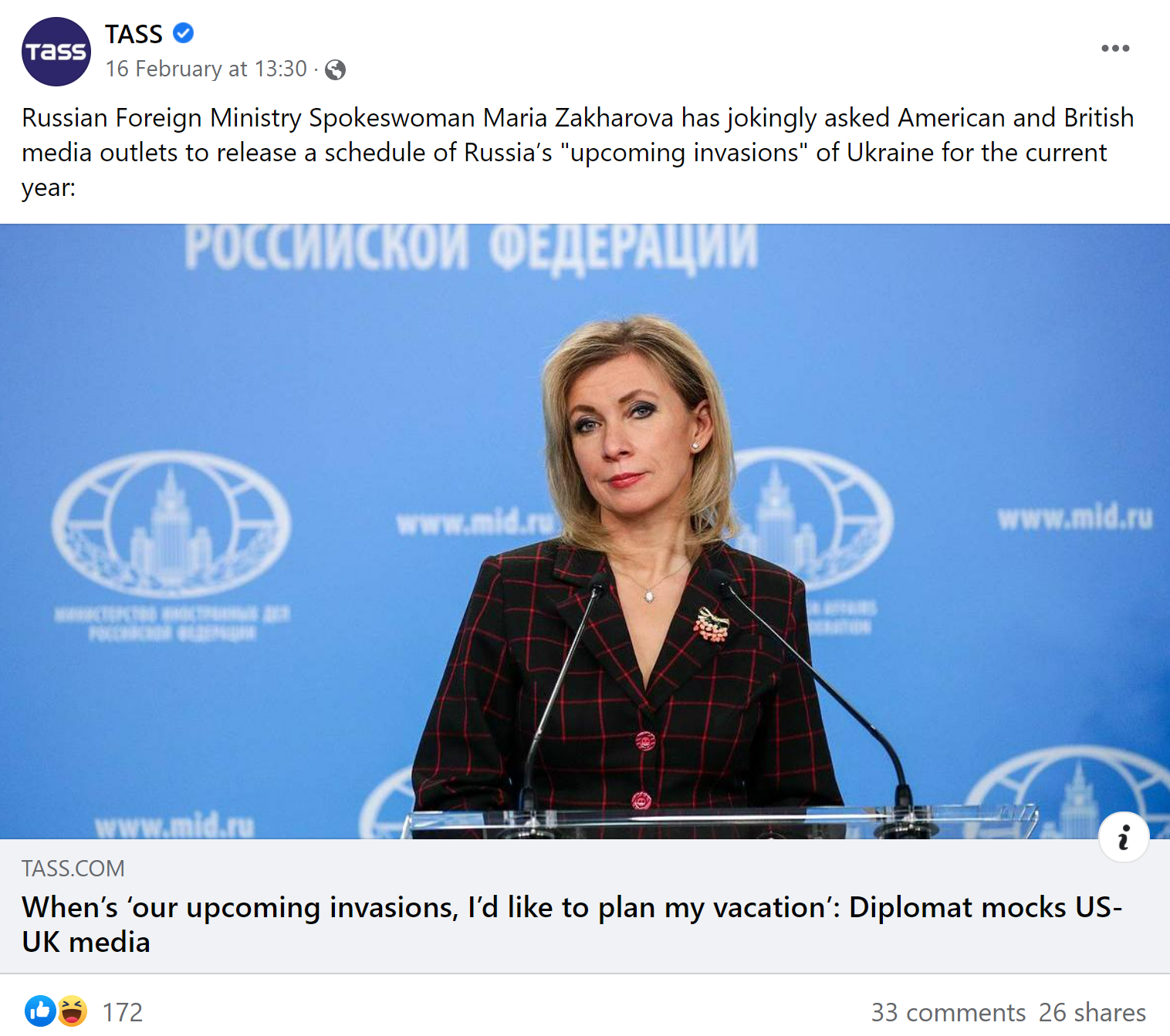
TASS, Facebook, 16 February 2022, https://www.facebook.com/221338351211505/posts/7331893213489281
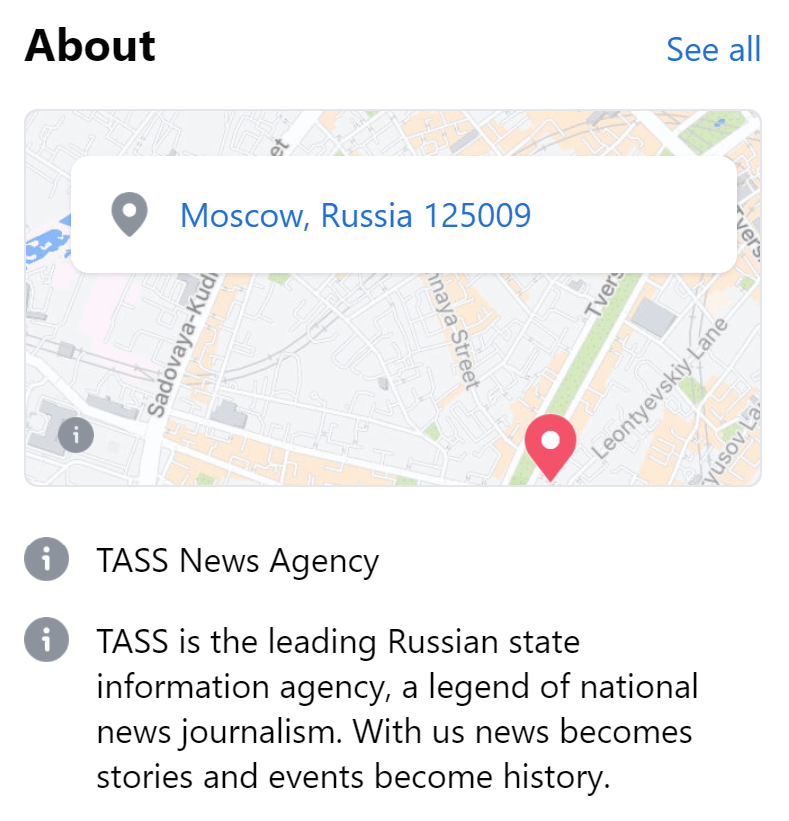
TASS, Facebook, retrieved 25 February 2022, https://www.facebook.com/tassagency.eng/
Articles that Facebook is failing to label in some posts include claims that:
- Ukraine planned a “false flag” incident “prepared by British-trained saboteurs”
RT, 19 January 2022, https://www.rt.com/russia/546554-donbas-false-flag-ukraine/
- “American mercenaries” are “preparing a provocation using chemical weapons”
RT, 21 December 2021, https://www.rt.com/russia/543861-us-pmc-chemical-provocation-ukraine/
- UK intelligence reports about an invasion are “false stories”
RT, 23 January 2022, https://www.rt.com/russia/546864-moscow-uk-ukraine-claim/
- Media reports about troop movements are “hysteria”
RT, 13 April 2021, https://www.rt.com/russia/520879-troop-movements-ukraine-border/
- “War-hungry armed Americans in combat clothing” are operating in Ukraine
RT, 27 January 2022, https://www.rt.com/russia/547425-us-soldiers-ukraine-front/
- The most popular article in the sample amplified comments from the Croatian President, Zoran Milanovic, that “blamed the US for escalating the [Ukraine] crisis”, receiving 9,416 likes, shares and comments in total.
RT, 25 January 2022, https://www.rt.com/russia/547307-croatia-withdraw-nato-troops/
- Facebook whistleblower Frances Haugen has warned that the platform’s secrecy and lack of transparency will prevent the identification of “influence operations” run by countries like Russia, China and Iran.
“Whistleblower: Russia taps Facebook ‘herds’ to sow division in Ukraine”, Politico, 23 February 2022, https://www.politico.eu/article/whistleblower-frances-haugen-russia-taps-facebook-herds-to-sow-division-in-ukraine/
Authors