Former Amazon Boss Takes Charge of UK Antitrust Strategy. What Does It Mean?
Jade-Ruyu Yan / Mar 4, 2026Jade-Ruyu Yan is a UK Reporting Fellow at Tech Policy Press and openDemocracy.
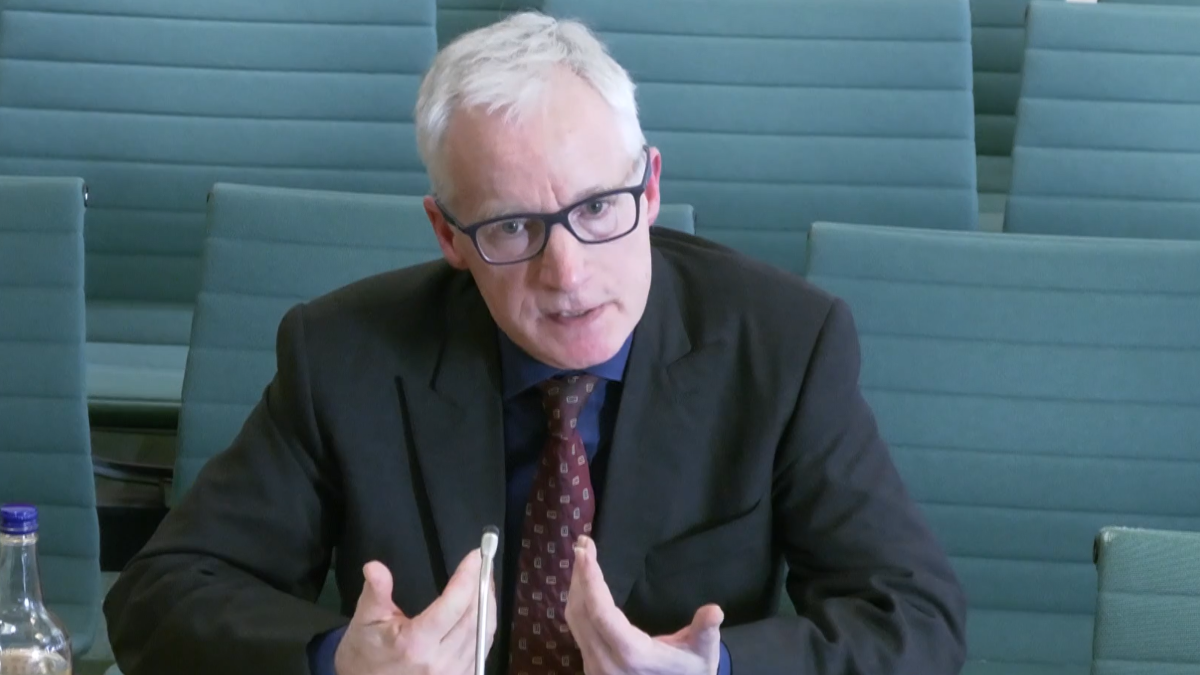
New UK Competition and Markets Authority chair Doug Gurr speaking at a parliament committee hearing on Tuesday, February 26. Source: Parliament TV
Early last week, Doug Gurr, a former Amazon executive, appeared before a United Kingdom parliament committee in a suit and tie to make his case to lead the country’s antitrust watchdog, the Competition and Markets Authority (CMA). His appointment positions him to shape the country’s regulatory strategy for the next five years.
The move marks another step in the UK's strategy to attract Big Tech investment and chase economic growth, and has prompted concern amongst critics that Gurr’s appointment will weaken the country’s regulation of Big Tech and its ability to hold these companies to account.
“The appointment calls into question the credibility of the CMA with regards to Big Tech,” said Amber Darr, lecturer in Competition Law at the University of Manchester and a senior research fellow with the UCL Centre for Law, Economics and Society.
But it’s worth noting that Gurr is “the face” of the watchdog and is more “emblematic” of the changes the government has made to its mission, said Darr. The organization’s chief executive remains former competition lawyer Sarah Cardell. The two will work “in partnership”, according to a government release announcing Gurr’s appointment. Last year, the UK government issued a document outlining its expectations for the competition watchdog, namely for it to “support and contribute to the overriding national priority of this government – economic growth.”
“It’s been super clear that the government wants the CMA to calm down,” said Darr. The antitrust watchdog has blocked high-profile deals in the past, including ordering Meta to sell GIF creation website Giphy and blocking Microsoft’s acquisition of gaming platform Activision Blizzard in 2023, prompting Microsoft president Brad Smith to say the UK was “bad for business.” The regulator later approved the deal, after negotiating mitigating terms.
Gurr’s predecessor, Marcus Bokkerink, who also came from a business background as a former Boston Consulting Group executive, was ousted over pushback from the government that he did not sufficiently prioritize growth and business interests. Finance minister Rachel Reeves instructed regulators at the time to “[tear] down the regulatory barriers that hold back growth.”
Gurr was appointed to lead the watchdog on an interim basis in January last year, a move seen as part of the Labor government’s push for more business-friendly decisions and to encourage private investment. Concerns about his ties to Big Tech were raised at the time as well.
Last week, Gurr struck a humble tone during the parliamentary hearing, with a lot of nodding and thank yous. He spoke at length about the importance of business investment and the factors hindering it, as well as the need for a “predictable” regulatory environment. He emphasized his intentions to focus more on consumer protection. In Gurr’s time as interim head, the watchdog had not blocked any mergers – a first since 2017, according to an analysis by the Financial Times.
Before Gurr was formally appointed, he was announced as the preferred candidate of Peter Kyle, Secretary of State for the UK’s Department for Business and Trade. Kyle, who was previously Secretary of State for Science, Innovation and Technology in 2024 and 2025, has been criticized for being too close with Big Tech firms; he had 28 meetings (an average of over one meeting a week) with people affiliated with the sector over a span of six months, a 70% jump in meetings from his predecessor, according to an analysis by The Guardian.
There has been broader criticism and reporting about Big Tech’s proximity to the government; in the UK, tech firms have been given outsized access to ministers in comparison to activist groups. In the US, tech firms such as OpenAI and Anthropic have poured billions into lobbying efforts in the US, while venture capital firms such as Andreessen Horowitz, which have also spent big on lobbying around AI regulations, are plugging AI startups for national defence efforts.
A signal to Big Tech?
The appointment sends a “very positive” message if you're Big Tech, said Fiona Scott Morton, an economics professor at the Yale School of Management. The message is less positive, “if you’re everybody else.”
The UK’s CMA was “the best competition authority in the world” up until a few years ago, said Scott Morton. It sought to block mergers likely to give firms market dominance and lead to higher prices for consumers; this, she said, is no longer the case – and the situation may worsen still under Gurr’s permanent leadership.
“That’s probably the biggest casualty of this appointment,” said Darr, saying that the signal from the watchdog to large tech firms is that “we will go easy on you.”
In the past, the UK’s watchdog had “a lot of innovative ideas,” said Darr, including breaking out to make the Digital Markets, Competition and Consumers Act, which came into effect last year and significantly expanded the regulator’s powers. The law enables it to set specific regulatory rules for companies, engage in proactive enforcement, impose stronger penalties, and directly enforce consumer protection laws. This act was pitched as a counterpoint of sorts to the EU’s Digital Markets Act, said Darr.
Gurr’s appointment comes as the US has been criticized for exerting political pressure and executive branch control over its financial regulators. Earlier this month, the US’s antitrust chief left after clashes with the Trump administration, with experts worried that the White House is pushing for weaker antitrust enforcement. Trump has issued controversial pardons relating to antitrust enforcement, pardoning sports and entertainment executive Tim Leiweke after he was indicted for bid-rigging, and public tensions rose at the Department of Justice last summer, when the department dropped a lawsuit challenging a takeover by tech company Hewlett-Packard Enterprise after the corporations involved reportedly engaged with senior officials.
In the US, the situation “is far worse,” said Scott Morton, describing it as “a different order of magnitude”. Still, she said that the UK could be moving towards the US model: “Obviously, a person from Big Tech becoming the enforcer of Big Tech is moving in the direction of government capture.”
“As far as I can tell in the UK, [the government] really wants growth and not weaponization,” said Eleanor Fox, a professor at New York University School of Law who specializes in antitrust and competition policy. “The US has gone that extra big step: they want to use political weaponization without principle to favor their friends and hurt their enemies.”
The appointment also follows a pattern of countries amending or revisiting their digital regulation, which some have interpreted as a response to the US’s threats of retaliation. “The move to confirm the UK chair could be interpreted as part of a global trend of not taking an aggressive stance against Big Tech,” said Darr.
The EU is “under tremendous pressure” from the US to review its digital regulation, said Darr. US President Donald Trump has criticized the EU’s digital services rules, saying that they unfairly target US companies. He threatened to impose tariffs on countries with digital laws he labeled as “discriminatory.”
Last year, South Korea clashed with the US over its digital regulation laws, and Canada reversed its digital services tax that would have applied to tech giants such as Amazon, Google and Meta, in a move criticized as capitulation to the US threat to cut off trade talks.
The UK watchdog’s future
Questions have also been raised about the process used to appoint Gurr. The Business and Trade Committee, which questioned Gurr during the recent hearing, warned in its concluding report that he was the only candidate considered for the role, saying that this was “not the hallmark of a robust recruitment process. One member of the three-person panel vetting candidates was CMA Board Member and Senior Independent DirectorJustin Basini, who had already worked with Gurr during his interim role at the watchdog.
When Tech Policy Press followed up to ask the Department for Business and Trade whether Gurr was the only candidate considered for the role, a spokesperson declined to comment.
The politicians on the committee pressed him on whether he would step back from an upcoming decision on whether to impose bespoke and proactive regulatory rules on Amazon’s web services subsidiary. The rules are reserved for companies with “substantial and entrenched market power” and annual sales of over £1bn in the UK, or over £25bn worldwide, known as “Strategic Market Status”. This decision follows an investigation that found that Amazon and Microsoft dominate the UK’s cloud services market. The probe warned that this dominance could lead to higher costs and less choice, as well as reduced innovation and lower quality of service for businesses.
On whether he’d recuse himself from the Amazon decision, Gurr answered: “We will take it on a case-by-case basis.” (“You will understand why we are concerned by that answer,” replied committee chair and Labor politician Liam Byrne.)
There are also concerns that Gurr will not use the new powers given to the watchdog by the Digital Markets, Competition and Consumers Act.
“Our view is that enforcement action has been quite weak,” said Byrne during the hearing. “We are concerned about whether you might pull your punches and leave the new powers available to the CMA unused,” he added later.
After the Business and Trade Committee questioned Gurr, it “took the unusual step of writing a concluding chapter” to its report, Byrne said in an interview with Tech Policy Press. The chapter outlines “risk mitigation measures” the watchdog should take to ensure its regulation stays on track, according to the report.
These include ensuring that the government’s growth agenda does not interfere with competition; making the organization’s operational independence clear; wielding the powers of the Digital Markets, Competition and Consumers Act effectively; reconsidering the amount of time (two days per week) allocated for the role, which the committee identified as potentially too short; and reconsidering whether Gurr should be required to “recuse himself from any decision about designating Amazon with Strategic Market Status.”
“He clearly had … the experience and the brainpower and the track record in public life to be appointable,” said Byrne, speaking to Tech Policy Press. “But he was a candidate who came with a number of risks.”
“We do not accept these criticisms,” a spokesperson for the Department of Business and Trade told Tech Policy Press. “Doug Gurr brings a wealth of experience from multiple sectors, and over the past 12 months has worked in lockstep with CMA leadership to reform the organization. The Government has reaffirmed the CMA’s independence while ensuring it defends consumers, supports fair competition and helps to grow the economy.”
Representatives for the CMA declined to comment, and Gurr and Peter Kyle did not respond to a request for comment.
Representatives for the Commissioner for Public Appointments directed Tech Policy Press to the Department for Business and Trade, but confirmed that “the Commissioner was consulted – as required under the Code – on the Senior Independent Member for the panel.”
“We’ll all be looking at the CMA’s actions going forward, especially in the digital arena,” said Darr.
Authors