Ghost Sharks, Robo-Dogs, and the Theater of Border Technologies
Petra Molnar / Apr 15, 2026Petra Molnar is a fellow at Tech Policy Press.
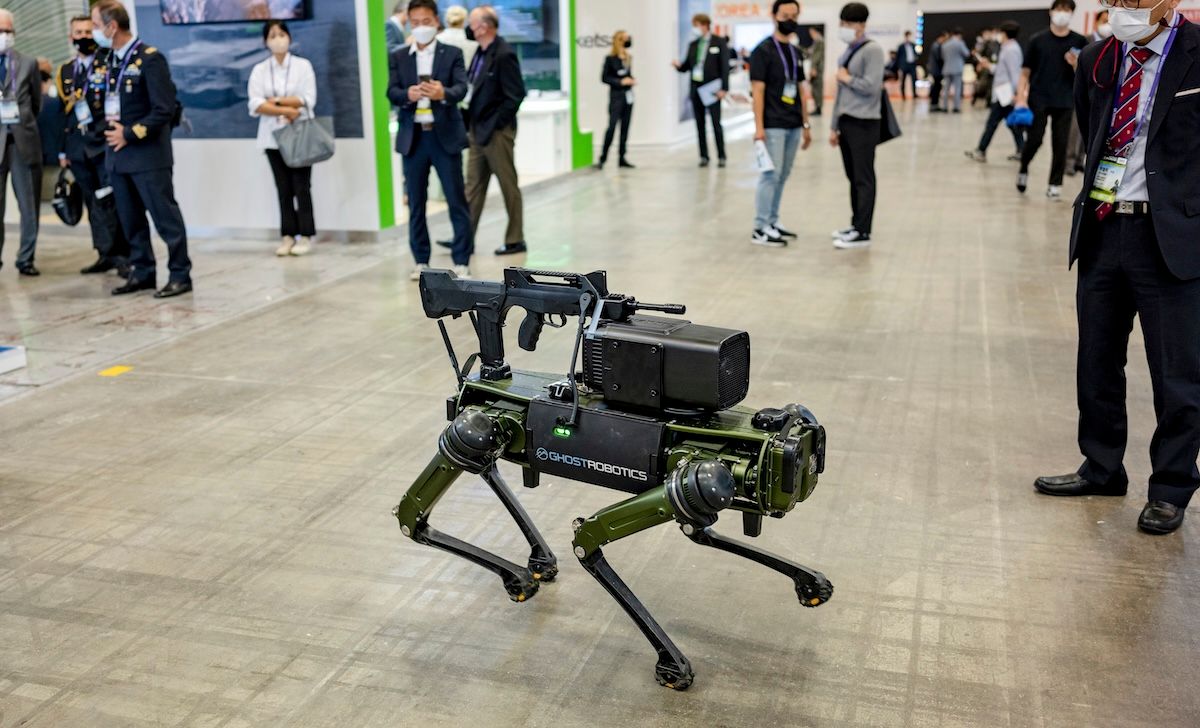
The Ghost Robotics Vision 60 exhibited during the Defense Expo Korea 2022, the biggest military weapon exhibition in the country, held at KINTEX (Korea International Exhibition and Convention Center) on September 21, 2022 in Goyang city, Gyeonggi, South Korea. (Photo by Chris Jung/NurPhoto via AP)
The shark-infested waters of Australia are about to meet a new species.
Ghost Shark, a new autonomous submarine of the Australian Navy, is an extra-large autonomous undersea vehicle designed for long-range, long-duration missions without surfacing. Ghost Shark is developed by Anduril Australia, the same Anduril known for supplying border technologies to the United States, including autonomous surveillance towers at the US/Mexico border. Anduril received $1.7 Billion from the Australian government for Ghost Shark submarines, with the operational release date expected in early 2026.
This new “species” of border surveillance is just one example in Australia's growing and lucrative border and military industrial complex. Australia has steadily expanded its capacity to surveil its maritime borders, building on long-standing policies to incarcerate people who seek asylum by boat in heavily securitized onshore and offshore immigration prisons. The Australian government has allocated $1.37 billion on immigration detention and compliance in its 2025-2026 budget. Australia’s immigration detention policies have also become a hallmark for border externalization all over the world, with countries like the UK and the US adopting and expanding upon these carceral logics.
Robo-dogs as border guards?
But Australia is not alone in deploying these technologies to patrol its borders. In a similar perversion of the natural world, the Department of Homeland Security (DHS) in 2022 announced that robo-dogs, quadruped, military-grade machines resembling a canine, had joined America’s arsenal of border technologies. Able to right themselves when kicked and adept at scaling even the most inhospitable of terrains, the announcement framed the robots as lending “a helping hand (or “paw”) with new technology that can assist with enhancing the capabilities of CBP personnel, while simultaneously increasing their safety downrange.” It is telling that the emphasis is here, and not on the people being pursued by these machines.
Robo-dogs are semi-or fully autonomous and obey human commands. In fact, the Australian army has experimented with using headsets to read brain signals and control robot dogs via a brain-robotic interface. And with the addition of generative AI, robo- dogs are developing their own voices and personalities: “a debonair British gentleman, a sarcastic and irreverent American named Josh, and a teenage girl who is so, like, over it.”
These machines have also been used by various law enforcement departments, including in Honolulu and New York City. In Hawaii, the program was cut short after a public outcry when it came to light that the robo- dogs were used to monitor houseless people during the COVID- 19 pandemic, reading their temperature. But the New York Police Department announced in May 2023 that it was re-introducing robo-dogs for law enforcement and rescue operations in the city, proudly unveiling on TikTok a unit painted with black and white spots, like a Dalmatian, “to help keep NYC safe.”
While similar deployments have not been recently reported in the European Union, in 2019, the newspaper Le Monde reported that the EU had also quietly announced various robo-dog pilot projects: a “bio-mimicry enabled artificial sniffer” called SNIFFER, with a research and development budget of 3.5 million euro, and DOGGIES, or the “Detection of Olfactory traces by orthoGonal Gas identification technologIES,” whose logo is a dog with a CCTV camera in place of its head. Other projects, such as Sniffles and Snoopy, had multimillion-euro budgets and involved a consortium of state entities, including the Hellenic (Greek) Ministry of Public Order and Citizen Protection; the EU’s border force, Frontex; and Thales and other various private companies. What became of these projects remains unclear: some are listed in the EU- wide project database as “closed projects,” while others were never made public at all.
In contrast to this relative secrecy, DHS proudly announced the planned rollout of the robo-dogs across social media with its start-up partner, Ghost Robotics, a company well known for its viral videos of robots jumping up on boxes, standing up after being violently kicked, and, more recently, for being outfitted with guns. Ghost Robotics has also been outfitting the Israeli Military with technologies used in the ongoing genocide in Gaza. Since 2023, other US companies appear to have developed their own robo-dogs, with units equipped by telecom companies like AT&T and Verizon spotted walking around the annual Border Security Expo in El Paso by journalist Todd Miller.
Border tech spectacles
Search and rescue groups working in Arizona and Texas that I work with have shared that these robo-dogs do not appear to be widely used and have not been seen traversing the Sonoran desert. However, that does not mean that they are not there. But more importantly, they are one of the sharpest manifestations of the growing arsenal of border technologies, many of them more mundane and less sensational, that have intensified significantly since the second Trump Administration
This is why it is critical to examine the messaging these technologies send in the growing theater of border technologies. As scholars like Nicholas de Genova have argued, the border has long been a spectacle, one which repetitively reinforces migrant “illegality” as an objective fact. This type of criminalization of migration, or “crimmigration,” as written about by César Cuauhtémoc García Hernández and others, renders people on the move a problem to be solved increasingly through ever more technology. The use of military or quasi-military autonomous technology, such as US robo-dogs or AI-powered lie detectors like the EU’s iborderTRL pilot project, powerfully legitimizes the connection between immigration and national security, and they increasingly push toward the criminalization of migration through increasingly hard-line tools. In this type of framing, people on the move are presupposed to be criminals unless proven otherwise.
Because of their visceral, sci-fi-like qualities and draconian interventions, robo-dogs and Ghost sharks can obscure the less visible but equally harmful projects, such as visa-triage algorithms and biometric registration systems. And with the normalization of technology in facets of everyday life, focusing only on the most dramatic tools risks overlooking the vast iceberg of harm hiding beneath the surface. Moreover, as scholars like Martina Tazzioli note, border technologies cannot be separated from the deep violence that already exists at the world’s borders. Carceral infrastructures like refugee camps in Greece separate families for years, racialized exclusion remains central to Western border control, and the policies of Israeli apartheid render Palestinian communities unable to enter, leave, and live in their homeland.
Robo-dogs and ghost sharks serve as powerful symbols of the spectacle at the center of modern border control. However, they do not operate in isolation. Instead, they sustain and legitimize the infrastructures, policies, and practices working behind the scenes. These technologies are not just tools of control, but also tools of misdirection.
In the theater of border control, we must critique not only what is proudly presented on stage, but also what is quietly happening behind the scenes. Border spectacles do more than deter movement; they reshape public attention and policy priorities. While high-visibility technologies dominate headlines, quieter systems of data collection, risk scoring, and biometric control are normalized with far less scrutiny.
If governance frameworks focus only on these tools, they risk leaving the broader infrastructure of automated exclusion intact. The deeper challenge lies in addressing the integrated systems of data, infrastructure, and private-sector influence that underpin modern border control, a system predicated on power asymmetries. Without this broader lens, any reform efforts risk targeting only the most visible symptoms while leaving the system itself unchanged – just the way it likes it.
Authors