How Brazil's AI Governance Vision Got Sidelined at the India Summit
Tatiana Dias / Feb 27, 2026Tatiana Dias is a fellow at Tech Policy Press.
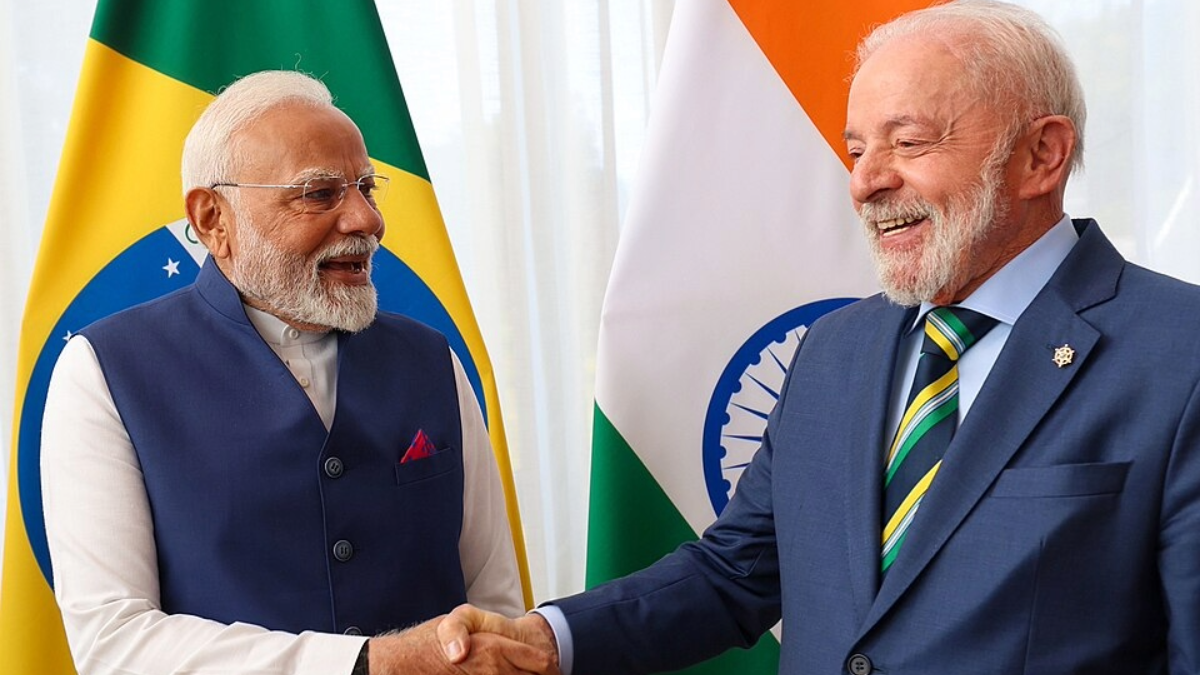
Indian Prime Minister Narendra Modi meets with Brazilian President Luiz Inácio Lula da Silva in Brasília on July 8. (Prime Minister’s Office)
Brazil arrived at the India AI Impact Summit with a clear mission: to reinforce the need for digital sovereignty and multilateralism and use the global event as a stage to build alternatives to the dominance of major American tech powers.
Brazilian President Luiz Inácio Lula da Silva came with combative rhetoric against the concentration of power among big tech companies, announcing agreements with India as an opportunity to prevent the world from returning to a "Cold War between two powers," namely the United States and China.
"The data generated by our citizens, companies and public bodies is being appropriated by a handful of conglomerates, without equivalent return in value generation and income in our territories," Lula said in his speech at the event. "When few control the algorithms and digital infrastructures, we are not talking about innovation, but about domination."
Brazil has long positioned itself as a leading voice in digital governance. At the G20 summit in 2024, which Brazil chaired, Lula's government pushed digital inclusion and AI governance as central agenda items, emphasizing the need for developing countries to have a meaningful say in how AI is governed globally. And under Brazil's 2025 BRICS presidency, leaders signed a statement on AI governance explicitly calling on the United Nations to take the lead in formulating global AI rules and warning that without fair governance, the technology could deepen inequalities between developed and developing countries.
Given its size, population and industrial capacity, India is a strategic ally for Brazil. And indeed, the AI Summit could have been the perfect opportunity to seal that pact.
But Brazil ran into reality: despite signing relevant bilateral agreements with India, the multilateralism agenda Lula came to defend was forsaken where it mattered most.
A strategic alliance, with limits
One of Lula's most significant attempts to boost multilateralism was signing cooperation agreements between Brazil and India during his visit to New Delhi, including for the exploration of critical minerals, setting a $20 billion trade target over the next five years. Brazil holds the world's second-largest reserves, and India seeks to reduce its dependence on China in the sector.
The two countries also signed the Brazil-India Digital Partnership for the Future, aimed at increasing cooperation on public digital infrastructures and the development of AI technologies, including by dialing up discussions on national strategies and large language models.
"Brazil is looking for partners with similar structural characteristics: large populations that produce data and culture, investment capacity in science and technology sectors and countries aware of their potential roles in AI sub-chains and mobilized around digital infrastructures," said Rafael Zanatta, director of Data Privacy Brasil, a non-profit civil society organization that promotes the protection of personal data and other fundamental rights, who attended the summit. There, India seemed like the natural ally.
"Despite the difference in population size, many of our problems are similar, our scientific and technological knowledge is close," Lula declared after signing the agreements. "We are going to strengthen the Global South, so that we never again enter a cold war between two powers."
According to Zanatta, however, Brazil and India have quite distinct approaches to AI governance and the future of the technology. "What [Indian Prime Minister Narendra] Modi has done over the last twelve months was accelerate an industrial policy approach — minerals and chips, data centers and workforce preparation — very much aligned with what the US wants and needs as well," he said.
The AI Impact Summit, in his view, made this clear: beyond large tech companies using the event as a showcase to announce investments in the Global South, Modi himself reinforced the industry-driven nature of the event by emphasizing “incentives for large knowledge-economy firms, ambitious workforce training targets and the positioning of Big Tech companies as ‘essential infrastructure’ from which new Indian services and business models can emerge.”
The difference became even more evident with India's signing of the Pax Silica, a US-led pact to ensure supply chain security for the AI industry.
Brazil, by contrast, did not even sit at the table for its discussion. (The agreement was signed by only 12 countries, selected due to their roles as strategic input suppliers.)
The summit's real outcome for Brazil
The AI Impact Summit concluded with the signing of the New Delhi Declaration, a document that functions more as a statement of principles than as a regulatory instrument able to effectuate meaningful change in how AI is governed globally. According to a report by CircleID, Lula himself was reluctant to sign it — but ended up endorsing the declaration.
Brazilian civil society organizations considered the document excessively aspirational and ineffective. Notably, it doesn’t explicitly mention “multilateralism” or the UN — the agendas Brazil had championed at the event. Instead, it just called for “further international cooperation and multistakeholder engagement across our countries," endorsing the multistakeholder model, in which companies and states engage within a shared governance structure.
"The model proposed by the declaration thus paves the way for bilateral governance between Big Tech and major states — with the Global South reduced to the role of consumer and data supplier," wrote CircleID’s James Görgen, a specialist in Public Policy and Government Management in Brazil.
The structure of the event itself, which, as fellow 2026 Tech Policy Press Fellow Apar Gupta documented, placed tech CEOs and heads-of-state in close proximity behind closed doors while civil society was kept out of the room, already made this dynamic visible.
“The summit's structure grants multinational corporations parity with sovereign governments, normalizing a form of ‘multi-stakeholderism’ where AI companies negotiate any potential governance rules directly with states,” Gupta wrote for Tech Policy Press.
In fact, after his speech, Lula met with Google CEO Sundar Pichai. According to a post in the official Lula’s account on X, Pichai underscored Brazil's importance and the big tech companies' partnerships with the public sector. (Brazil spent more than $200 million on public procurement of Google products over the past three-and-a-half years, according to a 2025 study.) Lula, in turn, spoke about his government's plan to attract investment in data centers — an economic priority of his administration, despite questions over lack of transparency and ignored socio-environmental impacts.
The meeting ended with a promise to "deepen the partnership." Symbolically, both posed for a photo taken by the official photographer of the Brazilian presidency.
Authors