In the Twenty-first Century, Space is the New Railroad for Billionaire Ambitions
Janet Vertesi / Mar 10, 2026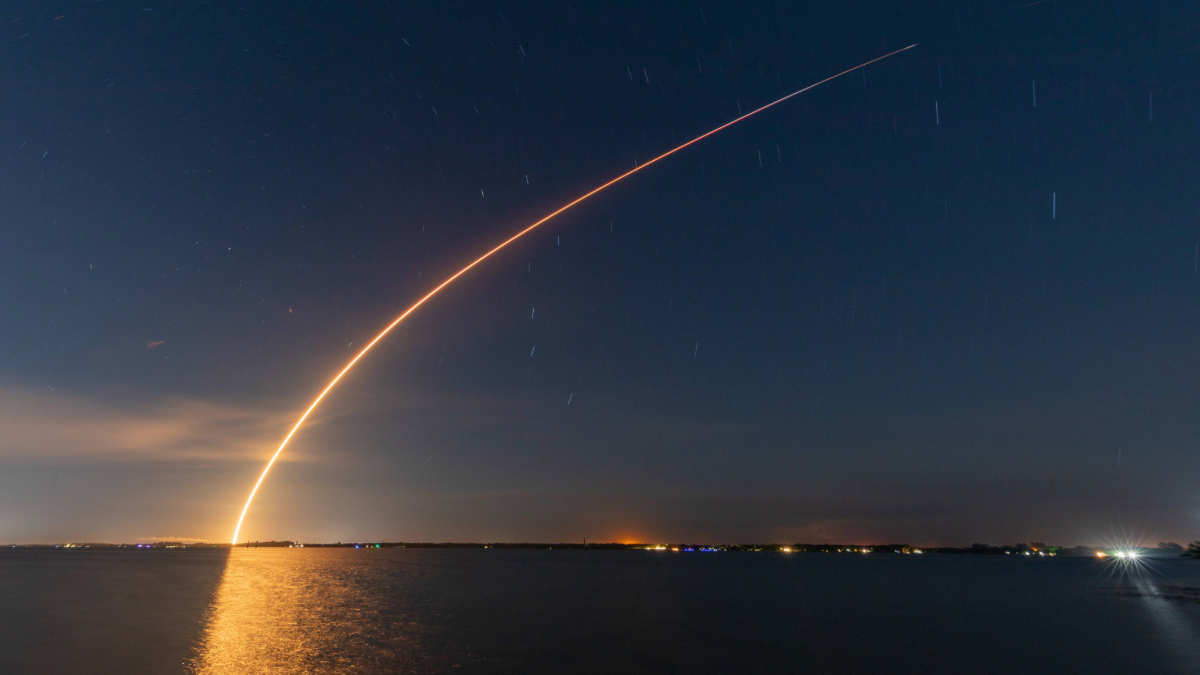
With clearing skies from light fog and a thin cloud layer December 1, 2025 at 2:44 AM ET, SpaceX launches Starlink 6-86. (Photo by Scott Schilke/SipaUSA)(Sipa via AP Images)
The classic board game Monopoly is memorable for its brightly colored cards named for the hottest developments of the Gilded Age, in which players race to acquire premium property such as Board Walk or Park Place. But there is another way to win the classic game that rewards first movers’ advantage: buying up the railroads and the utilities. The rents from early consolidation among these companies can stop prospective real estate titans in their tracks. Own the tracks and the pipes, and you own the board.
We may be equally distracted when it comes to today’s tech barons’ enchantment with another hot property: space. When Paypal billionaire Elon Musk started SpaceX and Amazon billionaire Jeff Bezos started Blue Origin, many were perplexed. Explanations point to a disconnect with worldly affairs or childish obsessions with science fiction. One might easily glean this impression from Musk’s glib statements about life on Mars and his namesake in a little known work of science fiction, or from Lauren Sanchez Bezos’s Barbarella-style spandex spacesuit.
If national space exploration during the Cold War made much of planting flags on moons and planets, however, these men are playing a different game. This is orbital Monopoly, and they are playing to own the pipes.
The Gilded Age reference is not misplaced. When the railway barons were busy building their empires of steel, Andrew Carnegie bought up the steel mines and mills that supplied the rails. He and his investors were enriched beyond imagination thanks to vertical integration and preferred pricing. At the same time, enormous corporations like General Electric bought up shares in local power grids and utility companies, then flooded the market with low-quality electrical appliances. These spoke of the future to the 1920’s housewife even as they increased her household’s reliance on the very grids they owned, ensuring a double payout.
Then as now, these companies and their excessively wealthy leadership operated outside the scope of regulation. The government raced to catch up, even as elected officials lined their pockets thanks to their stock market success. Inequality increased until the economy teetered on the precipice of the greatest depression yet seen. The ensuing depression saw millions of formerly comfortable households out of work. If the resonances seem stark, so are the rules of the game.
Like the American West across which the barons once built their empires, space is governed by multi-party treaties, rules largely imposed by the US in the prior century to ensure its continued supremacy. Communications and military satellites need to orbit close to the equator to be maximally effective, so as the Space Age began countries jostled for control over this narrow band. Equatorial countries emerging from European colonial interests, long overlooked in the global order, saw their chance. If the laws of the sea or the air applied to space, then they could claim the domain above their countries as sovereign territory, even charging the powerful for access.
This was unacceptable to superpowers like the US, who argued instead for an international space treaty based on territorial neutrality. With lofty language about representing “all mankind,” this ensured safe and free passage for anyone who could afford to get there, with continued suppression for those who could not. For decades, access to space was managed not merely through the brute cost of entry, but through inter-governmental memoranda of understanding, international treaties, and limited forms of technology transfer between democratic nations willing to play by America’s rules.
The same laws that make space appear neutral ironically lay the staging ground for monopolistic capture. Space is not just open, but open for business—through the infrastructure of access. This is no longer just a question of profit or national might. Instead, space offers the power to leapfrog international laws—as Musk’s personal decisions over the years to switch Starlink access on or off in Ukraine demonstrate. Outside of governance, treaties, and peace-making, citizens become subjects to the whims of capricious billionaires whose sympathies and attention vary from one moment to the next.
To be sure, bringing launch capacity back to the United States under private companies has been a tremendous achievement, supported in part by government grants and contracts with SpaceX, Blue Origin, and other “New Space” startups. Yet launch capabilities are no longer about territory or engineering capabilities. Space-based communications in near-Earth orbit are essential for our next generation of GPS systems, internet, data management, and political economy. Controlling access to space is a way to leapfrog the mundane worlds governed by American regulation overseeing terrestrial telecommunications and media. Access to space offers the ultimate “Get Out Of Jail Free” card for our current material worlds dominated by players like Comcast or Verizon, Lockheed or Boeing, Time Warner or AT&T.
This much was evident when these same billionaires bought Twitter and the Washington Post, moves that baffled some experts. It appeared these CEOs were over-extending themselves, amassing a portfolio of corporations across industrial sectors, unpracticed at the skills necessary to run media ventures—like trust, safety, or truth in reporting. But if PayPal and Amazon were each about creating one unavoidable infrastructure that was too big to fail—online payment or delivery logistics—then developing launch, data, news, and telecom capabilities in-house is a different move, an infrastructure project on its way to the literal and financial stratosphere. Like Carnegie’s mines, mills, and production lines, this is not a diversified portfolio but a consolidated one.
It can be easy to forget why regulation matters when confronted with something as difficult and unforgiving as space. The resources required to maintain an earth-to-space pipeline, let alone an economy, are vast, and orbit is hard to reach without first blowing up millions of dollars of equipment on the launchpad in full public view. It may indeed seem preferable to blow a billionaire’s investments into atmospheric dust particles, instead of risking the public purse. But when America took the same approach to the railways and utilities, the monopolists’ price-setting and rent-seeking gouged both the everyday American and the state. As decades of later waffling between public and private ownership of these large infrastructures shows, accountability is not an ingredient you can readily add later.
It is also possible to flourish under principles public accountability, whether imposed by government in the public sector or by civic-minded morality in the private. In the twenty years I have spent working with scientists and engineers of NASA, they do not measure their success through ownership or profit, but through science in the public interest, stimulating competition for government contracts and maintaining public enthusiasm for science and engineering. When one of Bezos’s predecessors, Eugene Meyer, purchased the Washington Post in 1933, he explicitly oriented the daily rag toward truth-telling and evading special interests in the interest of supporting democracy with a reliable fourth estate.
Yet if the technological tactics of today’s space barons are not entirely new, the organizational tactics are. They effect domination through liminal or invisible materials like data, investment capital, and off-world satellites. Duopolies are apparently exempt from monopoly law, as if two titans locked in extended competition subject to the same shareholders offer any respite. The companies involved are not vertically but laterally integrated, stretching across tight-knit networks of erstwhile competitors, members of portfolio companies, and subsidiaries to weave apparently distinct corporate pipelines into the same coffers. This challenges a regulatory environment attuned to specific industrial sectors, looking for instance of vertical integration, singular monolithic corporations, or insider trading.
Our laws today are out of step with this new space race. Those of us tuned into problems of tech regulation focused on devices and data privacy would do well to recall that rockets and satellites are information communications technologies too. Thinking outside existing competition regulation can help us to regulate the billionaire-owned networks that undergird our democracies, on Earth and in space. It can also help us to confront Earth-bound infrastructures that have much in common with these New Space capabilities, like the data centers and corporate conduits that support AI.
As we enter a new era of state regulatory retreat, Peter Thiel’s drumbeat that “Competition is for losers” finds new and troubling resonance. The era of benighted competition in a neoliberal marketplace is over, and an unelected class is claiming the next generation of railroads and utilities through spaceflight and communications, injecting unaccountable infrastructures into the fabric of our lives. Regulating Big Tech giants as they jostle to become Big Space requires a clear-eyed view of infrastructure, capital, and monopoly, as well as the threat to democracy should access to space be in the hands of very few titans in this moment of government destabilization. In space as on Earth, Monopoly is the name of the game, and the way to win is to own the pipes.
Authors