Ireland's Upcoming EU Presidency Puts its Big Tech Dependence in Spotlight
Liz Carolan / Apr 10, 2026Liz Carolan is a fellow at Tech Policy Press.
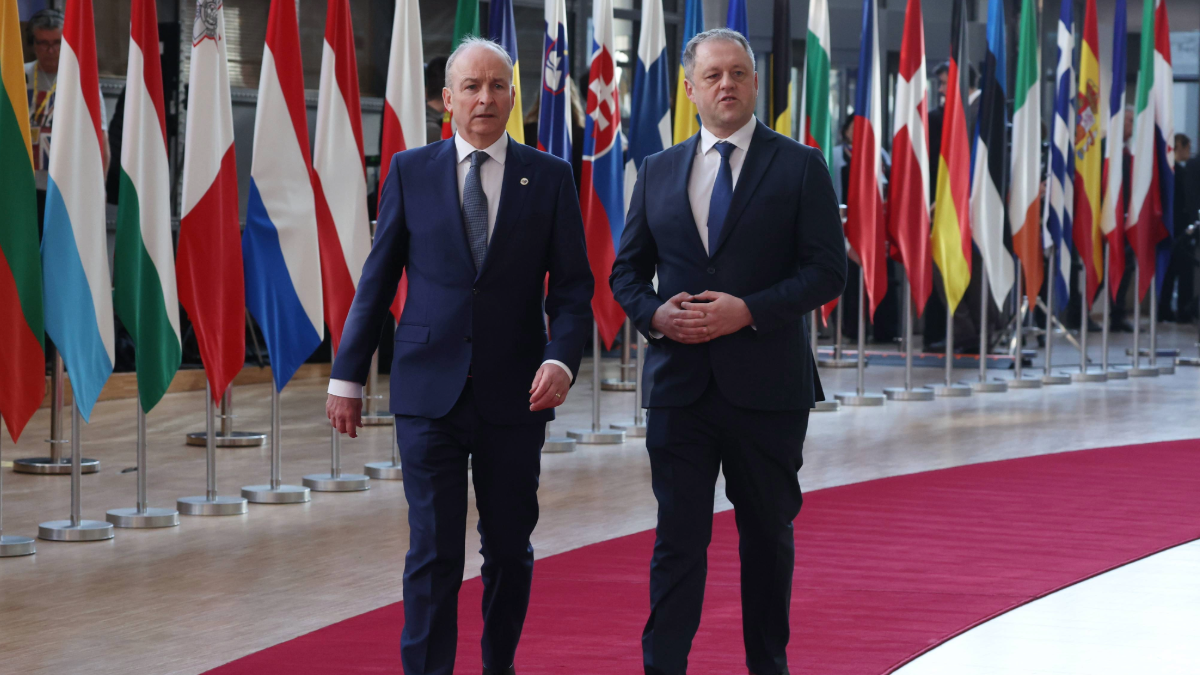
Ireland's Prime Minister Michael Martin, left, arrives for the EU summit at the European Council building in Brussels, Thursday, March 19, 2026. (AP Photo/Omar Havana)
From July 1, Ireland takes over the rotating chairmanship of the Council of the European Union — a six-month mandate to act as an honest broker among 27 member states at a moment of maximum consequence. The incoming Presidency must hammer out the EU's next €2 trillion budget, navigate crises in security, energy and climate, and advance some of the bloc's contested Digital Omnibus, all while fielding calls from the Big Tech companies that underwrite Ireland's corporate tax base.
The Presidency is a big deal for a small country like Ireland, bringing rare agenda-setting powers and the responsibility to reach bloc-wide compromises. Government ministers have stated publicly that a goal for the term is to “make the country look good.” But a defining question of contemporary Irish politics is, to whom does Ireland wish to look good? Torn between a deep indebtedness to the European project and economic dependency on US multinationals, these internal tensions will never have been more consequential to European tech policy than in the latter half of this year.
What Ireland is saying
Ireland won’t publish its official Presidency policy program until June but clear signals have emerged from political speeches. Taoiseach (Prime Minister) Micheál Martin has rather unambiguously declared, “We want to major on competitiveness in the six months of the Irish Presidency.” Foreign Affairs Minister Helen McEntee, in a keynote speech at Europe House in January, went a little broader, framing the Presidency around three pillars of competitiveness, values, and security, which she sees as fully interlinked, saying “without security, there can be no prosperity; without competitiveness, we cannot sustain our societies; and without values, none of it matters.”
“Digital” got — by my count — just two mentions in that speech, and “technology" just one, and all of these came under the part about “competitiveness” (eight mentions of its own). This is where tech policy is likely to sit in Ireland's Presidency agenda, embedded in a broader economic competitiveness story about infrastructure investment, supply chain resilience, and not falling behind in the global race for new technologies. The one exception is child online safety, with McEntee singling out child sexual abuse online as one of the “two greatest challenges facing modern society” under her “values” pillar.
But competitiveness means different things to different people. The EU has set itself a goal of strategic autonomy, of building European alternatives to and reducing dependence on American technology, in the service of both security and resilience, and being able to compete on the global stage. But a review of the tech company submissions to Ireland's Presidency consultation reveals an explicit attempt to get Ireland to reframe competitiveness as keeping EU markets open to US platforms. Big Tech lobby group CCIA Europe is most explicit, saying “Buy European” mandates are self-defeating, that “real digital sovereignty comes from diversification and choice. Europe should prioritize open markets.”
Simplification and the Digital Omnibus
Tech companies are also clear in their understanding that competitiveness equals deregulation. Meta opened its consultation submission offering, without being asked, an “overarching slogan” for the Irish Presidency: “A competitive, agile Europe in a fractious world.” It then explains what it means: “a complete overhaul of Europe’s digital rulebook” and “a pause on implementation of the pipeline of digital laws.”
Deregulation is where Dublin and tech companies might find themselves in tune. McEntee, in her keynote, said that Dublin agreed with the “simplification” agenda, and while she shied away from explicitly mentioning the Digital Omnibus, tech company submissions go into great detail about their demands for her Government in their stewardship of this EU package. Critics see the DigitalOmnibus as an attempt to roll back on the suite of digital laws passed in the last decade, and it is likely that the GDPR parts of the negotiations will fall during Ireland’s presidency.
The other items on the agenda
In practice, the Presidency’s bandwidth is likely to be consumed by things other than digital policy. The Multiannual Financial Framework (MFF) negotiations alone will see Ireland try to hammer out compromises between member states with opposite positions on how to allocate the bloc’s budget of just under €2 trillion. Squaring defense spending demands against resistance to cutting farm subsidies, against reluctance among member states to pay more, may exhaust Dublin’s firepower.
Add to that Ireland’s basic but very real security anxieties around hosting 47 heads of state and government, and it is easy to see how digital policy, and by extension the demands of Ireland’s resident tech companies, end up taking a back seat.
Holding the Presidency is as much about building a country’s soft power as achieving any actual policy goals, and Irish politicians keep repeating language around a desire to be a trusted “broker” in this role. As Minister for European Affairs, Thomas Byrne said in an interview, "We have to be an honest broker and to get things done at an EU level. You have to make the country look good."
But Ireland wants to “look good” to two constituencies currently at (economic) war. The country has benefited hugely from EU membership, and there are sky-high levels of public support for membership (though it recently slipped from a Brexit-era high of 93% to 82%). It will have its own fights to bring to the MFF negotiations, especially on funding for science and agriculture. But it also benefits hugely from, and in many ways relies for its financial prosperity on, being a destination for US investment in Europe.
These tensions have played out already over the past decade. Dublin has been responsible for the implementation of the General Data Protection Regulation (GDPR) in the bloc, and has faced accusations in Brussels and other member state capitals that its economic dependence on the companies it regulates has softened its enforcement.
The leaders would really rather not choose, hence, the emphasis on the “broker” framing, to which it would like to add “bridge.” This is most explicit in the framing of a key milestone of the Presidency, the International AI Summit with the theme Enabling AI to Power European Growth, co-organized with the Commission and planned for October 14th. Minister of State for AI Niamh Smyth has said she hopes the event positions Ireland as “the bridge between Europe and the global tech sector,” and to “move beyond dialogue into decisive, global leadership.”
Ireland’s great hope is that, come December, it has pulled off the tricky job of being seen as both a broker and a bridge by two constituencies it relies on, but who are in active conflict. The choices made along the way will have long-lasting impacts on the future financial direction of the EU, on the bloc’s digital regulation framework and on the companies lobbying Dublin. “Looking good” rarely feels so consequential.
Authors