Nepal's Gen Z Used TikTok and Discord to Win a Historic Election
Aaradhyaa Gyawali / Mar 9, 2026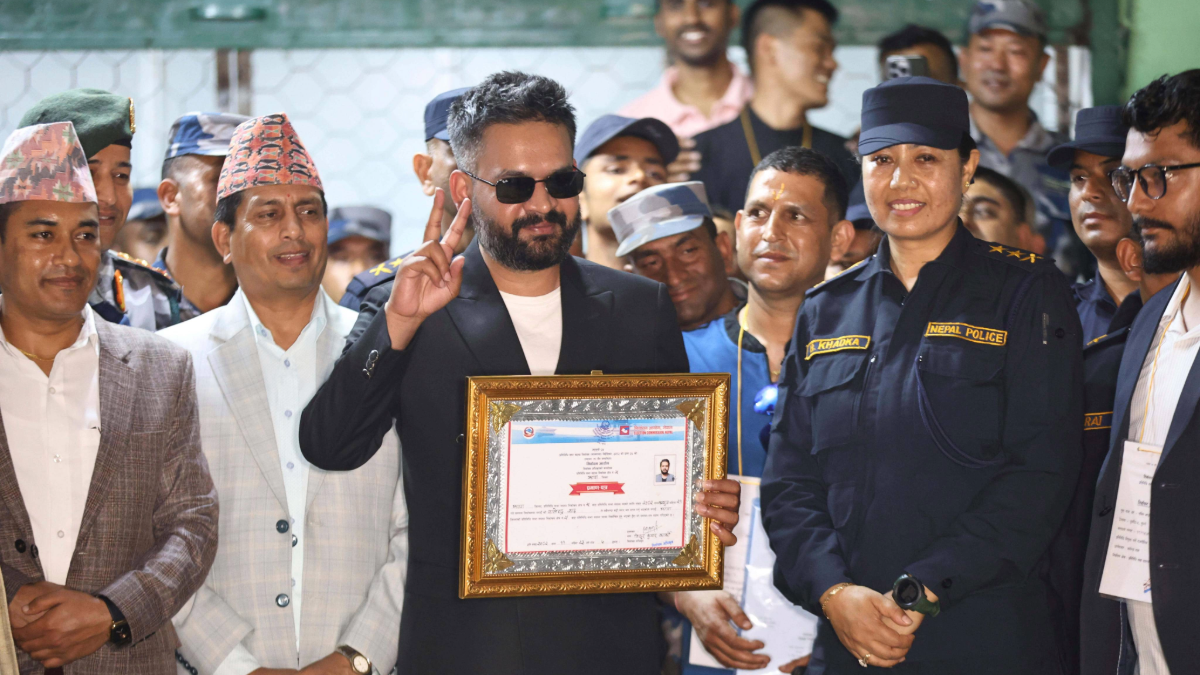
Balendra Shah, foreground, former mayor of Kathmandu Metropolitan City and prime ministerial candidate of the Rastriya Swatantra Party, receives his victory certificate after defeating former Prime Minister Khadga Prasad Oli of the Communist Party of Nepal–Unified Marxist-Leninist (CPN-UML) in Jhapa Nepal, on Sunday, March 8, 2026. (AP Photo/Umesh Karki)
On March 5th, 2026, Nepal held its first election after the GenZ revolution toppled the government last year. The revolution has undoubtedly rewritten the political map of Nepal. The rapper-turned politician, Balen Shah, defeated K.P Oli, who had won in the same constituency six times since 1991, by almost 50,000 votes.
The post-mortem of last year will be written over the next few years, but as a 23-year-old Nepali student, my take is that while older generations endured corruption for decades, the new generation believes it can bring power back to the people with the help of digital technologies. We did so by borrowing tools from the Western world, which could never conceive how we would use them.
“I got into a fight with my parents about the election.” “How do I change my dad’s political leaning?” “How do I convince my parents to vote for a young politician in this election?” These could be questions asked on social media in any number of countries, but if you were scrolling through online discussions on Reddit or Discord about Nepal (e.g., r/Nepal or r/NepalSocial), you might notice a new, intense focus on politics since the GenZ revolution last year.
September 2025 was a pivotal moment for Nepali politics, a digital-first revolution against corruption amplified by social media. It was fueled by the #nepobabies trend, which migrated from Indonesia to Nepal via TikTok and Instagram reels. In Indonesia, the trend targeted the rise of a political dynasty, specifically challenging the president’s attempt to install his 36-year old son as vice president despite the legal age requirement of 40.
By the time it reached Nepal, it evolved into a viral format that showed on one side politicians’ kids flaunting their lavish lifestyle, including one infamously creating a Christmas tree with Louis Vuitton boxes, and on the other side the everyday struggles of normal people. This apparent disparity fueled young people with rage against the system. Thanks to the hashtags on Instagram and TikTok, the trend only got bigger. It grew big enough to drive 30,000 people to the streets of Maitighar — the city’s central square for all protests — Kathmandu, on September 8th.
Corruption in Nepal is older than anyone in this story, but seeing those people’s lifestyles on a 30-second reel did something that years of scandal reports could not do: it put things into perspective. Putting those videos in direct juxtaposition to a normal Nepali life gave the spotlight to the silent injustice that had deepened its roots within the system.
A Discord server operating under the name “Youth Against Corruption” became the central organizational point for the protest. Unthreatened by their age and perceived naivety, K.P Oli, then Prime Minister, did not take the movement seriously beforehand. Neither the city nor the police force was prepared to handle the crowd of thousands of young people, unarmed yet enraged, marching towards the parliament.
19 young people lost their lives that day.
What started as a GenZ revolution wasn’t just theirs anymore. The raw footage of the gunshots was everywhere on TikTok, Instagram, and YouTube. Thanks to an algorithm optimized for engagement, the videos traveled widely. While the average age of the crowd on the ground on September 8 was under 25, the average age of the protestors on September 9 is much harder to gauge.
The Oli government tried to scare the young people with bullets, but failed. The anger of the crowds on September 9 led to the toppling of the government, politicians being beaten up, and ultimately to K.P Oli's forced resignation.
After September 9, the “Youth Against Corruption” Discord server saw another exponential rise in community members, now from across the world. September 8 was supposed to be a peaceful protest; September 9 was never supposed to happen.
Participants on the Discord servers that had been discussing slogans and time and place of protest before September 8 were now discussing, “Who was going to lead the country?”, and more importantly, “Does anyone understand how the constitution works in this kind of situation?”
Designed for gamers to text and video-call while playing games, Discord probably never thought that it would be the primary electoral communication channel for the mountainous country in South Asia. The Discord server, Youth Against Corruption, belongs to Hami Nepal, an NGO with no direct political affiliation, and the members in the server spanned borders and countries.
The server was used for organizing the protest on September 8 and 9. After the protest, it became a discussion hub to discuss (and some have argued, decide) who should be the next prime minister. Out of 154,300 people in the server, 7,586 cast their vote in a Discord poll. Shushila Karki emerged as the winner with 50% votes and became the interim prime minister of Nepal.
After the protests, parliament was dissolved, and the interim government was tasked with rescheduling the 2028 election. The result was the March 5 election in Nepal. Unlike in the past, where the elections were considered an adult-only concern, this time around, young minds have a clear vision for the election: “We are tired of old politicians, we want newer, younger faces to lead the country.”
And, the most in-demand new face is Balendra Shah, the former mayor of Kathmandu. After the GenZ protest, he was the first name that started echoing in Discord as the candidate to lead the country, while he was still in his mayoral role. Balen, even though popular among youths, has a more mixed reaction amongst older voters. On the one hand, he has made efforts in infrastructure development, like roads and waste management, during his tenure; on the other hand, he is also infamous for his rage-filled late-night Facebook posts and his refusal to face the media to be accountable for his actions.
As a young Nepali, this first election since the GenZ revolution was significantly different from previous elections. Instead of being shaped by the party’s agenda or campaign budget, it is shaped by online platforms, algorithms maximized for virality, and tools built on the other side of the world, designed for completely different purposes.
One Nepali teenager, ineligible to vote, expressed their concern on Reddit about convincing their parents to vote for Balen’s affiliated party, and the solution they got in the comment section was to change their parents' social media algorithm. A comment read: “Open their Facebook, block the party they follow, block the leaders they like, and follow Balen and his party. Seeing their content might make them change their mind.”
It's not bots trying to manipulate votes, it's just teenagers and an algorithm.
We don’t know if that teenager used the advice they got on Reddit, but we do know that after 68 years, the Balen-affiliated RSP is on track to become the first political party to get a two-thirds supermajority in the federal election.
From Instagram reels to TikTok videos, the young people who posted #nepobabies videos posted videos trying to convince their parents and grandparents to vote for Balen and his party. Unlike earlier elections, this time it wasn’t about big gatherings and rallies; this time it started at home and expanded through social media.
The frameworks built in Silicon Valley focus on concrete threats such as bots being used to manipulate elections, harmful disinformation, and foreign influence. But what’s happening in Nepal since the protest does not fit any template. Platforms built for gaming, sharing photos, and videos are actively being used to shape the democracy of a country.
These instances are so nuanced that no trust and safety team is going to be able to capture them. No content policy defines what to do in such a situation. Tech built in the West morphs into a different shape once it goes beyond it. Yet, as we struggle to capture those nuances, the infrastructure built in the US is an active part of elections you may not even know are happening.
Authors