Search Remedies in Google Antitrust Case Can Work Even if Company Stays on Top
Sumit Sharma / May 4, 2026
In August 2024, US District Judge Amit Mehta issued a landmark ruling finding that Google maintains an illegal monopoly in general search and search text advertising. A remedy decision followed in September 2025, and the “Final Judgment” was issued in December 2025.
The remedies ordered by Judge Mehta fall into three categories. First, prohibitory injunctions that limit the terms of Google’s default contracts — shortening them to one year, preventing the tying of different Google services, and giving device makers more flexibility. Second, Google is required to share its web search index and user-side data with QCs (Qualified Competitors – companies eligible to use the remedies ordered). Third, Google must offer syndication licenses so QCs can access Google’s search results and text advertising feeds separately or as a bundle.
The prohibitory injunctions are unlikely to be effective as Google can continue to pay to be the default service on iPhones, carriers, OEMs and browsers – for both general search and its AI services. Indeed, the court accepts this, noting in the remedy decision that no other company will be able to outbid Google and win these distribution contracts. The remedies as ordered thus fail to fully address the liability decision finding that default contracts are key to Google illegally maintaining its monopoly position.
Indeed, shortly after the court issued its Final Judgment, Apple signed a multi-year, multibillion-dollar deal with Google to incorporate Gemini into Siri, reflecting the increasing use of voice assistants to find information and Google’s leadership in Gen AI. Google has also successfully incorporated Gen AI into its general search services (Google’s AI overviews and AI mode), and its unparalleled web index and user data give it an unbeatable advantage in further developing such hybrid services. Without policy interventions, stand-alone Gen AI companies like OpenAI or Anthropic are unlikely to meaningfully erode Google’s market power, especially given that Google continues to have the bulwark of being the default service on both Android and Apple smartphones.
All bets are then on the supply-side remedies — syndication and data sharing. The aim of the syndication remedies is to enable more competition in the short term by providing access to partial inputs that are hard to replicate for competitors operating at a substantially smaller scale. The web search index (a database of websites and their content) and user-side data (query, ranking, and SERP interaction) disclosures could spur more competition in the medium term (the six-year period the court’s ruling remains in effect) by providing key inputs to enable QCs to invest in and develop their own search infrastructure.
For this to happen, as I explain in a recent report, these supply-side remedies must be implemented judiciously — with appropriately estimated marginal or cost-based pricing, flexible license terms, and ensuring that the data disclosed is fresh or recent. The remedies must also allow QCs to mix and match remedies, stagger their use, and use the inputs provided by the remedies ordered in combination with their own search infrastructure and possibly other syndication feeds.
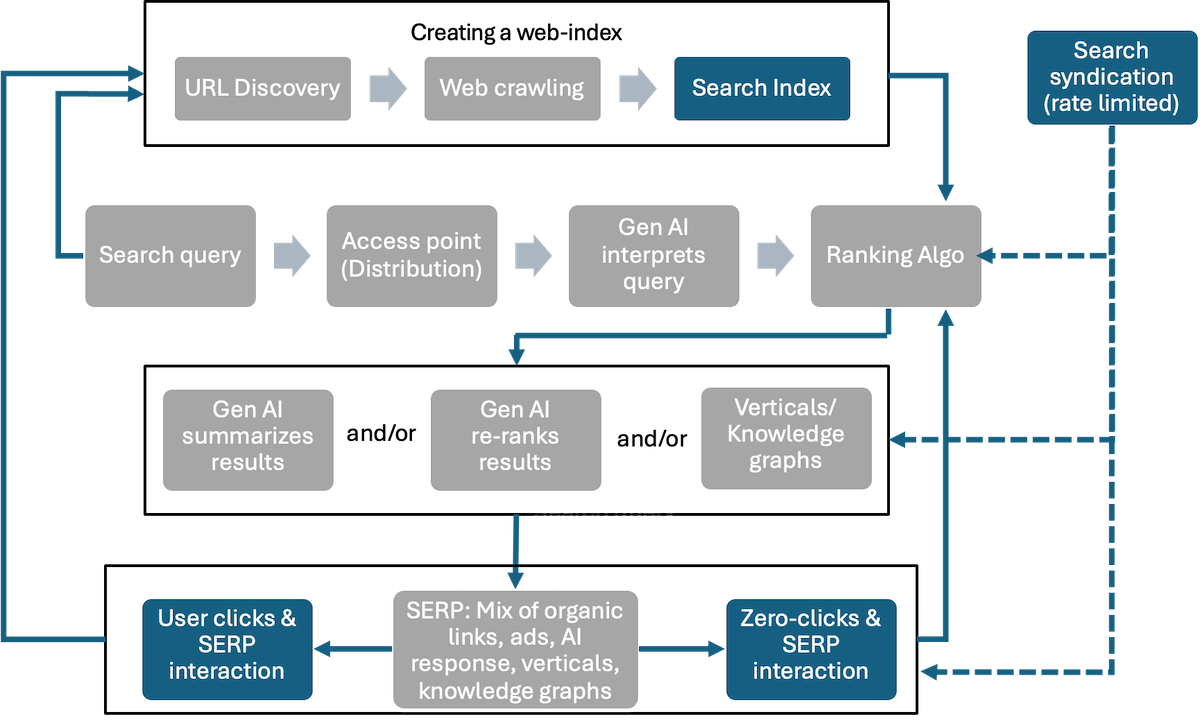
This is because the remedies ordered only provide a small subset of the inputs required to offer a competitive search service, as shown in the figure below. For example, the use of syndication by QCs is capped at 40% of queries in the first year and is intended to decline over the five-year syndication license term, and there are limitations on the web-search index and user-side data disclosure.
Figure 1: Inputs not supplied under the remedies shown (see grey boxes)
Source: Author
This means QCs will have to make substantial investments in their own infrastructure and differentiate their services to stay competitive. Effective implementation of the remedies could begin to lower the barriers that have kept competitors from investing in search.
Google’s competitors will still not be able to develop all the components required to offer general search services. For example, most companies will not be able to develop their own web-search index or search text advertising technology. But this is okay. The goal is not to replicate Google, but to enable a range of companies with different business models to enter and compete, whether through privacy-focused search, AI-native experiences, subscription models, or specialized vertical offerings.
Today, specialized vertical providers like Tripadvisor and Yelp, and Gen AI model developers other than Google, provide essential inputs for smaller companies to compete in general search. The availability of alternative suppliers of web search indexes and search text advertising can play a similar role, enabling sustainable long-term competition via competitors operating a spectrum of business models. The remedies must be implemented to allow for the development of such wholesale services.
Will all this come to pass? This will depend on how the remedies are implemented, and on ongoing appeals.
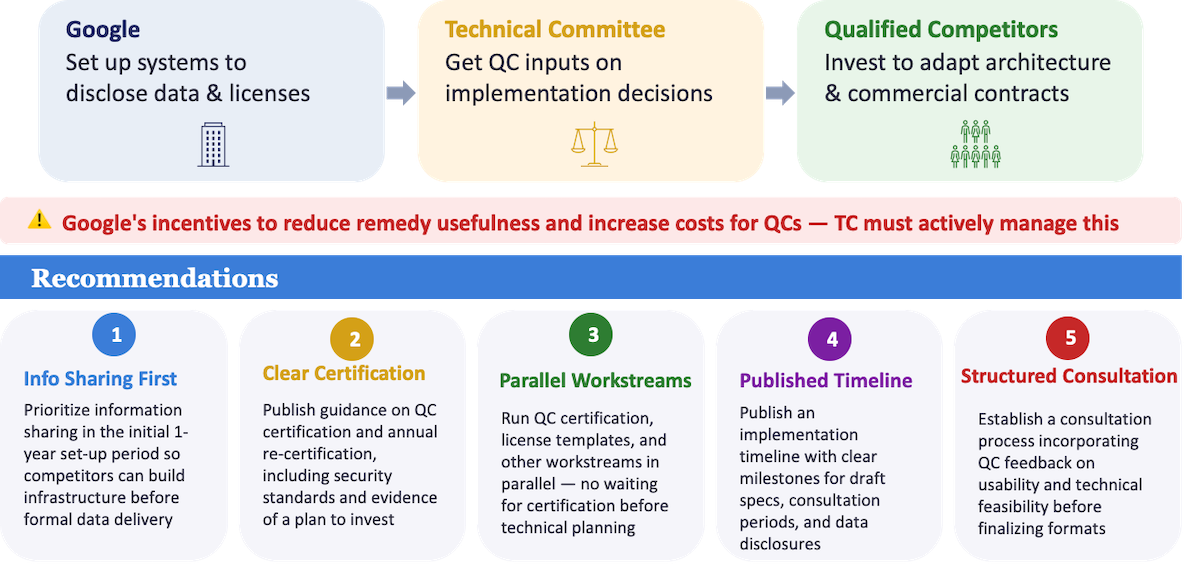
On implementation, the court puts the TC (Technical Committee – an expert body set up as part of the Final Judgment) and the Plaintiffs in the driving seat. This is a welcome contrast to Europe’s Digital Markets Act, under which Google has considerable discretion first in deciding how to implement similar remedies. Google has used this discretion to undermine the implementation of similar remedies in Europe. Google and QCs will have an important role to play in implementation, and the TC must ensure coordinated action and information exchange among all stakeholders, as shown in the figure below.
Figure 2: Effective implementation will require coordinated action from Google, qualified competitors, and the technical committee
Source: Author
Judge Mehta said at the Penn Carey Law School’s annual symposium on April 10 that the biggest challenge in the case was the size and volume of evidence and the breadth of the trial record. I expect this to be the case many times over when it comes to implementing the remedies. It is thus essential that the Technical Committee is adequately staffed and resourced. Google’s motion for partial stay does not ask for the TC to pause its work, though Google has reportedly tried to nickel and dime compensation for Committee members and suggested these roles should be part-time.
Then there are ongoing appeals by both Google and the DOJ/States. Both cases are headed to the DC Circuit Court of Appeals, with oral arguments potentially taking place in late 2026 or early 2027. The court rejected the more aggressive structural remedies that the Department of Justice had sought, including the divestiture of Chrome and Android. These are unlikely to be back on the table. But assuming the liability decision stands as I expect it to, there is a case to strengthen the remedies already ordered. This could involve further prohibitions on Google’s distribution payments, like only allowing payments for non-exclusive distribution, increasing the frequency of data disclosures, and improving the mandated syndication terms and conditions.
The fast pace of market developments and Generative AI technologies has been a determining factor in Judge Mehta’s thinking on fashioning remedies in this case. It will be interesting to see how this plays out in his decision on Google’s motion for a partial stay. During an April hearing, Judge Mehta was already wondering whether the remedies ordered would need fixes. In the meantime, the first three members of the TC have been appointed and are starting the important work of implementing the ordered remedies. It is important that these remedies already ordered are implemented effectively before any discussion of additional changes.
Disclosure: This article is partly based on a “Report on Data Sharing and Syndication Remedies in US v Google” published by the author in March 2026. This independent research received financial support from a Google competitor in the AI and search market.

Authors