Surveillance Technology is Silencing Journalists in Kashmir
Petra Molnar / May 7, 2026Petra Molnar is a fellow at Tech Policy Press.
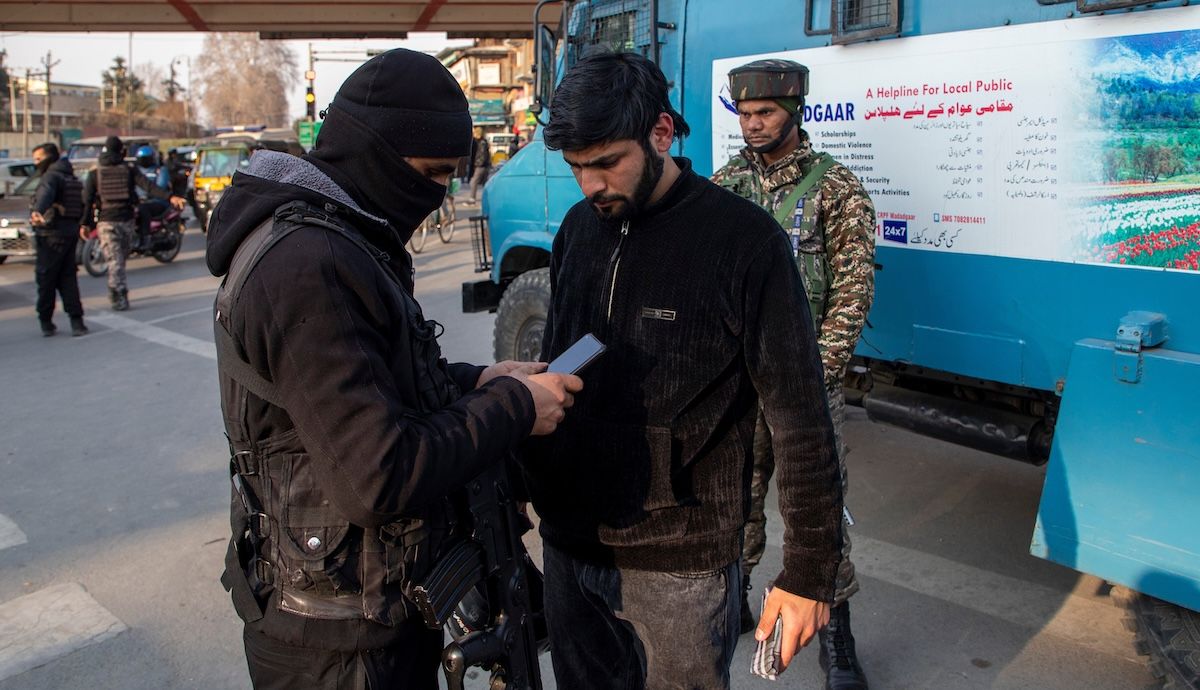
An Indian security personnel checks a mobile phone of a civilian during a random search operation ahead of Republic Day. Authorities across Kashmir have heightened security measures ahead of the 77th Republic Day on January 26, 2026 including intensified vehicle checks, increased patrols, and expanded surveillance using drones and high resolution CCTV cameras. (Photo by Faisal Bashir / SOPA Images/Sipa USA)(Sipa via AP Images)
Few places illustrate the entanglement of territorial conflict, digital governance, and repressive spyware as starkly as Kashmir, the mountainous region located in the northernmost part of the Indian subcontinent, bordered by Afghanistan to the northwest, China to the northeast, and Pakistan to the west. Long administered in part by India and marked by decades of militarization, Kashmir entered a new phase in 2019 when the government led by Narendra Modi revoked its limited constitutional autonomy.
In the years since, Kashmir has become a dense site of surveillance, where checkpoints and patrols are increasingly supplemented by biometric systems, networked CCTV, telecommunications controls, and expansive data governance frameworks. Indian authorities routinely frame these measures as ‘necessary’ for security and stability. Yet these technologies are also reshaping everyday life into a space of continuous monitoring, where movement, communication, and association are subject to continual scrutiny.
In April 2025, a deadly militant attack near Pahalgam in Kashmir killed at least 26 civilians, many of them tourists, marking one of the deadliest attacks on civilians in the region in recent years. The incident triggered a sweeping security response, including intensified military deployments and expanded surveillance measures, further entrenching an already pervasive security architecture across the region.
For journalists, this environment has produced a particularly fraught landscape. Reporting from Kashmir now entails navigating not only physical risks but also digital ones, including phone and social media monitoring, pressures on sources, and the threat of legal repercussions under evolving regulatory regimes such as the Digital Personal Data Protection (DPDP) Act. Newsrooms and independent reporters alike describe a shrinking space for dissent, where self-censorship becomes a practical necessity and anonymity a protective strategy to keep reporting from the region.
For example, in February, Kashmiri journalist Majid Hyderi was allegedly threatened by police officers that he would be “killed under mysterious circumstances,” after refusing to withdraw a complaint to the High Court in Kashmir, citing a “threat to life.” The threat, occurring at the High Court itself, prompted Hyderi to seek refuge in a nearby courtroom, and later received special protection due to the intervention of a judge In a March ruling, the High Court of Jammu and Kashmir and Ladakh instructed the local government to refrain from harassing the journalist and from taking any action against him without due legal process, with the next hearing on Hyderi’s initial complaint scheduled for the summer.
Hyderi’s ongoing harassment reflects a broader pattern in which Kashmiri journalists face intimidation and pressure from security actors, contributing to an environment of fear and uncertainty.
The following interview was conducted with Shakeen Ahmed (a pseudonym), a journalist living and working in Kashmir who requested anonymity. Although the original intent was to produce a co-authored piece, Shakeen ultimately felt more secure participating in an interview format and withholding his real name to protect both himself and his family.
The material for this interview was gathered using a shared online document, which was deleted as soon as possible to minimize any data breaches. Shakeen was also unable to communicate via Signal, the open-source, encrypted messaging service for instant messaging. While Signal has not been explicitly outlawed in Kashmir (unlike other applications), according to Shakeen: “ if [the] army finds out [about Signal] during checking, they take the phone and beat the person.”
This conversation offers a ground-level account of how journalists like Shakeen experience and understand surveillance in the region, tracing its presence across public space, religious life, and the borders that continue to define Kashmir’s contested reality.
Shakeen, thank you for your time and the risk you took to share your experiences with the Tech Policy Press. For many people, Kashmir feels like one of those places that they may have heard of but would have a hard time placing on a map. To situate us a little, can you describe what everyday life in Kashmir feels like right now?
In Kashmir, everything is monitored, controlled, and watched. The word “privacy” does not exist here. Take the example of your smartphone. It can be taken away from you anytime and you have to share your passwords with authorities, so that both police and army forces can access even your most intimate photos. Personal devices, especially smartphones, are not treated as private property. There are routine instances where people are asked to unlock their phones or disclose passwords at checkpoints or even on the street, which effectively exposes their messages, photos, browsing history and contact networks to the authorities.
This type of surveillance is really intimidating. VPNs are banned. CCTVs are installed anywhere and everywhere. You feel watched all the time. Someone’s gaze is fixed on you and follows you from the moment you wake until the moment you go to bed. The psychological impact is equally profound. Even when it seems like there is no direct intervention from the authorities into your daily life, there is always the persistent sense of being observed. People often describe it as an invisible gaze that follows them through the day. Over time, this type of ongoing gaze produces internalized control. You begin to regulate your own behavior, speech… and even your thoughts.
For readers who may not be familiar with the situation in Kashmir, how would you situate the current surveillance environment in the region within its broader political and historical context?
The current surveillance landscape must be understood in the context of August 2019, when Kashmir was stripped of its semi-autonomous status and disenfranchised, degraded, and downgraded to a Union Territory by the Modi Government. As a result, the region has effectively become a high-surveillance zone, where security logic shapes administrative practices. Post-2019, there has been a shift toward institutionalizing surveillance as a tool of governance and control in people’s everyday lives. This includes various practices such as prolonged internet shutdowns immediately after August 2019, the longest ever in a democracy, the expansion of digital monitoring systems, increased integration of intelligence databases, and greater centralization of policing and security operations.
I can give you real-life examples of this growing web of surveillance. Recently, one army camp “lost” its drone while they were surveilling a civilian area that comes under army jurisdiction. They asked all the imams (the heads of local mosques) in their area to announce it through the azzan loudspeakers in mosques, just like a call to prayer, saying that if anybody finds the drone in their farms or their orchid fields, they should not go near it and should inform the army immediately. Until now, I really did not know the army was using drones for surveillance directly in the countryside. Also, in Kashmiri villages, the army writes unique numbers on gates or main doors of houses to identify and track them. Mind you, this number is different from the official house number written on ration cards or election cards.
I also found it so bizarre that those who fly out of Kashmir, their travel is also monitored. At the only airport in the region, in Srinagar, the Central Industrial Security Force officials who directly work under the Ministry of Home Affairs record the details of your boarding pass before you go to the boarding gate. These are just some examples of how it feels to live every day in a zone of suffocation – or in the beautiful prison called Kashmir.
You have told us a bit about the daily manifestations of surveillance in Kashmir that you have seen directly. What other forms of surveillance are most prevalent today, both physical and digital, and how have these evolved in recent years?
As I said, the valley of Kashmir is divided between various military camps. The military has all our details. For example, they know that I am working as a journalist and an editor. They know that my sister is a lawyer and that my brother is a reputable businessman in the city. They know how many children my siblings have, and they know which communities their spouses belong to. Military intelligence keeps track of all this data on us and continually adds to it.
What this type of constant surveillance has created is a void, an invisible division in our society. It has fractured us. It has created a trust deficit. It is very difficult to trust one another. We were simple people, but occupation has turned us against each other. You never know whether the stranger you are talking to is an intelligence guy spying on you and secretly recording you. That is scary. Is it not?
Publicly available locations of military camps in Kashmir (retrieved April 29, 2026)
There is also a dense network of checkpoints across highways and urban areas. Every few hundred meters, you will see trigger-happy troops standing and monitoring, even directing the traffic. Deployment of high-end CCTVs is mandatory in public institutions, on intersections, in shops, and in schools. And I have not yet even mentioned identity checks or regular patrolling. And telecommunication surveillance? Oh my God, it is terrible. At any police station, they can check your call detail records (CDRs), which reveal who is communicating with whom. All they need is your phone number. The police do this even though the Jammu & Kashmir and Ladakh High Court ruled in March 2025 that CDRs alone are insufficient for conviction in criminal cases without corroborative evidence or voice recordings. The Cyber Cell of the Jammu & Kashmir Police Crime Branch also monitors our social media. Posts deemed “anti-national” or “seditious” trigger legal actions, and your career and life are gone with that, in the blink of an eye. You are slapped with the Unlawful Activities (Prevention) Act (UAPA), an anti-terrorism and public safety act, a highly controversial preventive detention law.
How do these different systems, such as cameras, checkpoints, data monitoring, and informants, interact? Do they feel coordinated as part of a broader infrastructure?
It is a massive web. These systems of surveillance and control are not isolated. A simple social media post, which the authorities feel propagates the “secessionist ideology,” triggers a physical visit from police to your home without you even having any idea this is about to happen. You are still scrolling, but the police are already knocking at your door. Intelligence gathered through local informants can also lead to digital scrutiny. CCTV footage from our streets can be cross-referenced with telecom data from our phones. This interconnectedness creates a feedback loop where different forms of surveillance reinforce one another. For civilians in Kashmir, this means there is no clear boundary between online and offline spaces: both are equally monitored and reinforce one another. For us on the ground in Kashmir, these systems do feel actively coordinated, because if you are the target, they will invest all their energy to track you until you are proven guilty.
How have recent legal or policy developments, such as the Digital Personal Data Protection (DPDP) Act, affected journalists such as yourself, but also the everyday people of Kashmir?
The DPDP Act was passed in 2023 by the Indian government as a framework to safeguard personal data, but the truth is that it actually gives the government impunity to call the shots. In a region like Kashmir, any journalist publishing personal data without consent risks severe penalties. Yet the state retains expansive powers to access and process data and individuals have limited avenues for redress. Oversight mechanisms are also not always transparent or independent. Therefore, the DPDP law does not actually protect people’s data but actually reinforces the lived reality of surveillance in Kashmir.
What the DPDP law actually does is it alters how journalists and reporters can do their jobs. Journalists now think a hundred times before using a quote or even how to write it. Our sources who previously freely shared information now only do so after you agree that you will not identify them with their real names—just like me for this interview! It is a difficult situation for a journalist to survive in Kashmir. Now, because of these harsher laws, young journalists in Kashmir quit even before they start exploring their reporting careers. This is disheartening and disturbing. Because if the media, the fourth pillar of democracy, does not have a spine, then we are truly doomed.
In your experience, Shakeen, how does digital surveillance of phones, social media, and internet shutdowns shape what people are willing to say or share?
Digital surveillance has reshaped how people communicate. I will explain with an example. I have noticed that people do not like, share, or comment on posts related to politics, conflict, or human rights violations in Kashmir. Social media platforms are no longer perceived as safe spaces for expression. People avoid political commentary, refrain from sharing sensitive information, and often even delete old posts. Messaging platforms are used cautiously and even private conversations are measured.
Recently, a clip of a national news interview went viral, when the reporter asked a sensitive question and the interviewee, a common Kashmiri person on the street, walked away saying, “I don't want to answer. If I do, they will come in the night and take me away, perhaps never to return.” This is how scared people are. It is a total climate of control.
There have also been reports of monitoring around mosques. What does this type of surveillance in religious spaces and other community sites look like?
Routine summoning of clerics to local army camps and police stations is now the order of the day in Kashmir. They are being told not to cross the line. They are asked to soften their tone, not to talk about the conflict in the region, or the conduct of the police or the army. They are told not to spread or share anything about separatism or radicalization. They are told to talk only about social issues, such as the dangers of drug addiction, moral bankruptcy, cleanliness, or the treatment of senior citizens or parents.
Now, the fear in Kashmir has increased since they started profiling mosques and the community members who take care of our spaces of worship. For example, earlier in 2026, a detailed proforma was circulated among local village heads where they are supposed to share their bank account information, mobile numbers, emails, passports and even credit card details. Religious spaces, which traditionally function as the pillars of our community, are now also treated as sites of potential surveillance.
Sadly, this increased monitoring around mosques will further push people away from the mainstream. Operation WHAM (“Winning Hearts And Minds”), a strategy implemented by Indian security forces in Jammu and Kashmir to combat terrorism by gaining local support and trust, involving community outreach, infrastructure development, and education to address grievances) will miserably fail because you do not let your people practice even their religious beliefs and scrutinize their prayers. It has disintegrated our social and religious setup. Everyone is extremely scared. People who would normally find refuge in religious activities now prefer isolation. Masjid (the mosque) matters in Kashmir. It is not just a place of worship; it is a social space where people are healed, where they can talk about their fears and apprehensions, their daily frustrations, and whatever bothers them. If they are intimidated in this space, also, where else do they go?
Recently, a young boy told me: “I used to go to Mosque to pray five times a day, but since the CCTV's were installed, I don’t go. I feel that some third party is watching and monitoring what should ideally have been the conversation between me and my creator. You are infringing my religious values.” These practices inside our sacred spaces are triggering fears of increased surveillance. Kashmiri religious schools have also faced intimidation, with one of the biggest seminaries in the region being declared an unlawful entity, accused of having ties with Jamaat-e-Islami. As one Srinagar resident told me, “this is not a place to live in peace and yet the world calls it paradise on earth for its breathtaking beauty. Bullshit.”
Living in Kashmir also means living with ‘the border’ every day. Shakeen, at or near the Line of Control, the 740 km/450 mile heavily militarized de facto border separating Indian-administered Jammu and Kashmir from Pakistani-administered Kashmir, near and other militarized zones, what role does surveillance technology play in shaping movement and security practices?
At the border, surveillance is explicitly militarized. Gaining access to the border region is difficult. Firstly, you have to get permission from the respective police stations to enter the border area. You submit your details in the required form, attach proof of your identity and the purpose of your visit, and then you maybe get the permission. You also have to share your phone number at every checkpoint, your identity card, and then they will also click pictures of you. In those fenced borders, drones will also monitor your activity, with further expansions planned.
For civilians living near the Line of Control (LoC), this type of surveillance translates into restricted mobility, frequent checks, and constant observation as they go about their days. The authorities justify surveillance here for securing the border, but as we have seen, it also bleeds over into pretty much every aspect of Kashmiri everyday life.
You have already alluded to this, but as a Kashmiri journalist working under these conditions, how does surveillance shape your day-to-day work, the safety of your sources, and your sense of risk?
Earlier, people would pour their hearts out to me. Now they are silenced. This is dangerous. While silence can in and of itself be its own protest to the heartbreaking situation in Kashmir, as more and more people feel too scared to talk to us, journalists find it increasingly difficult to report the uncomfortable truth of what is going on every day. For me, journalism is the practice of what the government does not want you to report; everything else is pure PR. Unfortunately, today in Kashmir, the truth comes with a cost.
I have seen countless examples of this type of silencing. Police now summon journalists to police stations and ask them to sign a bond that guarantees that they will not write against the state. The reporting space has shrunk and young journalists are scared and increasingly switch to other professions soon after they go into the world of work after graduating. Sources are reluctant to speak to the media and share the hair-raising details which have become part of their daily lives. Because I also work as an editor, I often talk to my fellow editors about how critical newspapers now also face extinction by design. Media houses simply do not publish stories that can harm them, or ones that threaten legal or state action. A fellow editor walked out of jail after 600 days and his media outlet is shut forever. Kashmir media is at a breaking point. What we are really talking about is the death of journalism in Kashmir.
Have there been moments where you felt you had to self-censor or change how you reported because of surveillance?
Self-censorship has become the new norm. The kind of journalism scribes do in other free parts of the globe? We can not do that here. Not possible. Our stories simply die at the editor’s desk. Not die, actually, the stories are deliberately murdered so that the media house does not receive notice to shut down all operations. And who can blame them? They also have families to feed. Journalists in Kashmir have been put behind bars, and they are on “no-fly lists” that restrict their movement out of India. In some cases, the websites and socials of media houses are completely pulled down. And it is not just freelancers or small presses that are being targeted. Even the journalists who work for reputable national dailies like The Hindu and Indian Express are now being summoned to police stations for their reportage from the region.
As we wrap up, what do you think is most misunderstood about surveillance in Kashmir, especially by international audiences?
Many people simply cannot understand how the impact of surveillance on social and religious life is deeply disruptive. For example, when we talk about the monitoring of mosques in Kashmir, when surveillance extends into spaces of worship, it alters how people engage with their faith and community. People’s discussions become cautious, their attendance patterns change, and their very expressions of identity are moderated. More broadly, surveillance also contributes to a breakdown of trust in our communities. People become wary of each other, unsure of who might be reporting information to whom, fragmenting society and weakening our collective life.
I think that global audiences believe that Kashmir is a problem between India, Pakistan, and China. But instead, Kashmir is under surveillance per square meter. It disturbs relationships, how you carry yourself at work or who you are as a person. This type of surveillance changes you completely. Another gap in understanding is the deep psychological dimension of surveillance. Living under constant observation produces profound anxiety. For example, according to Médecins Sans Frontières, almost every second Kashmiri person walking on the streets experiences mental distress. And people in the West have zero idea about this. We are being surveilled every second of our lives – and this surveillance has made us mentally ill.
Thank you so much for sharing a window into your life and your community, Shakeen. Lastly, what would meaningful accountability or protection for journalists and civilians look like in Kashmir?
I don't know. And I am not sure what I suggest will ever be translated into reality. Of course, structural change is important to begin with and there should be clear legal limits on data collection and monitoring in Kashmir.
But actually, first I want to ask the Indian government: why do you surveil us? And now that you are controlling us, you have to be transparent about the use of technologies. How is the footage from these thousands of CCTVs used? Where does it go? Who profits from it? There must be proper mechanisms for journalists or civilians to challenge this massive, unlawful surveillance apparatus. This is my hope, but I am not optimistic that it will ever see the light of day.
Authors