Tech, Venture Capital and the Hype of War
Elke Schwarz / Jan 22, 2026This post is part of a series on Hype Studies that will appear on Tech Policy Press in 2026. More from the series is here.
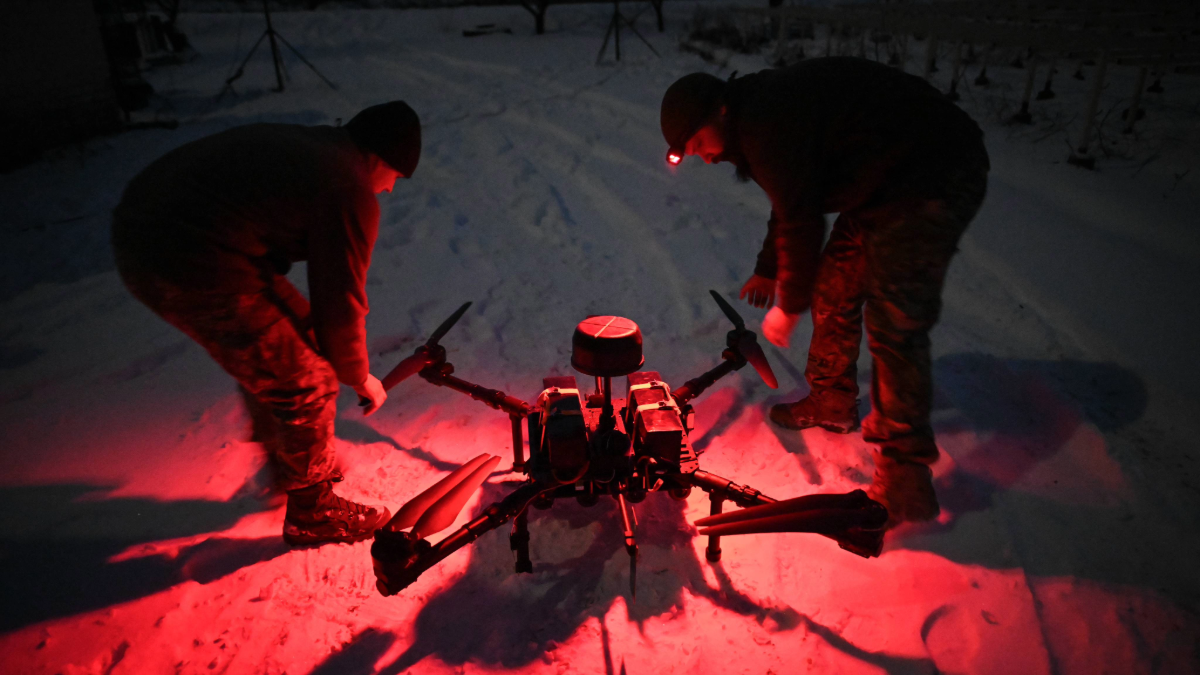
Two Ukrainian servicemembers make final preparations on a heavy bomber drone at the launch site before a close air support mission, in a hidden drone outpost on the Zaporizhzhian Front 15 kilometers from Russian positions on December 30, 2025. Photo by Justin Yau/ Sipa USA)(Sipa via AP Images)
In 1933, the philosopher Simone Weil observed that modern war is characterized by an “inextricable mixture of the military and economic […] which reproduces the social relationships constituting the very structure of the existing order — but to a more acute degree.” Weil made these observations as the specter of war loomed across Europe and economic capacity was being called upon to build a war machine. Contemporary developments in military and economic affairs warrant returning Weil’s astute commentary.
In recent years, the venture capital (VC) sector has set its eyes on disrupting an increasingly lucrative military technology market. This move is galvanized by record global defense spending, which in turn is driven by European instability and sharp geopolitical tensions. A growing proportion of these budgets are allocated for new and emerging military technologies, including artificial intelligence and semi-autonomous drones — a market segment in which tech startups and their venture capital investors dominate. Investors expect the global defense market to continue on an unusually high 4.4% year on year growth trajectory until 2030, and make their investment decisions accordingly. This has buoyed a venture capital sector investing in dual use and military tech which, according to Pitchbook, has had “one of the strongest years on record” and, unlike other VC investment ventures, shows no sign of slowing down. War and instability is, and has always been, an opportunity for business. But unlike in previous epochs, when the government was the driver of innovation in military tech, it is now the private sector which drives change.
As Andreu Belsunces Gonçalves highlights in his opening post for this series, VC capital is first and foremost “speculative capital” which places “early bets on uncertain futures and benefits from dramatic shifts in momentum.” VC is also an impatient form of capital. Investors typically need to see increased traction from startups on a 18-24 month timeline, for the next funding round. This is structurally difficult in an environment where procurement cycles are slow and subject to regulatory oversight. This poses a significant obstacle to tech startups which need to get “from prototype contract to production contract in a timeline fast enough for a VC cycle” in order to successfully traverse the infamous “Valley of Death.” To attract continued VC funding, startup companies are thus compelled to overpromise, exaggerate utility, and deal in hyperbole. Venture capital depends on hype. Unlike any other period in modern military technology marketing, the current military tech landscape is now subject to the same hype as civilian tech.
From hype machine to war machine
Hype is a way to guide perceptions, perspectives, and practices through emotive narratives. In a military context, the hype of technology is intrinsically tied to a hype of war. In this nexus, VC logics and Silicon Valley culture blends with heroic ideas of conflict and warfare to form a semiotic pairing by which one domain becomes deeply entangled with the other. Consider, for example, how VC business is framed in terms of warfare, as in a 2011 blog post by a16z (Andreessen Horowitz) partner Ben Horowitz titled “Peacetime CEO/Wartime CEO.” Horowitz extolls the virtues of various autocratic measures, including the need to violate protocol to win, heighten contradiction, cultivate paranoia, and employ other bellicose tactics in order to “win the market.” According to Horowitz, a “wartime CEO” like him is “too busy fighting the enemy” to read management books. It is a ‘do what you need to do in order to survive’ attitude.
The semiotic interchange also goes in the other direction: warfare appears in terms of financial competition. The US “Secretary of War,” Pete Hegseth, frequently presents the American war-machine in tech industry parameters of “speed and volume” and risk appetite. Only recently, he turned an acquisition program into a ‘portfolio’ that listed speed in getting tech to the frontlines as one of its indicators of success. “We are,” as Hegseth quips, “capitalists after all.”
In a similar register, the term ‘10x’ is increasingly finding its way into military initiatives, such as with US Army program 10X, which seeks to improve mobility and mission planning by a factor of 10, or the UK’s declared aim to make the British Army “10x more lethal”. The term 10x derives from investment circles and is often traced back to the 2014 book Zero to One by Peter Thiel and Blake Masters, in which the authors confidently proclaim that if “you’re 10x better, you escape competition.” Thiel did not coin the term, but he turned it into gospel for the tech startup industry. To see it now leveraged for lethality, as it is in the UK’s Strategic Defense Review, is both meaningless and disturbing. This new amalgamation of business and warfare is perhaps best symbolized by the recent swearing in of four high-level executives from Palantir, Meta, and OpenAI — none of whom have any specific military training — as high-ranking US Army Reservists.
Winning at all cost
The boundary between business and war has long been porous, with tropes from each spilling over into the other, but in this new configuration one effortlessly blends with the other, tying the aims of one to the practice of the other. The aim is to “win” in the widest sense of the word. Storytelling becomes a war of hyperbole, exaggeration, and reactive frenzy for financial gain. The controversial defense data analytics company Palantir, for example, has adopted the slogan “The Primacy of Winning” as its ethos. Winning, here, means presumably both beating the competition and beating the enemy. This ambiguity opens up a wide space for the hype machine to become the new war machine.
Marketing lethal force entails a careful blending of fact with fiction, which merges VC dynamics with war dynamics to produce various layers of speculative projection and heroic narrative. Here too, the ambition “to win” is foregrounded, as in Palantir’s promotional video “The Future of Warfare,” which proclaims that “battles are won before they begin.” More often than not, however, winning is about winning contracts, business, or an advantage. The “Primacy of Winning” is about aggressively outcompeting other industry players, but, if need be, it can also be leveraged as an expression of patriotism and resolve.
Palantir co-founder Peter Thiel is perhaps the most radical purveyor of narratives in this register. Like Palantir’s CEO Alex Karp, he has a tendency to advocate for conflict because he sees conflict as a driver of growth and pathway to winning. Business and war and ideological zeal blend together into one single logic. Thiel was leaning into this logic in his latest New York Times interview, where he suggested that the true cause of secular stagnation is 50 years of peace and stability.
All of this talk produces effects: it normalizes a frame by which crisis, chaos, and upheaval become necessary requirements for growth and prosperity.
Crisis facilitates exception. Exceptions facilitate that business is done under the cover of darkness at speed and scale. They allow for normal democratic processes and regulatory guidelines to be circumnavigated in order to amass contracts and drive expansion. War as a mode of exception in this way becomes a business necessity. We should at least consider, then, that VC aims are a source of destabilizing trends, and that this means sowing latent possibilities for war and conflict as a matter of routine.
Shifting the ‘vibe’
These hyperbolic narratives in the new defense tech space quite literally put into practice some of the ‘wartime CEO’ aims highlighted earlier. To be sure, the myriad of VC companies currently proliferating in the US and European defense tech landscape are not all cultivating such narratives to the same degree. But they all capitalize, to some extent, on the ‘vibe shift’ being produced by a handful of extremely active and often interlinked US-based VC companies like a16z, Founders Fund (Palantir cofounder Peter Thiel’s VC company), 8VC (a VC company by another Palantir founder, Joe Lonsdale) and associated neo-primes like Palantir, Anduril, and SpaceX. This ‘vibe shift’ normalizes conflict and the display of force as a means to peace and freedom. Nothing says “peace” like a swarm of 40-pound AI-enabled missiles with a kill radius of more than 15 meters each.
The tragic reality of war is rarely, if ever, taken into account in these narratives. Instead, the entanglement of financial, technological, and military logics is already quite advanced. The UK and Europe are fast falling into line with US practices, often by pointing toward the needs of Ukraine. The exigencies of surviving a war of aggression is thought to justify relaxed procurement regulations and other exceptions to normal business rules in Ukraine. However, Ukraine itself is often held up as a shining example of how defense procurement should ideally work. Procurement for military technology is decentralized in Ukraine, organized by brigades who are able to “procure directly from manufacturers.” In effect, the brigades themselves operate like startups vying for “investment” from internal or external sources, creating a free market system for all things weapons related.
Venture capital thrives in these conditions. The need for speedy and rapid procurement has generated initiatives like Brave1, known also as the “Amazon for war,” which enables Ukrainian soldiers to obtain weapons for points. The points are earned through action – the destruction of a tank is rewarded with 40 points, a killed Russian soldier is worth a dozen. The ongoing war has also facilitated other VC initiatives like Darkstar, which connects weapon companies to brigades and other parties at the frontline to enable new technology startups to ‘battle test’ their weapons, which in turn drives up valuations for budding market entrants.
There is a perverse abstraction at play here. Investors consider Ukraine a lucrative opportunity and tragically depend on the war for their financial returns. Those fighting in the war know that they depend for their survival on the continued influx of weapons technology and the financing associated with it, but would rather that the bloodshed and horror end. Both aims become enrolled in an interdependency through which risk is distributed in an extremely uneven manner. Media coverage on war-related financial opportunities and the need to invest in defense tech grossly overshadows reporting on the realities of the war — deaths, injury, destruction, and so on.
Blending war and venture hype does — at a minimum — two things. The first is that it facilitates the interchangeability of war and business by making it normal to read each through the lens of the other. This, in turn, provides justification for any measures perceived to be needed for winning and survival. Winning and survival are more easily achieved in a business context; it is much harder to achieve in actual conditions of war, which entails a complex set of socio-political dimensions. The blending of narratives about business and war therefore fundamentally subverts the meaning and understanding of war. The second consequence of this blending is that it centralizes war, creating dependencies. This applies not just to war as something occasional and exceptional, but also the apparatus that emerges around a new perpetual need for war and conflict. Once infrastructures and ecosystems have been created that rely on war and conflict for returns, these must be fostered. Indeed, this becomes an existential imperative for companies and investors.
As the US descends into more chaos and acts of violence at home and abroad, European states should take pause and reflect on the implications of the current dynamic. The more of the world that is enrolled into the VC war-tech hype machine, the more we must ask where this leaves the possibility for peace.
Read other aticles in this series
Authors