The AI ‘Revolution' is Not a People's Revolution
Vassilis Galanos, Tania Duarte, Bruna Martins / Jun 2, 2026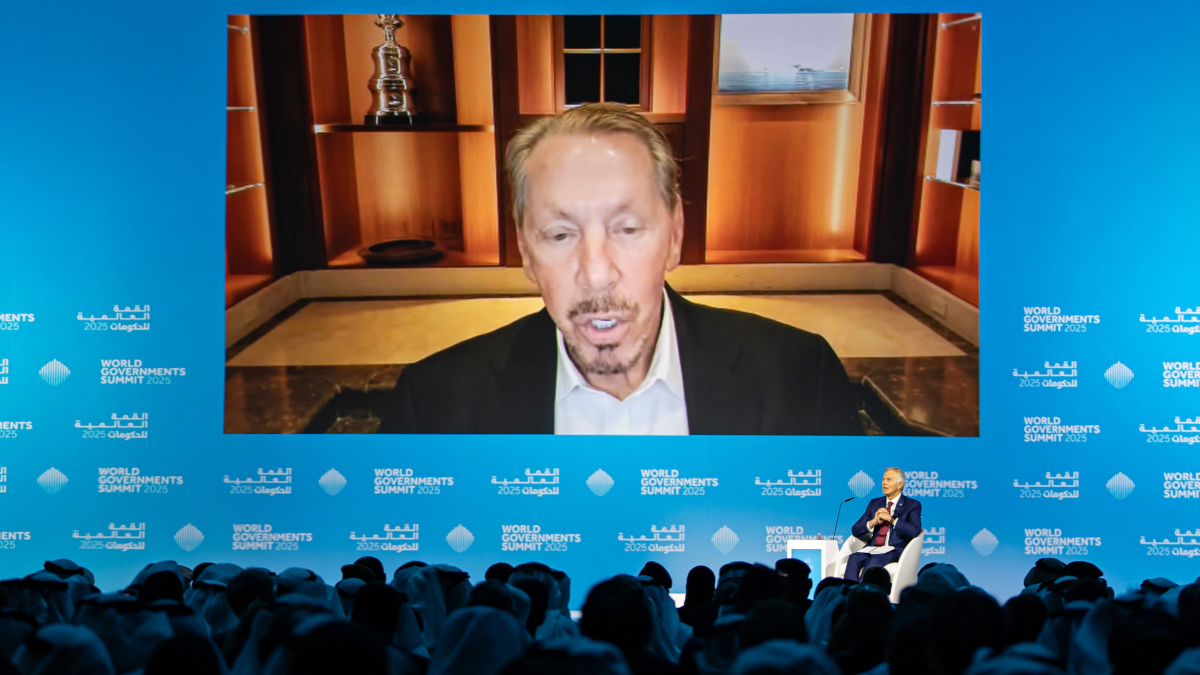
Larry Ellison, executive chairman of Oracle Corp., via video link, and Tony Blair, former UK prime minister, at the World Governments Summit in Dubai, United Arab Emirates, on Wednesday, Feb. 12, 2025. Photographer: Christopher Pike/Bloomberg via Getty Images
"Revolution" has become the favorite word of the people selling us AI. That should make us suspicious. The revolutions we celebrate, historically, were typically led by people, not inflicted on them.
Take, for instance, former UK Prime Minister Tony Blair. On May 26, the former Labour Party leader published an essay criticizing the UK Government. The essay laid out a new policy agenda and ten point plan. The plan includes measures such as rolling back on net zero goals on greenhouse gas emissions, removing regulatory barriers to business, reducing spend on disability benefits in favor of more on defense spending, doing “whatever it takes” action on immigration, and lower taxation.
The rationale for these measures, which do not seem in line with Blair’s Labour party history, is that the UK is contending with two epochal changes. The first is the rise in geopolitical power of China, and the second is:
…the technology revolution led by developments in artificial intelligence, which will change everything. I mean everything. There is no point in debating whether this technological revolution is a good or bad thing. Just know it is a ‘thing’. In fact, it is ‘the thing’.
Of Blair’s ten points, number nine is:
Most important of all, reorganizing the whole of government around the harnessing of the 21st-century technological revolution.
Throughout the essay, the words ‘revolution’ or ‘revolutionize’ are mentioned at least seven times.
On May 27, Blair discussed the essay in interviews on influential platforms. In one interview on The News Agents, he uses the phrase “AI revolution” three times. On the Today program, he mentions AI or technology revolution or uses the word ‘revolutionary’ nine times.
Blair doesn't frame his agenda around inequality, cost of living, social justice or the public good. Instead, his narrative suggests subservience and acquiescence to the US and to its technology. He describes a world we must embrace which includes robots taking jobs, existential risk, and AI solving climate change.
We’ve heard this before, especially from executives whose wealth and power are directly connected to how many people are using the technology they develop. This is the first time, though, that an ex-prime minister has discussed a specific technology in such excitable, repetitive, hyperbolic terms. It’s worth noting that Blair’s think tank, The Tony Blair Institute for Global Change, received £250 million from Oracle founder Larry Ellison, the largest amount of money ever received by a UK think tank. Oracle is a US technology company that is currently building data centers seen as necessary for AI’s expansion.
According to the Cambridge Online Dictionary, in everyday parlance the word revolution can mean “a very important change in the way that people do things.” But from a political point of view, its first definition reads: “a change in the way a country is governed, usually to a different political system and often using violence or war.”
Historically, revolutions are seen as movements led by people that drive progressive social change. Accepting Blair’s revolution requires agreeing that using unconsented data harvested from populations, processed through biased algorithms and presented to people in addictive interfaces that overwhelmingly generate wealth to US elites, is the change that people want. Or that the “AI revolution” is inevitable and must not be questioned—which seems an inherently anti-democratic stance.
Blair is not the only elite pushing the AI revolution. At a graduation ceremony at the University of Arizona, students booed former Google CEO Eric Schmidt’s explicit demand that they ‘get on the rocket ship.’ At the University of Central Florida, students booed a real estate investor who expected them to be excited for the “next industrial revolution” despite the fact that their experience of the AI age is growing power imbalances, rapid climate change and job insecurity.
Elsewhere, other forms of AI resistance and data center protests also show that people are starting to see through this constructed narrative. The ‘AI revolution’ is not a revolution of the people, and it is important to ask why this choice of language is so common among the technology’s boosters, as well as what lies behind it.
From revolution made by the people to people manipulated by revolution
While in any historical revolution the machinery may have mattered, it never revolted on its own. Revolution, where it happened, was made socially and politically—through conflict, choices, and struggle.
As revolutions become celebrated in history schoolbooks and thus canonized generationally, it feels awkward to go against them. The mobile meaning of the term ‘revolution’ becomes stabilized at the position of the dominant authority. The term becomes convenient in another way: it can sound political while being anti-political. It suggests transformation without naming winners and losers.
That’s one reason the word gets used so aggressively: who would want to slow an announced revolution, especially one promised alongside more hospitals, safety, and national renewal? If we’re in a revolution, then hesitation becomes backwardness, critique becomes denialism, and regulation becomes sabotage.
Politicians often want the thrill of rupture (“everything must change”) paired with the comfort of recurrence (“nothing fundamental needs to be contested”). A revolution that doesn’t disturb the existing settlement asks for applause, not participation. Belgian social theorist Raoul Vaneigem forewarned us in 1963:
“Revolutionary” ideology is theory which has been recuperated by the authorities. Words exist as the frontier between the will to live and its repression; the way they are employed determines their meaning; history controls the way in which they are employed. [...] Revolution is made everyday despite, and in opposition to, the specialists of revolution. This revolution is nameless, like everything springing from lived experience.
The political abuse of the term revolution is semantic manipulation; it is narrative infrastructure. “AI revolution” frames the current developments as destiny rather than as a set of contestable choices about data, labor, energy, surveillance, and governance.
The ‘revolution’ that wants no revolutionaries
In the 2010s, political revolts and digital media were genuinely entangled and contested through events such as the Arab Spring, Euromaidan, Occupy Wall Street, and Indymedia. Whatever one thinks of their outcomes, the technologies were part of collective organization and street-level coordination.
By contrast, the proposed “AI revolution” arrives as a package of procurement decisions, product integrations, automated triage, productivity dashboards, surveillance upgrades. In that sense, it lacks the ambiguous, insurgent edge that the previous “information revolution” sometimes carried. Those who are revolting are not, in general, using AI to revolt. AI is more likely to be used against revolt through facial recognition, predictive policing, border targeting, autonomous weapons and workplace discipline.
So when politicians praise “AI revolution,” we should ask: revolution for whom? Revolution done by whom? Revolution to whom?
‘Revolution’ as a way to avoid politics—and “politics” as a way to avoid revolution
In 2020, Iranian-American activist Hoda Katebi used the term “revolution-washing” to describe how big fast-fashion brands appropriate cultural and political revolution insignia for marketing purposes. Given that washing machines also involve lots of spinning, there’s a cyclical pattern worth naming, as illustrated in this image:
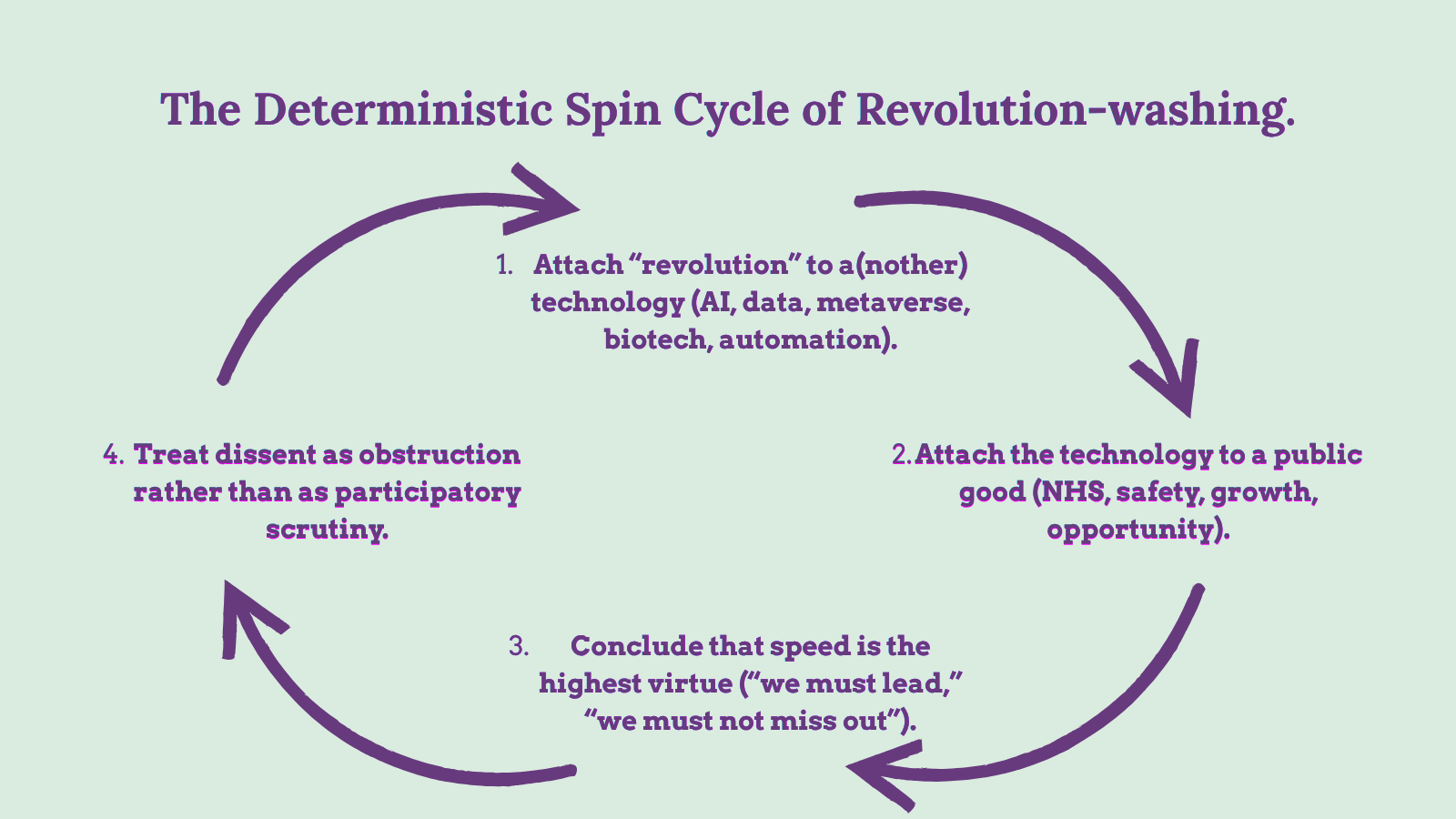
Image by Vassilis Galanos
- Attach “revolution” to a(nother) technology (AI, data, metaverse, biotech, cryptocurrency, automation).
- Attach the technology to a public good (NHS, safety, growth, opportunity).
- Conclude that speed is the highest virtue (“we must lead,” “we must not miss out”).
- Treat dissent as obstruction rather than as participatory scrutiny. Repeat.
Once this pattern is in place, “revolution” becomes a solvent that dissolves the normal requirements of governance. Procurement becomes destiny. Regulation becomes “red tape.” Social consent becomes assumed. Until the next technological revolution, following the path of technological determinism, is rhetorically announced.
And, crucially, responsibility gets blurred. If this revolution is something happening to us, then nobody is accountable for deciding how it happens.
Can the word ‘revolution’ mean something again?
If a politician says “AI revolution,” we can ask for specifics that match the historical weight of the term:
- What institutions will change, and whose decision is it?
- What values are being revised “far below the surface of social life”?
- What counts as success besides adoption and scale?
- What happens to those who refuse—patients, workers, citizens? Do they count as revolutionaries or counter-revolutionaries?
- Where are the material inputs of the “revolution”: data centers, energy, minerals, labor? What happens if these workers revolt?
- Who bears the errors, the bias, the automation of austerity and the austerity of automation?
- What role do hype-driven narratives of inevitability play in removing democratic agency?
If today’s leaders are swayed by the rhetoric and grandeur of “revolution,” they should be prepared for the politics that come with it: contestation, accountability, and the possibility that the public might choose a different path.
Authors