The World Is Already Resisting AI. Now, There is a List to Prove It.
Petra Molnar / May 21, 2026Petra Molnar is a fellow at Tech Policy Press.
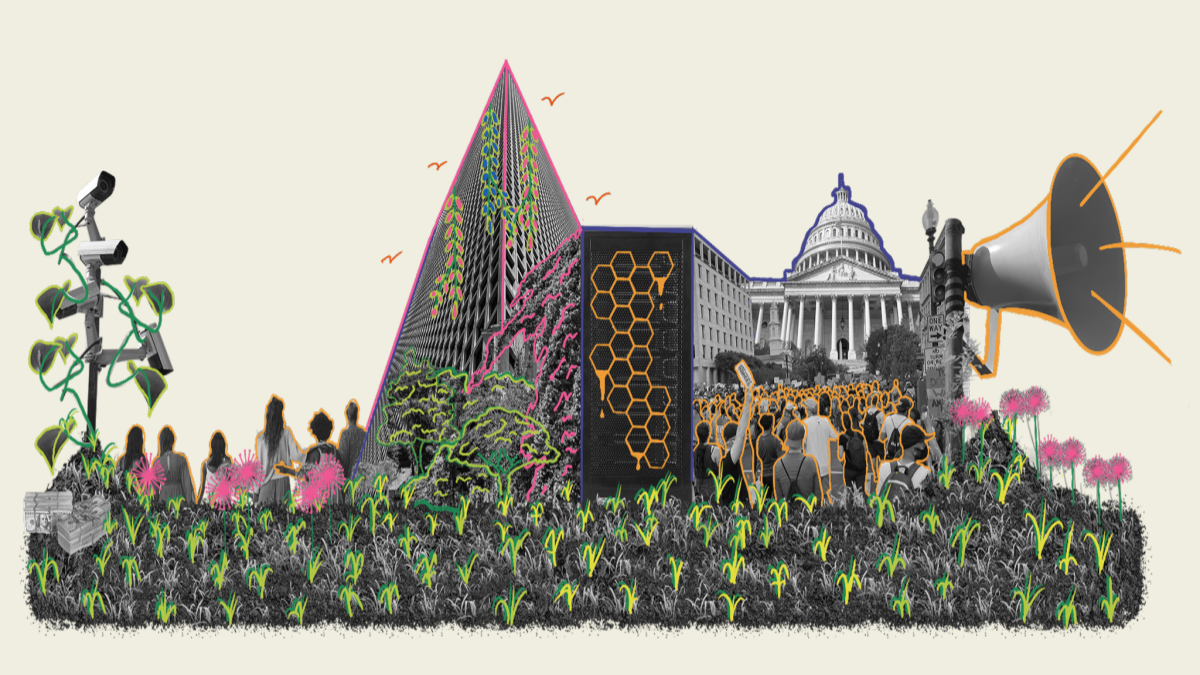
Image created by DAIR for the AI Resist List. Used with permission.
"Any deceleration of AI will cost lives," wrote venture capitalist Marc Andreessen in his 2023 Techno-Optimist Manifesto, framing resistance not merely as futile, but as murder. Two years later, Sam Altman, CEO of OpenAI, declared the arrival of artificial general intelligence not as a question but as a certainty, describing AI as "the next step in a long unfolding exponential curve of technological progress." Later that year, Jensen Huang, Founder and CEO of NVIDIA, was predicting that OpenAI would become "the world's next multitrillion-dollar hyperscale company," brushing aside concerns about overreach as the complaints of people simply missing the bigger picture. These messages, repeated across boardrooms, keynotes, and manifestos, have been consistent: AI is happening, AI cannot be stopped, and anyone who thinks otherwise is naive at best and dangerous at worst.
Journalist Karen Hao has spent years pushing back against that frame. Covering the social impacts of artificial intelligence, Hao has documented how the rhetoric of inevitability functions as a political choice, one that forecloses debate, concentrates power, and insulates a small number of corporations from accountability.
Challenging this inevitability is the animating premise behind the AI Resist List, which launched yesterday as a collaboratively built, publicly accessible database documenting acts of resistance to the AI industry from across the world. The project — which spans legal challenges, worker organizing, community campaigns, artistic interventions, and technical tools — was built by a team of researchers, journalists, and critical scholars working across seven time zones and supported by the Distributed AI Research Institute (DAIR), We and AI, and our Refugee Law Lab at York University.
The core claim of the AI Resist List project is simple: the "scale at all costs" approach to AI development is not inevitable. People are already resisting it –in ways that are creative, consequential, and still almost entirely invisible in mainstream coverage of the technology.
A participatory map, built from the ground up
The AI Resist List did not begin in a boardroom or at a research center. Its initial scoping was carried out by two fellows from the Migration and Technology Monitor: Wael Qarssifi, a journalist from Syria, who has reported on the human impacts of surveillance from his home country but also in Malaysia, and now the EU, and Verónica Martínez, a reporter and photojournalist based in Ciudad Juárez and El Paso, whose work has documented the effects of surveillance and militarization along the US-Mexico border. Both brought not just language skills (Arabic and Spanish) and regional networks, but also situated knowledge, an understanding of what resistance looks like in communities that are routinely surveilled, constrained, and spoken about rather than listened to.
The choice to have two colleagues with lived experience of migration and borders take ownership over the initial mapping for the project was deliberate. Too many efforts to document tech harms reproduce the very problem they aim to critique: knowledge extracted from affected communities, processed elsewhere, and returned in a form that those communities neither recognize nor control. The AI Resist List sought to work differently. Every initiative named on the list was contacted before publication. All descriptions were reviewed multiple times for accuracy and safety multiple times. No group was included without consent, with one exception: an individual who could not be reached, but whose details were extensively documented in a lawsuit.
The research also intentionally centered on the Majority World, where AI systems are frequently deployed with fewer regulatory safeguards and greater potential for harm, and where some of the most inventive and consequential forms of resistance are already underway. Of the entries tied to a specific region, nearly six in ten are from the Global Majority, a centering that reflects a broader methodological commitment. A map of resistance built primarily from the vantage point of Silicon Valley or Brussels would be a map of the wrong thing.
Four ways of pushing back
The list is organized around the Countering AI Inevitability Framework, four overlapping modes of resistance: Resisting, Refusing, Reclaiming, and Reimagining. The taxonomy matters because it expands what counts as resistance.
Some entries are immediately legible as resistance. For example, in New Mexico, the New Mexico Environmental Law Center filed suit on behalf of community members against the Doña Ana County Board of County Commissioners, challenging their approval of "Project Jupiter," a hyperscale data center planned near the southern border as part of OpenAI's Stargate Initiative. The community members alleged the county failed to comply with state public transparency laws and issued significant public financing for the project despite serious environmental and public health risks.
Thousands of miles south, in Uruguay, Movimiento por un Uruguay Sustentable mobilized a digital citizen campaign pushing for greater transparency around a proposed Google data center in Canelones. Organizers demanded information about the project’s impact on local air quality, the socioeconomic benefits it would provide beyond the 50 promised jobs, and the downstream consequences of its rare-earth supply chain on other communities.
In Japan, the Japan Metal, Manufacturing, Information and Telecommunication Workers' Union (JMITU) petitioned a Tokyo government labor commission to force IBM to disclose the AI data used to help determine wages. In the petition, accepted by the Tokyo Metropolitan Government Labor Relations Commission, the union wrote plainly: "Humans place too much faith in decisions taken by AI." The case was resolved through reconciliation, with agreements in JMITU's favor.
These are perhaps more recognizable forms of collective action. But the AI Resist List also documents subtler, creative, and unique modes of refusal.
For example, in Chile, some residents of Quilicura, a working-class municipality on the outskirts of Santiago, became a human chatbot for a day. Quili.ai, a website designed to resemble an AI interface, instead routed user queries to community members who responded in real time. Over 12 hours, collaborating with local artists, they answered 25,000 prompts from users in 68 countries. The point was not to prove humans could outperform AI. It was to get people to pause long enough to ask what they were actually giving up, and for whose benefit, by outsourcing their queries to a system built on the exploitation of the Maipo River basin and communities like their own.
Labor exploitation at the center of the AI supply chain
If there is a single thread running most consistently through the list, it is labor. The AI industry's expansion is not only a story about data centers or foundation models. Rather, it is a story about whose labor makes those systems function.
In California, mental health professionals at Kaiser Permanente organized a five-day hunger strike over the healthcare providers’ “failure to address the needs of patients,” 24-hours of which were devoted to protesting the future role of AI in mental health care. The protests were part of an historic 6 ½-month work stoppage to secure a new contract. The mental health workers protested what they described as the transformation of healthcare into an assembly line: the replacement of clinical judgment with algorithmic triage, the pressure to see more patients in less time, and the gradual erosion of what it means to care for another person. Their union is also now advocating for California legislation that would prohibit AI systems from offering or advertising therapy services unless a licensed professional remains responsible for the care.
In the Philippines, several organizations representing digital workers formed the Coalition of Digital Employees – Artificial Intelligence (CODE AI) to push for worker representation in AI policymaking, document harms caused by AI adoption by outsourcing companies providing customer service and other back-office work, and hold employers accountable. In Nairobi, the Data Labelers Association, founded by data labelers themselves and now nearing 900 members, advocates for fair working conditions, transparent contracts, and recognition of the cognitive and emotional labor involved in training AI systems, while also providing mental health support for its members.
One particular initiative highlights the importance of psychosocial support. Kauna Ibrahim Malgwi, a former content moderator and licensed clinical psychologist, developed an intervention plan that combines psychotherapy, expressive arts, peer support, and community healing to provide sustainable mental health care for data workers who train AI systems. A pilot program is now underway to support 20 to 50 workers in Kenya, with the goal of building a scalable model for long-term structural care. Her work was developed out of her own experience and extensive interviews with content moderators, workers whose labor is indispensable to the AI industry, yet who remain largely absent from public discourse.
Finally, more than 1,000 Amazon employees signed an open letter to company leadership in 2025, warning that the company's aggressive AI push was undermining its climate commitments and helping to construct a more militarized surveillance state. Their three central demands were unambiguous: no AI with dirty energy, no AI without employee voices, and no AI for violence, surveillance, or deportation.
Resistance is also happening at the bottom of the AI supply chain, in the places where the materials that make AI physically possible are extracted. For example, Friends of the Congo worked alongside the Congolese communities confronting what they describe as centuries of environmental racism and resource extraction that is now accelerating as AI and other industries drive demand for cobalt, gold, copper, and coltan. The organization has worked with families seeking legal accountability from major tech companies over the deaths of children in cobalt mines, and has organized an annual Congo Week since 2008 to build global solidarity around what remains largely invisible in discussions of AI's costs.
The AI Resist List deliberately traces these connections, from the data center to the mine, from the annotation worker to the user of the finished product or service, because the industry's framing has largely succeeded in making those relationships abstract. AI, therefore, becomes something to marvel at rather than a system of power to critique: an inevitability that emerges from servers and from code, with supply chains treated as irrelevant and labor rendered invisible.
The narrative front of resistance to AI
To illuminate these connections and challenge the perceived inevitability of AI, resistance must be thought of as not only material, but also as linguistic and visual. For example, when Microsoft began aggressively integrating AI features across its products in 2025, users pushed back, calling it "Microslop." The term, a portmanteau mocking the low-quality AI-generated outputs flooding the company's products, went viral precisely when Microsoft banned it from its Copilot Discord server and subsequently shut the server down entirely. A dedicated website, www.microslop.com, now documents incidents of AI-generated content degrading user experience across the internet.
Similarly, Better Images of AI, a project coordinated by We and AI, is pursuing a more structural intervention by maintaining a free library of images that represent AI more accurately than the glowing robot brains and ominous blue orbs that dominate media coverage. The visual language surrounding AI shapes how people understand and feel about the technology before they read a single word of analysis.
Artist Sam Lavigne's Slow LLM approaches the problem similarly but through provocation rather than replacement. The browser plugin manipulates the code underlying AI chatbots to slow their response times to an almost comical crawl, prompting users to consider what, exactly, they are waiting for and why.
What resistance demands of tech policy
Taken together, the initiatives documented on the AI Resist List point toward a set of demands that no existing regulatory framework fully addresses, and that any serious agenda for AI governance would need to confront.
The first cross-cutting demand is transparency. Across the AI Resist List, from the New Mexico community challenging Project Jupiter to the JMITU union forcing IBM to open its wage-setting algorithms to scrutiny, the most basic demand is simply to know what is being built, by whom, with what resources, and at whose expense. Transparency is sometimes dismissed as a weak policy tool, a substitute for real accountability. However, even basic disclosure requirements, if consistently enforced, would fundamentally disrupt the industry's current operating model, which depends on opacity at every stage of the supply chain.
The second demand is participation. Amazon workers who demanded a seat at the table before their company's AI rollout, the Philippine coalition pushing for worker input in AI policymaking, the Uruguayan campaign demanding public comment, all point toward the same gap: Decisions about AI are being made too fast, in private, by a small number of powerful actors seeking to further enrich themselves, with no meaningful mechanism for those most affected to intervene. Policy responses committed to participation would require communities, workers, and affected people to have formal standing in decisions about AI development and deployment, not as perfunctory consultees, but as ultimate decision-makers.
The third cross-cutting implication concerns the supply chain. Friends of the Congo, Kauna Ibrahim Malgwi's mental health pilot for data workers in Kenya, and the Data Labelers Association in Nairobi demonstrate that the costs of AI are systematically exported to the communities least able to bear them and least represented in the rooms where AI policy is being made. Any governance framework that does not extend its scope to include mining communities in the DRC, content moderators in East Africa, and annotation workers in Southeast Asia is not governing AI. It is governing a carefully curated and lucrative industrial complex.
The fourth, and perhaps most structurally significant, insistence that unifies various examples in the AI Resist List is the question of who controls AI infrastructure. The campaigns against data centers in New Mexico and Uruguay are not simply local environmental disputes. They are early battles in a larger contest over whether the physical infrastructure of AI, including the land, water, and energy necessary to sustain the AI industry, will be treated as a public resource or a private asset. The communities pushing back are raising questions that no national AI strategy has yet answered adequately: Who authorizes this infrastructure? Under what environmental and democratic conditions? And what recourse do affected communities have when those conditions are not met?
The AI Resist List does not argue that resistance always succeeds, or that it will be sufficient to correct the vast power differentials created by the companies shaping AI development. Rather, it documents legal action, worker organizing, grassroots campaigns, artistic provocation, technical tools, coalition building, and the patient work of documenting harms that would otherwise go unrecorded. Its examples come from Germany, Japan, Kenya, Chile, the Philippines, the United Kingdom, Uruguay, the Democratic Republic of Congo, and the United States. Some involve large organizations, while others are a single individual.
Together, they constitute something the AI industry would prefer not to acknowledge – that AI is neither an unstoppable force nor beyond democratic contestation, and that people across every continent are willing to challenge its supposed inevitability.
Authors