Trump and Big Tech’s PR Campaign for Data Centers is Too Little, Too Late
Jenna Ruddock / Mar 9, 2026Jenna Ruddock is advocacy director at Free Press and Free Press Action.
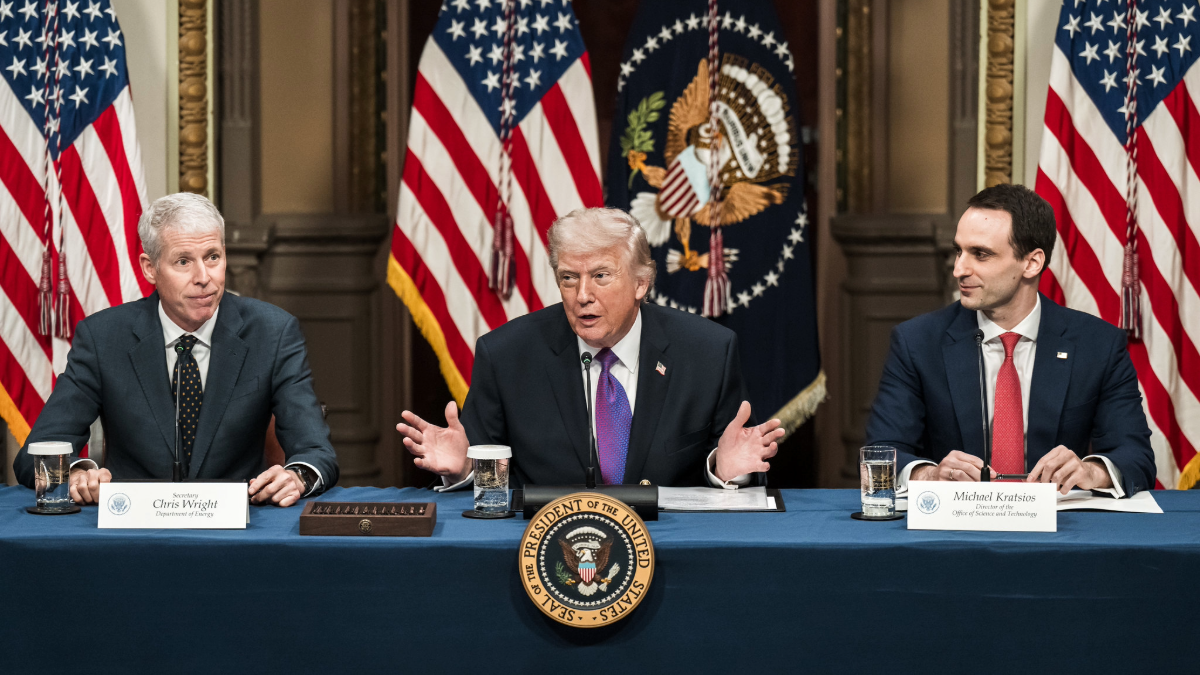
President Donald Trump participates in a Ratepayer Protection Pledge roundtable, Wednesday, March 4, 2026, in the Indian Treaty Room of the Eisenhower Executive Office Building at the White House. (Official White House photo by Cashen Turner)
Last Wednesday, leading US tech companies gathered at the White House to sign a nonbinding, unenforceable pledge to offset the costs of their increasingly power-hungry data centers. Executives from Amazon, Google, OpenAI, Meta, Microsoft, Oracle and xAI made the trip to Washington D.C. as their companies’ gargantuan infrastructure projects face bipartisan backlash from coast to coast.
The pledge marks a significant shift in the political headwinds surrounding the tech industry’s AI hype-fueled race to build hyperscale data centers – and the energy infrastructure needed to power them. Last month, President Donald Trump’s Energy Secretary, Chris Wright, denied any connection between data center energy demand and higher utility bills. Just six months ago, the Trump administration was trumpeting its executive order to speed up data center construction and permitting.
Since Trump announced the “ratepayer protection pledge” during his State of the Union address, experts have been quick to point out the technical, logistical, and legal hurdles to the plan – which was already thin on details. The White House has limited influence over utilities regulation, which largely plays out at the state and local levels. Data centers are being built faster than new energy infrastructure can be brought online, pushing companies to make head-turning deals like Microsoft’s bid to reopen Three Mile Island. And tech isn’t the only big money donor industry at play, as fossil fuel giants, monopoly utilities and, increasingly, private equity firms like Blackstone look to shape this infrastructural build-out to line their own pockets.
Ultimately, the pledge masks the reality of what’s possible if the ongoing data center construction frenzy is allowed to continue at its current pace, something neither the Trump administration nor key industry players are willing to negotiate. As communities across the United States are fighting to slow and even stop that relentless pace, the same companies that trooped to the White House this week with a promise to do better are fighting back at every step.
Data centers aren’t even close to covering their costs
Making companies cover the costs of their still-accelerating data center building frenzy is not a new idea.
A growing number of states, led by Indiana and Ohio, have successfully implemented large load tariffs in an effort to ensure ratepayers aren’t shouldering the costs of energy infrastructure built primarily to serve speculative data center demand – particularly if tech companies suddenly find themselves unable to justify the trillions of dollars they’ve earmarked for this infrastructure, spending that is increasingly supplemented by debt.
Other states are still struggling to make progress. Last week in Georgia, legislators failed to move a bill aiming to make data centers pay for the energy infrastructure built to meet their demands amidst opposition from Georgia Power and the data center industry. A similar legislative push ended in Washington “amid a barrage of industry opposition.”
And if tech companies driving the data center construction boom were truly committed to paying their own way, rising electricity prices would only be the beginning of the conversation.
“There’s the increase in the costs of electricity, but there’s also all of the public subsidies that are going towards these data centers and will also go towards these gas plants,” notes Jackson Voss, Government Affairs and Policy Coordinator at the Louisiana-based consumer protection group Alliance for Affordable Energy.
According to research by Good Jobs First, data centers are now one of the most subsidized industries in the US. From industrial tax credits to sales tax credits, the data center industry benefits from billions of dollars in tax subsidies – often just in a single state. Georgia alone stands to lose $2.5 billion to data centers’ sales tax exemptions this fiscal year as the state becomes a hot spot for AI infrastructure construction. “If the money is there for the [energy infrastructure] build out, then the money should be there to pay for all of this,” says Connie Di Cicco, Legislative Director for Georgia Conservation Voters. “You shouldn’t need the tax incentives. You should also be paying your full share of all of your taxes.”
Because data centers are not major long term job creators, Voss points out, “by the time it’s all said and done, there’s also not going to be much in the way of income taxes.” That’s even without accounting for corporate executives’ – including tech billionaires’ – appetite for layoffs they can attribute to advances in AI.
Virginia is currently considering a budget that would end the sales tax exemption for data centers, a subsidy that cost the state $1.6 billion last year – a move reportedly opposed by the Data Center Coalition, an industry lobbying group whose members include every company present at the White House pledge-signing ceremony except xAI.
Utility bills are also far from the only issue driving resistance to hyperscale data center projects across the country. They’re not even the only concern related to tech companies’ exploding demands for more energy.
Overwhelmingly, the energy infrastructure powering the tech industry’s rapid build-out of power-hungry data centers is dirty. Coal-fired power plants slated for retirement are being kept online to power new data center infrastructure – just south of Washington D.C., the Bitcoin mining company TeraWulf is looking to “repower” two already-retired coal plants. Gas-fueled power plants represent the largest single source of new energy generation for data centers in the US, as data centers helped to triple demand for gas-fired power over the past two years. On-site diesel generators emit carcinogenic pollutants with no safe level of exposure into nearby neighborhoods.
“What’s really happening with BYOG, Bring Your Own Generation, is gas turbines that sound like jet engines when you live next to them. You can see the gas emissions coming up off the ground,” says Elena Schlossberg, Executive Director of the Coalition to Protect Prince William County. Schlossberg lives in northern Virginia, home to the largest concentration of hyperscale data centers in the world. “What’s happening is gas turbines and diesel generators – and there are thousands of them, up to 10,000 in just northern Virginia. This idea that data centers are going to BYOG is going to destroy communities.”
New research indicates that the public health costs of emissions from just one data center campus in northern Virginia could be close to $100 million per year, largely due to respiratory and cardiovascular disease and premature deaths.
Elon Musk’s xAI, which signed onto Trump’s pledge, has used unpermitted gas turbines to power its massive data centers in South Memphis, Tennessee – releasing chemicals like formaldehyde and other carcinogenic pollution into neighborhoods already suffering the fatal impacts of industrial pollution.
Research from UC Riverside and Cal Tech estimates that across the US, public health costs related to air pollution from data centers’ energy infrastructure has surpassed $5.5 billion over the last five years.
“The scale at which we are talking about this demand is beyond irresponsible for anyone to think we’re going to create this kind of generation,” adds Schlossberg.
The real deals are still being made behind closed doors
While tech leaders make a public show of nonbinding commitments at the White House, in communities across the US their companies are still making deals behind closed doors – signing NDAs with local officials and lobbying behind the scenes in statehouses.
For years, tech companies have pushed back against even basic transparency surrounding their data centers’ resource consumption. Energy and water consumption figures are often categorized as “proprietary information” or “trade secrets” by companies like Google and Microsoft, with local officials prohibited from disclosing the information due to nondisclosure agreements.
“How much energy are we actually talking about? How much water are we actually talking about? You won’t even disclose these simple facts before you come to the community,” says Di Cicco. “But now you want us to trust you. ‘Trust us, it’s not going to come to ratepayers’ – okay, but I can’t even get simple details from you.”
In Louisiana, Meta is building one of the world’s largest data centers – a facility that could consume more energy than the entire city of New Orleans during peak summer demand. This would require Entergy, Louisiana’s largest electric utility, to build more than $3 billion in new energy infrastructure, including three new gas-powered plants. Meta has already failed to disclose key details about the project’s financing scheme. Groups like the Alliance for Affordable Energy have been fighting to make the details of deals like this public before regulators sign off, in order to ensure costs won’t be passed onto ratepayers.
“It’s really hard to imagine, just based on the places these deals are being made, the secretive nature of these deals, and the actual regulatory process that there’s any way at all that these Silicon Valley companies really are committed to paying all their costs when it comes to data centers,” says Voss.
With midterm elections looming, it’s increasingly clear that data centers will be a central issue in campaigns across the country – one that unites voters across geographies and across party lines. It already made headlines during critical special elections in New Jersey, Virginia, and Georgia late last year.
The industry’s push to rebrand its rapidly degrading public image was already well underway when Trump stepped in with his State of the Union pledge, with Meta running national television campaigns while local developers turned to Facebook ads. Late last year, Amazon commissioned research arguing that its data centers are actually subsidizing residential energy costs. In January, Microsoft issued its own voluntary commitment regarding its data centers’ water and energy consumption.
But an ad campaign won’t change what a growing number of voters are seeing happen in their own backyards, or in the next county or parish over. “We are subsidizing this unprecedented power demand among all of us while they get to privatize all their profits,” says Schlossberg.
“If they could figure out a different way, don’t you think they’d be doing it here?”
Authors