What Europe’s Digital Markets Act Has Delivered So Far and What Comes Next
Mark Dempsey, Maria Luisa Stasi / Dec 10, 2025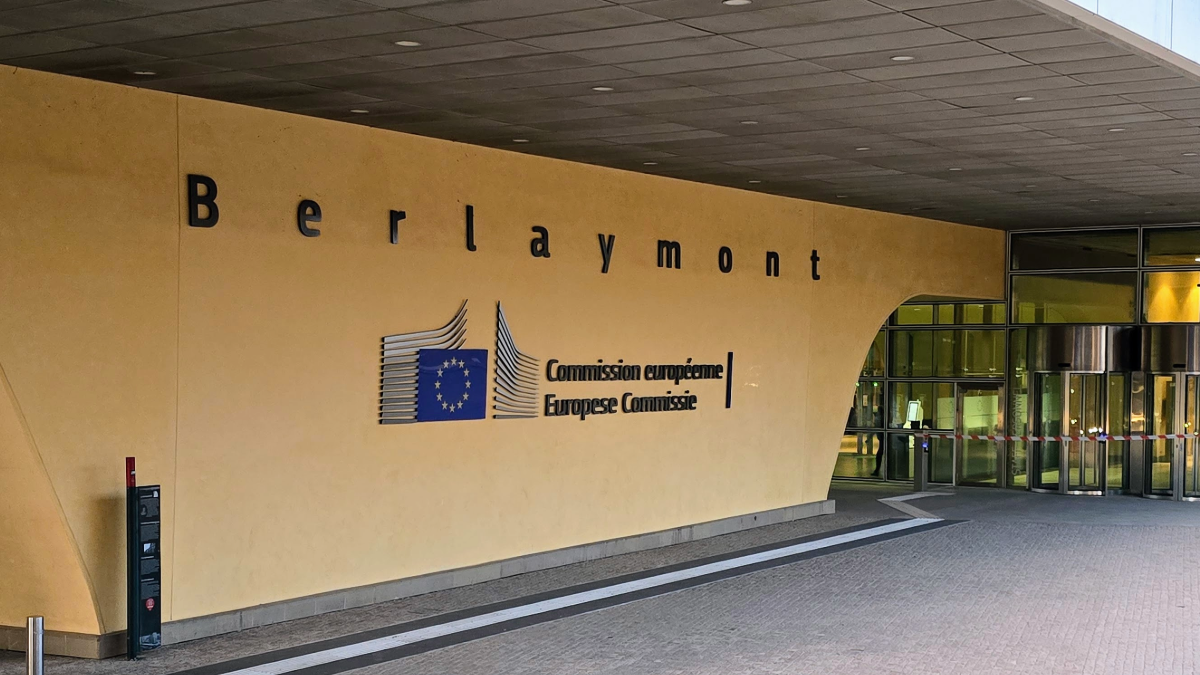
The headquarters of the European Commission in Brussels. Justin Hendrix/Tech Policy Press
This is the first in a series of provocations to be published in Tech Policy Press following the third iteration of a Digital Markets Act (DMA) enforcement symposium hosted in Brussels on November 20 and 21 by the free-speech organization ARTICLE 19 in partnership with the Center for Digital Governance at the Hertie School, the University of Trento, the Amsterdam Center for European Law and Governance and the University of Namur.
The idea for the two-day event stemmed from the recognition that the European Commission lacked a structured bridge to the research community in a setting which was inclusive, constructive and free from the usual public affairs firms and constant presence of Big Tech lobbyists. It also stems from the strong belief that scholars have a key role to play to help assess the deeper layers of the DMA, interpreting its provisions, testing their potential, both in themselves and in relation to other fields of EU law, and in creating evidence-based grounds for enforcers’ informed decision-making.
Enforcement ‘lay of the land’
Gatekeepers designated by the Commission under the DMA—22 in total, including online search engines, social networks, and operating systems—have been required to comply with all relevant obligations since March 2024. The Commission has been active in 2025 with select enforcement actions, including a €500 million fine against Apple for violation of anti-steering provisions that restrict developers from informing users about alternative purchasing options outside the App Store; a €200 million fine against Meta related to non-compliance with Article 5(2) of the DMA and not giving users genuine choice and, more recently announcements by the Commission to investigate Google for potential breach of the rules by demoting media publishers’ content in search results. The Commission has also started to assess whether Microsoft and Amazon should be designated as gatekeepers for their cloud computing services.
Moreover, last summer the Commission opened a public consultation to gather stakeholders’ feedback and suggestions on the DMA’s first review, aimed to sense-check the framework’s effectiveness so far towards ensuring contestable and fair digital markets, as well as its fitness for future challenges. Among others, the Commission specifically sought feedback on whether and how the DMA can effectively support a contestable and fair AI sector in the EU.
Yet, the DMA enforcement is hardly a downhill walk. The regulatory dialogue is slow, malicious compliance is a real issue, and asymmetry of information continues to be an obstacle difficult to overcome due, among others, to the fear of retaliation across businesses whose economic activities are intrinsically linked to those of the gatekeepers. What is more, the narrative around compliance, as well as the DMA goals and achievements, remains fundamentally captured by a few stakeholders, and appears far from giving fair credit to this potentially extremely powerful regulatory framework.
All these factors and more were considered at ARTICLE 19’s two-day event in the context of a competitive call for papers, where scholars were asked to assess the DMA in terms of its impact so far and propose next steps the Commission might consider. Some enforcement challenges and proposed solutions will be addressed in a series of articles for this publication over the next weeks:
- Todd Davies from University College London will explain how technological expertise can and should be integrated into DMA enforcement.
- Lucas Lasota, Jithendra Palepu, and Dario Presutti from the Free Software Foundation Europe (FSFE) will explore interoperability and free software, interrogating not only this year’s enforcement with regards to Google but also last year’s research on Apple.
- Kati Cseres from the University of Amsterdam’s Center for European Law and Governance will explore the legal transplanting of the DMA beyond the EU.
- Technologist Eliot Bendinelli will follow with some views on enforcement of the DMA’s data portability obligation so far.
- Lastly, Kalpana Tyagi from Maastricht University will elaborate on the interplay between cloud, the Data Act and the DMA and how generative AI might be considered and regulated at this relatively early stage.
The DMA enforcement is evolving, and enforcers are deploying this comprehensive toolkit to achieve effective compliance, notwithstanding a harsh imbalance of resources when compared to gatekeepers, and in an environment of unprecedented political pressure. The wide variety of research topics discussed during the symposium reflects the slowly but steadily growing body of enforcement materials available after the first year and a half of the rules’ application. Gaps will continue to emerge, both in research and enforcement, which we, together with academia and fellow civil society organizations, are committed to further exploring in the years ahead.
Other posts in this series:
- Who are Tech Experts and What Can They Bring to Competition Enforcement? — Todd Davies
- Can the Digital Markets Act Free Users' Data in the AI Age? — Eliot Bendinelli
- Making the Digital Markets Act Developer-Friendly — Lucas Lasota, Dario Presutti, Jithendra Palepu.
- Can Europe’s Digital Markets Act and Data Act Rein in Cloud Hyperscalers? — Kalpana Tyagi.
Read other aticles in this series
Authors