Why Documenting ICE’s Violent Raids is Only Half the Accountability Battle
Chris Mills Rodrigo / Jan 21, 2026Chris Mills Rodrigo is a fellow at Tech Policy Press.
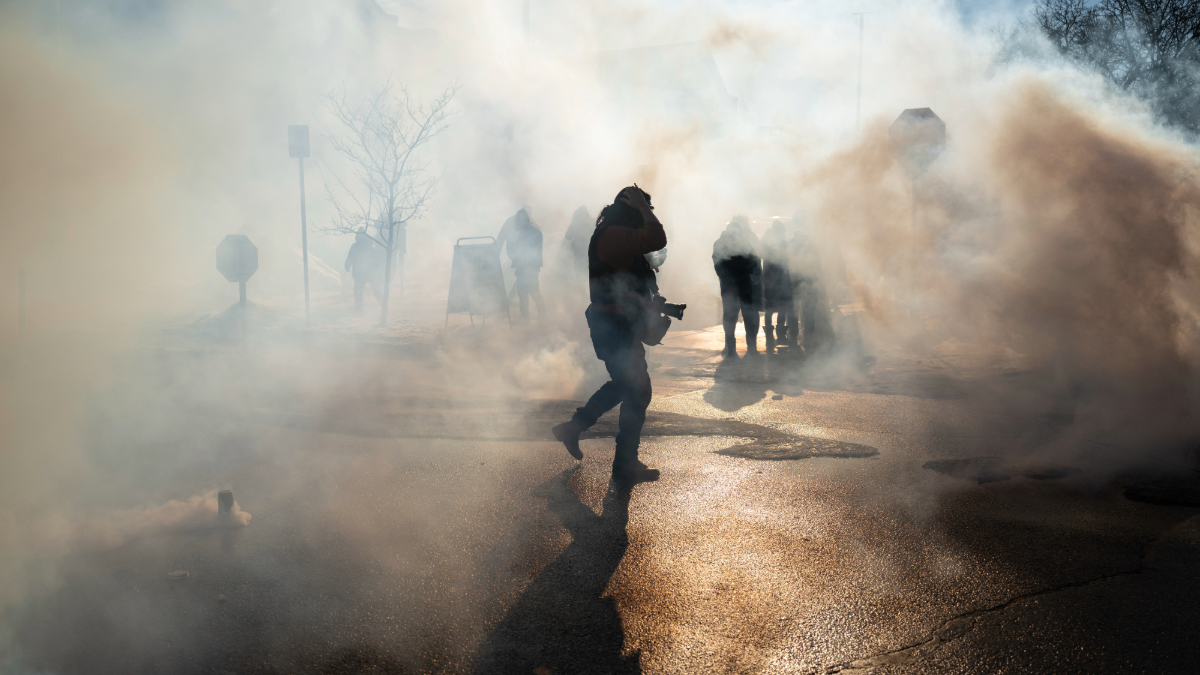
Onlookers and demonstrators walk through tear gas after confronting federal law enforcement agents during a raid in south Minneapolis, Minnesota, US, on Tuesday, Jan. 13, 2026. Photographer: Victor J. Blue/Bloomberg via Getty Images
One of the defining features of President Donald Trump’s second term has been its forceful and sweeping immigration raids.
Videos of Immigrations and Customs Enforcement (ICE) operations in workplaces and neighborhoods, often documented in real-time by bystanders or protesters and shared online, have sparked mass indignation and ushered in a reckoning over federal authorities’ aggressive tactics.
Clips of confrontations between protesters and ICE agents executing sweeps in Los Angeles helped precipitate massive demonstrations in June. And this month, videos of an officer fatally shooting Minnesota resident Renee Good spread rapidly online and ignited nationwide rallies and vigils calling for the abolition of ICE.
But gathering video of any activities by ICE or other federal authorities, let alone potential abuses, can be dangerous. There have been several reported cases of officers using force on bystanders taking photos and videos of their activities, including pulling weapons on observers and pushing down journalists.
In response, several initiatives — both private and governmental — have launched in the past year seeking to collect and catalogue potential infringement by federal authorities and, in some cases, to use that information to hold ICE legally accountable.
This kind of digital archiving work is not new abroad, especially in the context of global war crime documentation, but has not been as common a feature of US politics — until now.
But like those efforts, merely tracking and drawing attention to potential abuses may not deliver the changes sought by watchdog groups — with legal and logistic issues posing major hurdles.
When legality does not guarantee safety
The Trump administration appears not only to understand the importance of controlling what videos and images come out about its immigration operations but place a premium on shaping that information flow. The Department of Homeland Security, where ICE is housed, has released slickly produced videos celebrating forced deportations and misleading compilations purporting to show chaos in cities targeted by the administration that include clips from entirely different places.
At the same time, US officials have tried to dissuade the public from filming ICE agents themselves.
During a July press briefing, DHS Secretary Kristi Noem claimed that “violence” against ICE officers includes “videotaping them where they're at when they're out on operations,” as well as “encouraging other people to come and to throw things” at them or “doxing” them. DHS Public Affairs officer Tricia McLaughlin later told the Center for Media and Democracy that “videotaping ICE law enforcement and posting photos and videos of them online is doxing our agents,” and “we will prosecute those who illegally harass ICE agents to the fullest extent of the law.”
DHS did not respond to a request for comment on this story.
Despite those threats, experts on free speech stress that people have the right to film ICE — and any other law enforcement officers — exercising official duties as long as they do not obstruct their operations.
“The First Amendment protects the right to record law enforcement carrying out their public duties,” said Byul Yoon, Skadden Fellow at the American Civil Liberties Union’s Speech, Privacy and Technology Project. “Every Circuit [Court] that has looked at this question has found that the First Amendment protects the right to record law enforcement in public.”
That has not stopped ICE agents from physically confronting or intimidating individuals seeking to exercise their right to document enforcement operations.
In Charlotte, federal immigration officers followed Miguel Angel Garcia Martinez down a road for two miles and made plans to “smash” into him after seeing him taking photos of them, according to the Charlotte Observer. The 24-year-old US citizen had been taking photos of a November raid in the area and sharing them via an Instagram chat to alert potential targets.
In Los Angeles, agents wrestled 37-year-old graduate student Job Garcia to the ground, pressed their hands into his neck and detained him after he filmed them during a June raid at a Home Depot.
ICE agents have also allegedly gone after journalists documenting their operations.
A lawsuit against DHS filed by the LA Press Club, NewsGuild-Communications Workers of America and targeted individuals alleged that ICE agents assaulted and seriously injured journalists, legal observers and protesters during massive raids in June. A federal district judge agreed and granted a preliminary injunction in the case barring the DHS from dispersing, assaulting or using weapons against press or legal observers. The DOJ recently asked the Ninth Circuit court to vacate that injunction.
In another high-profile incident, ICE agents were filmed pushing journalists to the ground at New York City immigration court, resulting in one hospitalization. That came just days after an ICE officer was put on leave for pushing down a woman in the same building.
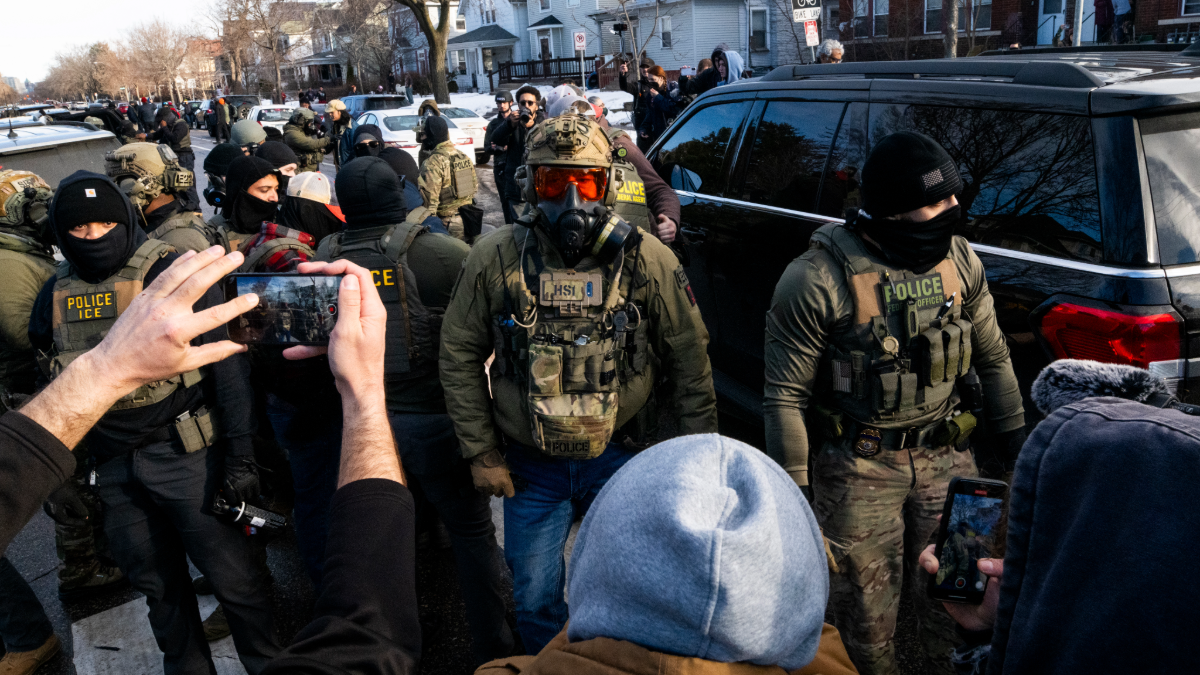
Federal agents are confronted by community members after they arrested two people from a residence on January 13, 2026 in Minneapolis, Minnesota. (Photo by Stephen Maturen/Getty Images)
The full extent of ICE retaliation against filming is unknown, prompting the ACLU to file a Freedom of Information Act request in November for DHS records concerning people who record or livestream ICE activities.
Governments and community groups join the cataloguing fray
Videos from bystanders have played a critical role in shining a light on ICE’s aggressive tactics, just like they have been in the past for exposing instances of police violence.
Winning over people in the court of public opinion may not be enough, though. Although videos have served to scrutinize or counter the administration’s telling of events and sparked protests in response, there is sparse evidence of watchdogs utilizing them to secure victories in court.
In response, Democratic state officials have stepped up efforts to catalogue incidents through official channels and potentially use footage of incidents to pursue legal action, largely in response to high-profile enforcement operations in their areas.
In Chicago, former Mayor Lori Lightfoot (D) and a group of attorneys announced the creation of a nonprofit that would serve as a “centralized archive of all the purported criminal actions of ICE and [Customs and Border Protection] agents,” shortly after a series of ICE raids in the city dubbed "Operation Midway Blitz" in September. The ICE Accountability Project formally launched this month.
Illinois Governor JB Pritzker (D) separately signed an executive order to create an independent board tasked with “capturing and creating a public record” and “recommending actions to hold the federal government accountable.” The raids in Chicago also prompted a collective of newsrooms and nonprofits to collaborate on collecting videos of ICE in response to calls for “transparency and accountability.”
Following October raids on street vendors on Canal St. in New York City, state Attorney General Letitia James (D) launched a portal for residents to send in photos and videos of potential violations by federal officers.
Just last week in Minnesota, Gov. Tim Walz (D) encouraged people to film ICE to “establish a record of exactly what's happening in our communities.”
“You have an absolute right to peacefully film ICE agents as they conduct these activities,” Walz said. “So carry your phone with you at all times and if you see these ICE agents in your neighborhood, take out that phone and hit record. Help us create a database of the atrocities against Minnesotans, not just to establish a record for posterity, but to bank evidence for future prosecution."
Similar initiatives have popped up on a smaller scale — for example, two Washington, DC, community groups came together in September to solicit videos of law enforcement misconduct more broadly.
“For both reporting out what's happening in different communities and the way people are being impacted, and also for pursuing eventual legal accountability if that's possible, this can be incredibly valuable information,” said Alexa Koenig, Co-Faculty Director of Human Rights Center at UC Berkeley and creator of the Berkeley Protocol on Digital Open Source Investigations, a guide and set of standards for using public information to investigate human rights violations.
Collection challenges remain pervasive
Given the Trump administration’s threatening posture toward those documenting its immigration policies, there is an inherent risk to asking people to capture footage of confrontations, even when they may flaunt the law.
Beyond posing potential physical harm, sharing videos could risk divulging the poster’s sensitive information, invite online harassment or retraumatize victims, according to Koenig.
“We're also in a moment historically where, even where the law does protect your ability to record what's taking place around you, there is a lot of potential physical risk and also digital risk and psychological risk,” she said.
There are also practical difficulties. Because these efforts are about capturing federal law enforcement violations, they are by nature largely patchwork. This can lead to confusion about where observers should send footage, especially in areas with overlapping catalogue projects like Chicago.
While having a diverse array of collection initiatives is not necessarily a negative, centralizing them could make it easier to identify broader patterns of misconduct, said Hadi Al Khatib, founder of the Syrian Archive and managing director of Mnemonic, an organization dedicated to open-source digital documentation.
Proving that incidents are part of a broader trend is incredibly important in international criminal law, said Al Khatib. “When it comes to the ICE violations, it's a completely different context, but I can still imagine that proving the systematic nature of them is beneficial,” he added.
These new efforts that encourage user submissions face unique challenges not typically encountered by more traditional open-source accountability projects. For one, strong chain of custody protocols are crucial if collected evidence is to be used to pursue legal accountability.
Eliot Higgins, founder of the open-source investigations organization Bellingcat, said it can be difficult to prove where videos that are uploaded to portals come from, and there’s more legal ambiguity about the admissibility of submitted content versus open-source information. The advent of artificial intelligence-generated videos has made proving the provenance of footage all the more important.
Open-source trackers have also developed a level of data verification and cataloguing expertise over the years that new projects may just be lacking, Higgins said.
“Governor Walz is saying ‘film this stuff,’” he said. “The thing is: it's not just about filming it. It's about putting it in a place where it can be found later. Because what can start with 10 videos can end up being ten thousand or one million, and then actually going back and searching through those videos — if they haven't had proper metadata tagged to them — becomes really difficult.”
Collection efforts that compile public videos in addition to soliciting submissions must also contend with social media platform policies that could suppress evidence either through content moderation policies barring violent posts or compliance with government takedown requests.
Elon Musk’s X, for one, has reportedly complied more frequently with government takedown requests. Facebook recently complied with a Justice Department request to pull down a group used by nearly 80,000 people to report ICE sightings in the Chicago area. And Apple removed ICEBlock, an app that allows users to flag enforcement activity in their communities, from its store at the request of the DOJ as well. Those companies have pointed to violations of platform policies around safety when justifying the takedowns.
Even in cases where social media platforms don’t willingly comply with takedown requests, the government has other ways to increase pressure, such as by issuing subpoenas to identify those who tape or share videos.
The DHS sent a subpoena to Facebook’s parent company Meta in September asking for personal details about the person running an Instagram account posting warnings about immigration raids in Pennsylvania.
Many of these challenges mirror hurdles that international war crime documentation projects have historically faced. Confusion and chain of custody concerns stemming from having multiple collection points have posed difficulties for efforts to track Russian war crimes in Ukraine. And amid the war in Gaza, YouTube pulled down the accounts of three prominent human rights groups at the behest of Israel.
As in those cases, those filming or documenting potential legal violations say that is only a partial solution. Organizing evidence of infractions, cataloguing it in easily accessible ways and then using bystander videos in the pursuit of legal accountability is in some ways an even taller task.
Authors