Without the Voting Rights Act, Black Voting Power Will Shrink by Algorithm
Cecilia Marrinan / May 21, 2026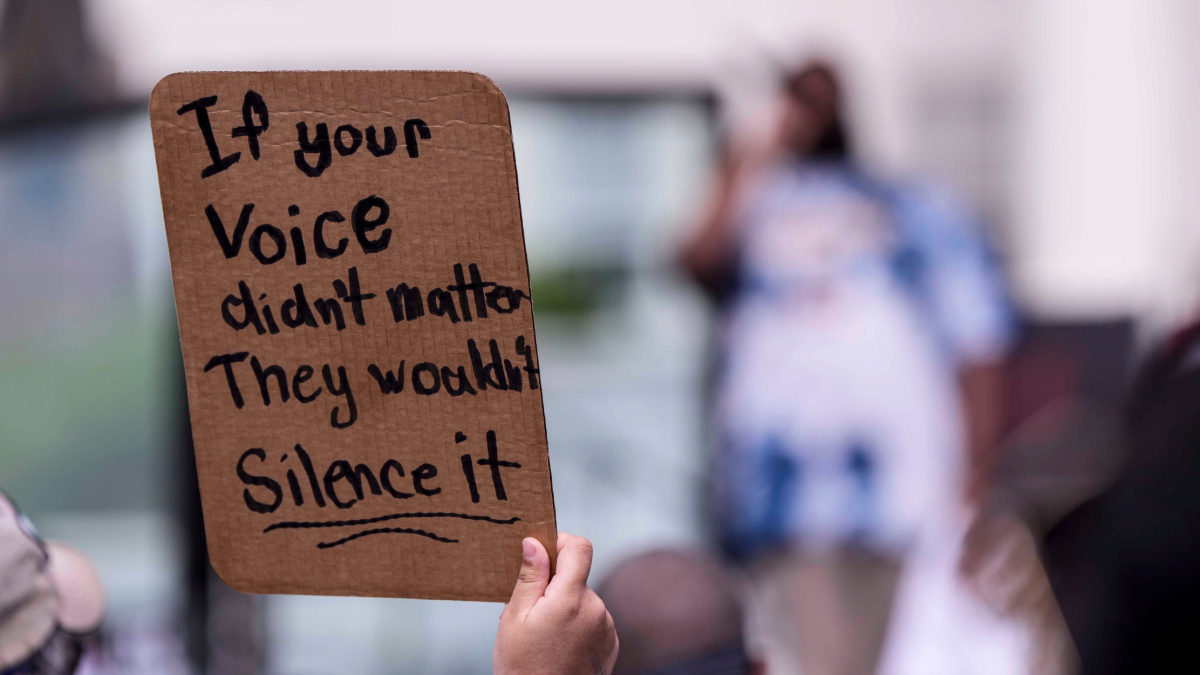
People listen to speakers during a voting rights rally, Saturday, May 16, 2026, in Montgomery, Ala. (AP Photo/Mike Stewart)
“Black communities are already living in the future of a tech dystopia when it comes to policing, or when it comes to all kinds of algorithms that are making life and death decisions.” — Dr. Ruha Benjamin
My paternal ancestor, Richard Lee Young, born in 1861, was born into slavery in Louisiana. Voter registration records reveal that by 1905, he was among the 0.2% of Black men in Louisiana who were eligible to register to vote. Richard was one of just 1,000 Black registered voters among 600,000 freedmen in Louisiana. All of Richard’s registration documentation includes a “colored” description in the remarks, representing a possible intimidation tactic amid the backdrop of post-Reconstruction racial violence to perpetuate Black voter suppression. Richard chose courage over safety, exercising his right to participate in the democratic process at a time when his country’s “democracy” offered little protection.
Gathered through registration documents over the decades, his journey represents a pattern: the strength of intergenerational Black resistance that protects our civil rights at the ballot box.
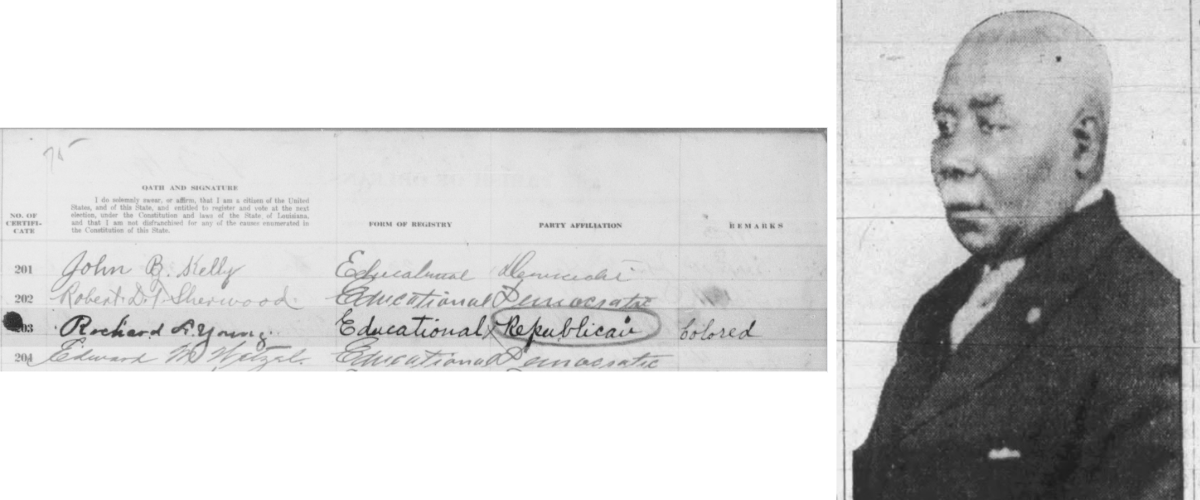
Left: Louisiana, Orleans and St. Tammany, Voter Registration Records, 1867-1949. FamilySearch, accessed Monday, December 2, 04:09:48 UTC 2024), entry for Richard L Young, 24 May 1913. Right: Photo of Richard Lee Young, Young Family Card of Thanks, The Louisiana Weekly (New Orleans, Louisiana), August 12, 1933, page 7, column 3, Newspapers.com, accessed May 2026.
In 2026, Richard’s story remains hauntingly familiar and reflects the historical recursiveness nested within voter disenfranchisement narratives. On April 29, the United States Supreme Court effectively gutted the last vestige of the civil rights protections by narrowing Section 2 of the Voting Rights Act, which prohibited racially discriminatory voting practices. The law, which helped end Jim Crow, was essential for Black voters’ self-determination and representation. The Supreme Court’s 6-3 decision determined that race-conscious redistricting is unconstitutional.
Many civil rights leaders have called the decision a betrayal. The case stemmed from Louisiana's 2022 redistricting map, which created a new majority-Black district to better represent the state's Black population. Despite Black Louisianans comprising roughly a third of the state's population, they were represented in only one of six congressional districts before the creation of the second.
The gravity of this moment requires an understanding of how historical social technologies can be redefined within the contemporary digital landscape, reshaping and systematically diluting Black voting power. In this essay, I will explore how the classifications of race neutrality in both legal and algorithmic landscapes will be operationalized and weaponized through the lens of a weakened Voting Rights Act.
The Supreme Court’s majority opinion states that “a vast social change has occurred throughout the South” and that “race and politics must be disentangled,” enshrining an institutionalized, fictional colorblind version of a raceless society to become a legal and lethal reality. In Louisiana v. Callais, the plaintiffs—a group primarily composed of White voters—acknowledge that traditional race-neutral criteria may lead to the underrepresentation of various racial groups. Predictions estimate that 30% of the Congressional Black Caucus could lose their seats without Section 2 protections.
The plaintiff's admission of harm eerily echoes the “race-conscious” language of Louisiana’s 1898 Constitution. A gross reduction of US voting rights that intentionally creates the false pretense of racial equity has historically produced fatal results for Black communities. The 1898 Constitution served as a foundational blueprint that led to mass Black voter disenfranchisement, exemplifying that the current Court’s race-neutral fabrication of a post-racial society is not the first time it has been weaponized at the ballot box.
The 1898 blueprint
Race-neutral language has long been a tool for Black voter disenfranchisement. The 1898 Louisiana Constitution’s pragmatic language was one of the original blueprints to target African American suffrage in the state, and it was successful. This legal architecture made Richard Lee Young appear as one of the sole Black voters in voter registration documents for decades. By imposing literacy tests, poll taxes, and grandfather clauses, the Constitution disproportionately targeted Black men while using “racially neutral” language. The outcome was devastating. In 1896, 130,344 Black men were registered to vote. By 1904, only 1,000 remained.
The persistent attempts to eviscerate the Black vote did not happen in a vacuum. It’s a legacy of the same institutional failure and judicial apathy that plagued the Supreme Court at the time. Justices were either unable or unwilling to intervene, allowing the 1898 Constitution’s destruction to proceed. In the Louisiana v. Callais ruling, the same “race-neutral” argument is employed.
How 1898 survived by 2026 suppression
The disenfranchisement that targets Black voters like Richard Lee Young is both contemporary and historically established. Voter discrimination is not a relic of the past; it disproportionately impacts working-class voters and voters of color as a studied, precedent-based, and national political practice. The Court’s opinion demonstrates not only judicial overreach but also an institutional failure to prevent history from repeating itself and to achieve racial discrimination through this new law. Whatever Chief Justice Roberts’s ultimate goal, the consequence of his Court has been to suppress the power of the Black vote. The Court’s race-neutral logic conveniently forgoes Section 2’s remedial purpose to prevent a repetition of the 1898 Constitution.
The mechanisms enforcing race neutrality, and by extension, the dilution of Black voting power, have adapted to maintain political stasis that preserves systems of regulation and surveillance erected against marginalized voters. The social technologies once used to suppress Black voting power, such as poll taxes and literacy tests, are being quietly reshaped by a digital empire that is radically changing the face of our voting and democratic processes.
How algorithms influence redistricting
Dr. Ruha Benjamin’s groundbreaking research on The New Jim Code exposes the social dimensions of how rapid technological advancement has produced a facade of objectivity that encodes and replicates systemic biases. Dr. Benjamin’s logic maps onto the politics of redistricting within the bounds of computational “efficiency.” Because Section 2 was weakened, algorithms increasingly used in the redistricting process can now operate without the Voting Rights Act's protections for majority-minority districts.
Academic researchers have cautioned about imposing race-blind algorithmic interference in redistricting. Moon Duchin and Douglas Spencer’s ensemble analysis, which generated millions of algorithmically drawn maps to compare with actual district plans, explicitly used race-neutral inputs. Duchin and Spencer’s results showed that this comparison vastly underrepresented Black-majority districts among the experiment’s selected districts.
The unregulated, multi-billion-dollar data-broker industry can also be examined to illustrate the evolving technological landscape that can be leveraged to skew partisan favor. Data broker companies, which notoriously provide little transparency and have shown bias against racial minorities, can strategically collect demographic and political preference data and sell it to the highest bidder to make predictions about voting patterns that can result in detrimental outcomes. Data broker biases are directly related to the socially technological methods imposed on Black men in Louisiana, just as the “colored” remarks defining Richard’s voter registration visually reveal that neutrality was never an option. Predictions based on one's race set a dangerous precedent, whether in writing or through algorithmic prediction.
Demographic data has always been weaponized to push partisan outcomes. In 2019, Thomas Hofeller, a prominent Republican strategist, was exposed for collecting data on Americans' voting patterns by race. According to a 2024 Politico article, L2, a political data broker company that claims to have 210 million voter records, combines consumer survey data to make inferences about individual preferences on issues such as race and civil liberties. L2’s services are used by redistricting commissions to analyze and scrutinize newly proposed districts and as a litigation tool to assess contested district lines. It can be reasonably inferred that this ruling could open the floodgates to more nefarious and unconstitutional methods of extracting data in a disproportionate manner that harms minority voters.
Callais, built upon other Court decisions that argue for a “colorblind constitution,” creates a doctrinal regime that rewards race-neutral processes producing racially disparate outcomes. Algorithmic ensemble methods and commercial data brokerage are the technical infrastructure that makes industrial-scale exploitation of that doctrinal opening possible. Duchin and Spencer's empirical work demonstrates that the race-blind rhetoric is incompatible with maintaining anything like proportional Black representation in segregated geographies.
Even in a ‘colorblind’ surveillance-capitalist landscape, evidence shows that data brokers use demographic factors as proxies to determine race and can sell personal information and attempt to influence electoral outcomes. This demonstrates that companies whose model is surveillance can make assumptions about an individual’s race and, therefore, their voting patterns. Under the guise of algorithmic objectivity, these companies have made tremendous profits by using racially neutral language, a pattern precedent in US policymaking, such as the 1898 Louisiana Constitution, that produces outputs far from neutral in practice. These practices not only work toward the abjection of the historically disenfranchised but also undermine the very fabric of the US democratic process.
AI is already used in map-making processes, and amid rushed attempts to redraw districts post-Callais, experts warn that AI's role will likely expand. This ruling is not merely a Black policy issue, as proposed redistricting efforts could construct a conservative supermajority in Congress, putting reproductive healthcare access, climate protection, and other issues at risk. The dangers of simultaneously using computational modeling and exploiting demographic data collection could become a catalyst for a potential avalanche of decisions that could further set civil rights protections back decades.
The US is not a post-racial or race-neutral society
“Today’s decision renders Section 2 all but a dead letter.” — Justice Kagan, Louisiana v. Callais Dissenting Opinion
The threat is real: Tennessee’s Republican lawmakers passed a bill that carved up Memphis, a majority Black district that has held a Democratic seat for over fifty years, ahead of the upcoming midterm elections. Louisiana’s Senate has passed a new map that would eliminate a majority-Black district. The immediate impact of the decision on the upcoming midterms is not yet known, but civil rights groups believe that new redistricting efforts will represent a massive shift in the 2028 elections, with some predicting that it could be the largest drop in Black representation since the end of Reconstruction. Voters challenging future discriminatory maps will face higher legal barriers and fewer statutory protections under a narrowed Section 2.
Protecting Black voting power demands new strategies that address the precarity of computationally manufactured redistricting methods that are more difficult to prove discriminatory in Court. There is a need for an increased set of public tools that highlight how computational software makes partisan gerrymandering harder to detect, and federal policies that establish guardrails for these redistricting methods and the data-broker industry are essential.
This devastating decision could reverberate from school boards to city councils; However, civil society and grassroots organizations are mobilizing across the South to push back against the new maps. Given the difficulty of passing voting rights legislation and data-broker regulation at the federal level, states must enact their own Voting Rights Acts that prohibit vote dilution, while simultaneously enacting harm-reducing guardrails for algorithmic redistricting that uses third-party data brokers.
We have never had race-neutral policies in the United States. Social and digital technologies have been, and will continue to be, used to produce partisan outcomes. Race cannot be considered a disparate metric.
Our generation is among the first to bear the growing weight of surveillance capitalism through a digital lens. Connecting with familial history holds weight and power, revealing patterns of the past that give us the tools and persistence to reimagine our democracy’s future. Rejecting the continued rhetoric of neutrality is the only viable path forward.
The author wishes to thank Jake Garfinkle, a genealogical researcher, whose work uncovered Richard Lee Young’s voter registration records and other relevant documents that connected this family history across time.
Authors