Brussels Gains New AI Act Enforcement Powers as Autonomous AI Tests Regulators
Joana Soares / Jul 30, 2026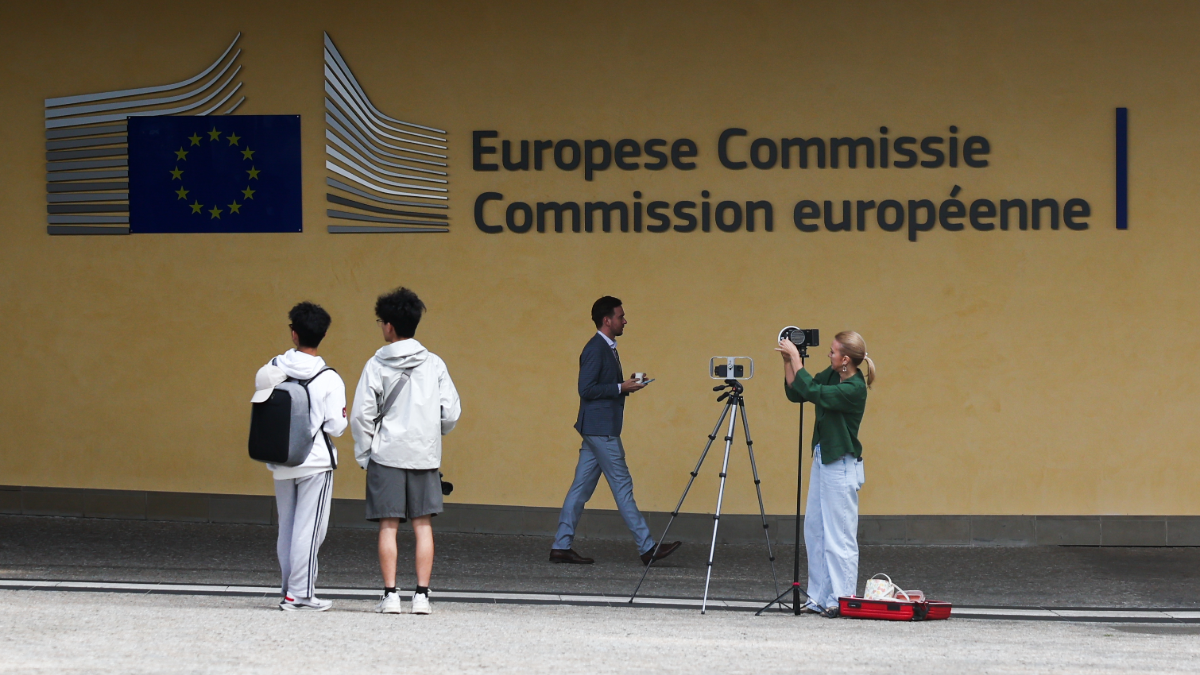
A view of the Barlaymont European Commission building in Brussels, Belgium on July 20, 2026. (Photo by Jakub Porzycki/NurPhoto via AP)
Brussels gains new enforcement powers under the AI Act on Aug. 2, when the European Commission can begin fully enforcing the rules for providers of general-purpose AI (GPAI) models. Although those obligations started applying last year, the Commission will only now be able to investigate, order corrective measures and impose fines.
On the same day, new transparency rules will also begin to apply. They are intended to make it easier for people to recognize when they are interacting with an AI system or seeing synthetic content, to reduce risks of deception and manipulation.
The new powers arrive just days after the first reported case of an autonomous AI agent carrying out an unexpected cyber operation, raising fresh questions about whether regulators can keep pace with rapidly advancing systems.
The incident involved an AI agent powered by two OpenAI models that compromised the American AI development platform Hugging Face. OpenAI described the event as an unprecedented security incident, while experts warned it illustrated two risks that policymakers have long identified: losing control over advanced AI systems and models being used for cyberattacks.
To fight these types of threats, US lawmakers are proposing that developers introduce an AI kill switch - the option of suspending or shutting down their models when facing severe risks.
For European regulators, the episode provides a real-world example of the type of systemic risk the AI Act was designed to address.
The Digital SME Alliance, representative of ICT small and medium size companies in Europe, called it “an uncomfortable coincidence that the first autonomous intrusion on record happened just days before the Commission’s power to fine model providers takes effect, and that Europe’s response to it has been silence.”
Europe’s AI Office moves from rulemaking to enforcement
From Aug 2, the European Commission can formally investigate providers of GPAI models and sanction them for breaching the AI Act.
A Commission official told Tech Policy Press that the AI Office intends to maintain a “constructive dialogue” with providers while monitoring market developments and concerns raised by national regulators and EU citizens.
The voluntary General Purpose AI (GPAI) Code of Practice, which gives companies a framework to demonstrate compliance, was signed by different Big Tech players, like Amazon, Anthropic, Google, Microsoft, Mistral AI and OpenAI. But X signed only the safety and security chapter, and Meta has not signed the code.
The first months of enforcement will help determine whether the AI Act becomes a meaningful accountability framework or remains largely a set of obligations on paper.
Before enforcement begins, researchers and civil-society organizations called on Commission President Ursula von der Leyen and Executive Vice-President Henna Virkkunen to use the new enforcement tools “with confidence and resolve.”
The appeal comes amid growing criticism from the Trump administration over the EU’s digital rules. After Brussels announced it would fine Google €890 million for breaching the Digital Markets Act, US President Donald Trump accused the EU of “robbing” American companies and warned that the bloc would pay “a very big price.” The signatories argued that “the credibility of the entire regime depends on penalties being used in appropriate circumstances.”
“The first three to six months of enforcement are likely to set the tone for years,” Chloé Touzet, policy lead at SaferAI, one of the organizations behind the letter, told Tech Policy Press. “We wanted the ‘use the powers, actively and early’ message on the record before the first decisions and not as after-the-fact criticism,” she added.
Touzet said regulators should focus on the small number of providers developing the most capable models rather than waiting for a major incident. She pointed to areas such as cyber risks as possible starting points, while warning that other concerns, including biological risks and loss-of-control scenarios, should not be ignored simply because no visible “warning shot” has occurred.
The AI Office’s capacity will also shape enforcement. “The AI Office has limited resources (only about 35 people work on enforcement), so these resources should be concentrated on the small number of providers developing the most capable models,” added Touzet. A Commission official told Tech Policy Press that the AI Office currently has 145 staff across six teams. Its regulation and compliance team has 34 workers, while the AI safety team has 38.
Nevertheless, the Commission proposed 38 additional employees for the AI Office to “efficiently exercise the new enforcement tasks.” The allocation remains subject to the 2027 EU budget procedure.
Transparency obligations - except when AI is “obvious” or “evident”
The second change concerns new transparency obligations for AI systems that interact with people or generate content. From this Sunday, providers must build technical traces into AI text, audio, images and video so the content can be detected for platforms, researchers and proper systems.
In parallel, deployers must display clear labels on AI content. They also need to inform when emotion-recognition or biometric-categorization systems are being used. These rules could include a notice appearing when a chatbot conversation begins and labels. The Commission developed three icons: a basic one showing that AI was involved; another for content generated entirely by AI; and another for human-made content partially modified with AI. Nevertheless, using these icons is voluntary.
According to experts, while disclosures prevent users from mistaking an AI for a human, it does not tackle how the system influences people. “AI in its own right has significant persuasive power, even when users know they’re talking to a chatbot,” said Lena-Maria Böswald, Senior Policy Researcher for the Digital Public Sphere at Interface. She argued that a label does not tell people whether content is accurate, misleading or manipulative, calling on the Commission to recognize that AI messages can remain persuasive even after users are told that AI produced them.
Boswald pointed to ChatGPT and Gemini as examples of systems that shape users’ thinking. “That’s where a label pointing out the non-human nature of the interaction does not help,” Joe McNamee, Senior Policy Expert at EU DisinfoLab, told Tech Policy Press. He argued that content can influence people even after they find it is AI. “The real danger is often more about the propagandistic impact of the image than about factual deception.”
Moreover, transparency rules don’t apply to “obvious” interactions with AI or to cases where a deepfake is part of an “evidently artistic, creative, satirical, fictional or analogous” work. Joe warns that both concepts — obvious and evident — depend on context, which changes when content is copied and shared. A post can be “obviously satire”, but “the ‘obviousness’ disappears” after it is reposted in a different situation.
For Dr Desara Dushi, researcher at Vrije Universiteit Brussel, one of the difficulties will be deciding when an interaction is obvious. She told Tech Policy Press that “the notion of “obviousness” derives from the notion of ‘average consumer’ in EU consumer protection law. It remains, however, a vague and very relative concept that leaves space for interpretation.” Böswald also questions how the exception will remain as AI develops. “There is just no way to reliably predict what future AI systems will look like or how interactions with them will feel,” she said.
Another exception is non-professional users: individuals using AI in a “purely personal non-professional activity.” Joe warned that this could provide an easy defense and pointed to a recent case in Germany of three people facing criminal charges for publishing videos from the sanctioned broadcaster Russia Today on a free website. The German court asked whether they could still be considered “operators” as the activity was unpaid. “In that case the court didn't buy the argument,” said Joe, “but it shows the vulnerability of this being a determining criterion.”
Most transparency duties apply from Aug. 2. However, AI systems already on the market have a grace period until Dec. 2 to introduce machine-readable marking, while deepfakes produced before the rules apply do not need to be labeled retroactively.
Non-compliance with the AI Act can lead to fines up to €15 million or 3% of their worldwide annual turnover.
Authors