Age Checks, AI Regulation and Censorship Put Internet Freedom Under Pressure
Justin Hendrix, Ramsha Jahangir / Oct 22, 2026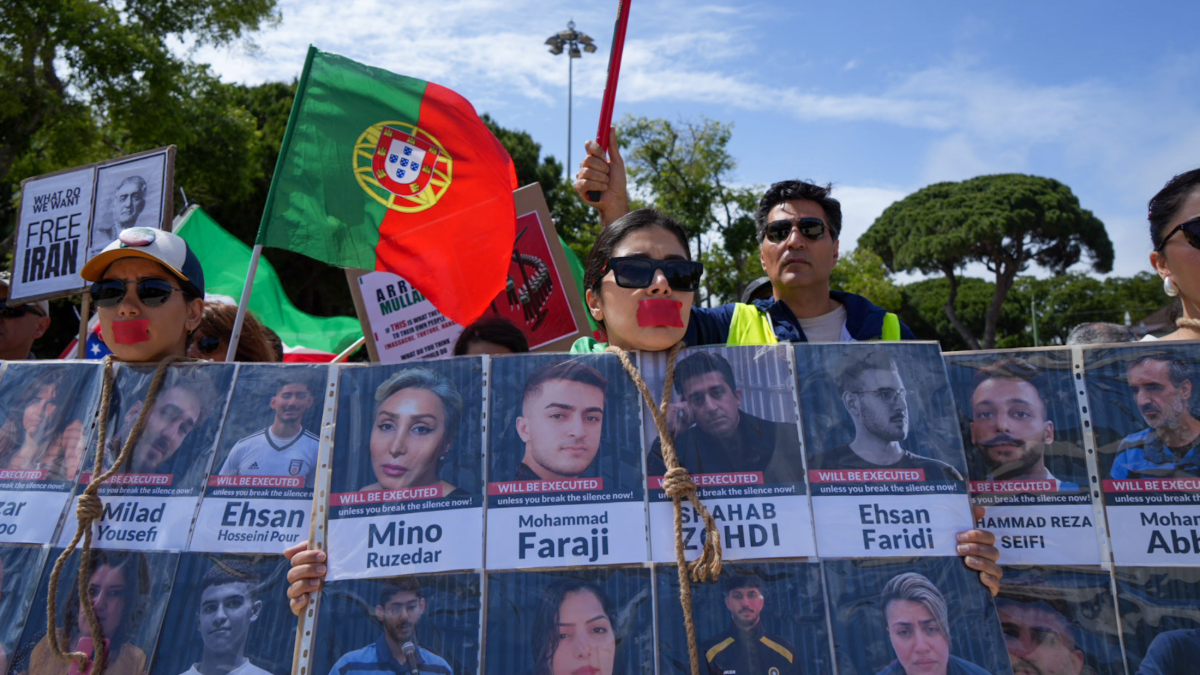
People with their mouths taped participate in a protest against internet shutdowns, arrests, and executions in Iran outside the Palacio Nacional de Belem in Lisbon, Portugal, on May 10, 2026. (Photo by Luis Boza/NurPhoto via AP)
Since its launch, Tech Policy Press has covered the findings of the annual Freedom on the Net report from Freedom House, a nonprofit organization founded in 1941 to advance democracy and human rights. As we noted last year, it is typically grim reading, a chronicle of governments suppressing dissent, people arrested for nonviolent expression, tallies of those attacked or killed for their online activities, and other threats to internet freedom.
It should come as no surprise to our readers that the topline results in this year’s report correspond to more of the same, as authoritarianism continues its advance across the planet. Freedom House finds that “Global internet freedom declined for the 16th consecutive year.” Among the most significant developments was Iran, which, amid demonstrations that rocked the country earlier this year and the subsequent United States and Israeli military strikes on the country, “imposed the longest nationwide internet shutdown Freedom on the Net has ever recorded.” In Russia, the Putin regime “consolidated control over internet service providers (ISPs),” further restricting internet access and introducing new censorship measures.
But the problem goes far beyond these worst offenders: only 9.1% of the world’s internet users live in countries that Freedom on the Net considers “free.” The US remains in that increasingly lonely category, but it has seen its standings decline substantially over the years. Owing to mass surveillance of online activists by federal authorities, prosecution of journalists who reported on protests against immigration enforcement activity in Minnesota, and “steeper penalties on people for their online activities” in various parts of the country, the US scores 73 on the 100-point scale, just four points from the “partly free” category.
Global internet freedom. Source
Age checks and AI raise new concerns
One prominent trend driving concern over internet freedom, according to Freedom on the Net, is the global proliferation of measures to restrict children and teens from accessing certain online content. (Tech Policy Press is tracking this trend in its Global Social Media Age Restriction Tracker.) These policies often come with requirements for age assurance, which the report says “has become a pressing rights and cybersecurity issue.” Pointing to Turkey and China, Freedom on the Net says these laws “open a new vector for abuse, with identification requirements enabling bad actors and repressive governments to create a footprint of people’s online activities.”
The report warns that age checks relying on facial scans, government-issued identification or other sensitive personal data can threaten privacy and anonymity. It also points to evidence that children have continued to access social media despite new restrictions. Policymakers and technologists who seek to implement age assurance in a rights-respecting manner will need to work together to overcome technical obstacles and to mitigate the privacy and security risks, according to the report.
The report extends the focus from prior years on the threats that artificial intelligence — and often, attempts to regulate it — poses to internet freedom. Pointing to measures across multiple countries targeting the use of AI for online harassment and impersonation, as well as mitigation measures such as labeling AI-generated content, Freedom on the Net says some “raised concerns about overreach.”
India, for example, introduced rules requiring prominent labels on AI-generated content while shortening the period in which platforms must remove content flagged by authorities from 36 hours to three hours. Civil society groups warned that the shorter deadline could encourage platforms to remove legitimate journalism and satire rather than risk penalties. In Mexico, authorities arrested two online journalists under a law restricting certain uses of AI-generated images and voices, despite a carveout for journalism.
Where there is good news, it stems from “mass movements that overthrow repressive leaders,” such as in Bangladesh and The Gambia. Bangladesh’s status has steadily improved since a popular uprising led to the removal of Prime Minister Sheikh Hasina in 2024. It recorded the largest improvement for the second consecutive year and experienced its first year without an internet shutdown in a decade.
The Gambia continues to see improvement since it ousted Yahya Jammeh nearly a decade ago. The report credits reforms to censorship rules and the passage of a data protection law in December 2025. The report lauds the use of digital tools to mobilize pro-democracy movements in India, Iran, Hungary, Serbia, Kenya and Cuba, noting these movements are often met with state violence and retaliation.
Every year, the report comes with a list of policy recommendations. These are much the same as prior years, insofar as they address internet shutdowns, the need to instill “accountability mechanisms and normative frameworks to disincentivize the misuse of surveillance tools,” the need to improve digital security safeguards for journalists and human rights defenders. A new recommendation this year calls for support for satellite internet access.
The report also urges policymakers to put internet freedom at the center of decisions about agentic AI, systems that can carry out tasks with limited human intervention. As these systems become more widely adopted, societies will face choices about how to configure the internet around them. Freedom House says those decisions should preserve open exchange and free expression as fundamental values.
Freedom House adapts to a new funding reality
Close readers of our prior coverage of the report will know that, for years, Freedom on the Net was substantially funded by the United States government under its portfolio of projects to advance democracy and human rights. That portfolio was decimated in the first year of the Trump administration, and Freedom House suffered substantial layoffs after cuts to State Department-funded democracy and internet freedom projects “severely impacted” the organization. As we previously reported, the funding cuts affected Freedom House’s ability to produce the Freedom on the Net and sustain its network of more than 200 internet freedom defenders. The impact is evident in this year’s report, with the organization no longer able to work with researchers and local organizations across all the countries assessed, instead relying on staff-written summaries and consulting independent experts on only a subset of them.
This year’s report says it was funded by “the Dutch Ministry of Foreign Affairs, Google, the Internet Society, and the New York Community Trust, as well as through a partnership with the Rutgers Democracy Lab (RDL).” The methodology section of the report suggests this new constellation of supporters did not provide enough funding to sustain the same approach used in years past.
“We've made good progress to stabilize Freedom on the Net in this new funding environment, though it required the difficult decision to scale back the scope of the 2026 edition,” said Kian Vesteinsson, deputy director for research at Freedom House and one of the authors of Freedom on the Net. “As in previous years, our network of partners in the global digital rights community played an important role in informing and validating the findings. I'm optimistic that more donors with a strong commitment to the transformative power of the internet will step in to ensure the project's long-term health, particularly as agentic AI makes research on digital rights all the more urgent.”
Authors