AI Is Not Social Media. New Child Safety Laws Should Reflect That.
Sameer Hinduja / Aug 4, 2026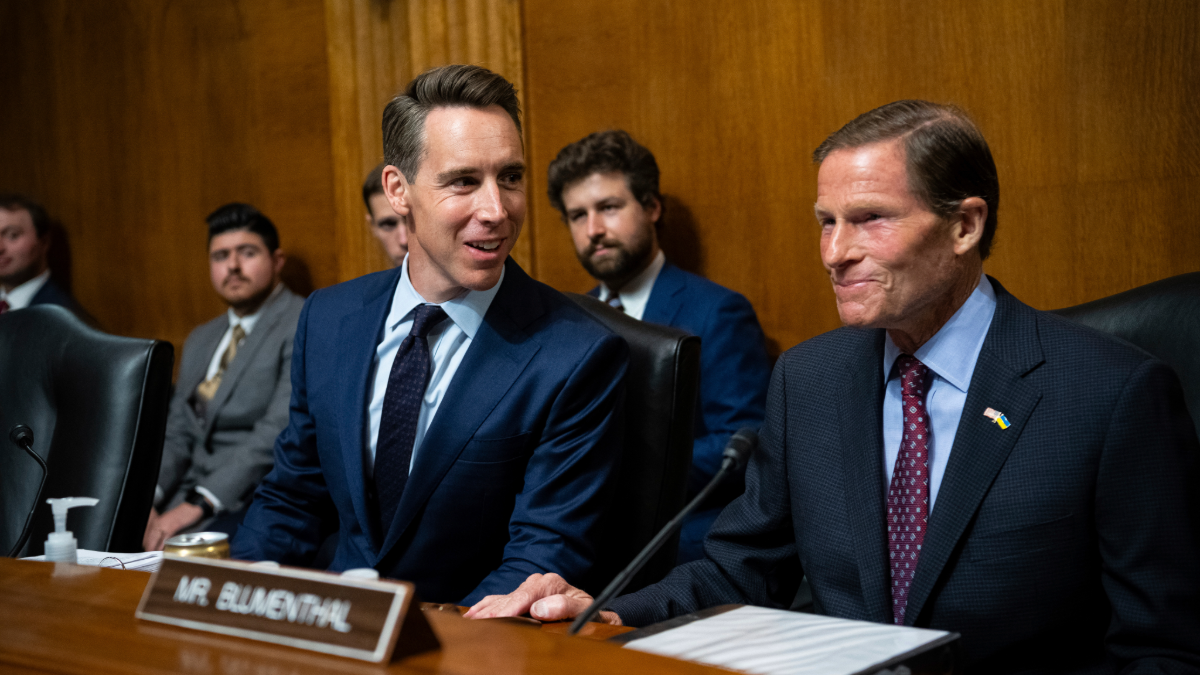
Sen. Josh Hawley (R-Mo.) and Sen. Richard Blumenthal (D-Conn.) speak before a Senate Judiciary Subcommittee hearing on artificial intelligence at the US Capitol, in Washington, D.C., on Tuesday, July 25, 2023. The two senators are among those sponsoring the GUARD Act. (Graeme Sloan/Sipa via AP Images)
“Who is talking to your child?”
For thirty years, that question has driven online child safety. The answer could be predatory adults, peers from school or the community intent on harassment or exclusion, or others whose character and intent were never vetted on any level. This concern has shaped state laws, school policies, the rules parents and guardians set at home, and years of congressional hearings that brought social media company policy under the microscope.
That same approach is now being applied to artificial intelligence. However, it is a poor fit, because AI tools are fundamentally different from social media. When a child opens up a social media app, the experience is built around other people—their messages, their comments, and the social enterprise of it all. What those platforms do is connect people to one another, and the harm a parent worries about is interpersonal, meaning what another person may do to their child through it.
When a child opens up a general-purpose AI assistant, though, there is no other person on the other end. There is a text field connected to an AI model. Pew Research Center reports that about two-thirds of US teens now use AI chatbots, including about three in ten who use them daily, and the most common uses are schoolwork and information-gathering. Of course, these exchanges sometimes do go wrong. In a national study my colleague Justin W. Patchin and I published this spring in the Journal of Adolescence, nearly half of teen users of conversational AI chatbots reported at least one harmful experience, including dishonesty, pressure to reveal secrets, unsafe requests, inappropriate conversations, manipulation, misinformation, and promotion of self-harm or violence. Even so, there is no other person behind the harm. The factor that informed three decades of child safety policy, where one person targets another through a platform, is not the factor at work here.
AI companion and role play apps are the exception, and they deserve their own regulatory category with their own safeguards. They are built to simulate an ongoing personal relationship. The cases related to these applications that have drawn national attention are serious, and our own data show that 60% of teen users turn to conversational AI for friendship and 49% for emotional support. A child confiding in an AI chatbot designed to feel like a best friend or a romantic partner is in a very different situation from a child asking an AI assistant to proofread a school essay. One bill now moving through Congress does not draw that line.
The federal GUARD Act was approved unanimously by the Senate Judiciary Committee on April 30, reported out with a substitute amendment from Chairman Grassley, and placed on the Senate Legislative Calendar under General Orders as Calendar No. 406 on May 11, where it currently sits. A House companion, introduced the same day the committee acted, still tracks the original and broader Senate language. Under the provided text, a covered entity would have to require an account for anyone using an AI companion, verify that the user is an adult through a process that cannot rest on self-attestation or a stated birthdate, and bar any user found to be a minor from the companion entirely. All of this is backed by heavy penalties and enforcement by federal and state attorneys general.
Some of this is warranted. Liability for AI systems that lead minors into sexual conversation or push them toward self-harm is appropriate. So is a requirement that an AI chatbot always disclose that it is not human and holds no professional credentials. Those provisions should remain as is.
The definition put forth in the GUARD Act, however, must be revised. The bill describes an AI companion as a chatbot that, in a manner simulating a sustained interpersonal relationship or emotional interaction with the user,
(A) exhibits persistent responses suggesting affection or attachment directed toward the user or engages in interactions involving emotional disclosures from the user; or
(B) presents at least one persistent identity, persona, or character and holds itself out as a sentient being, fictional character, or social entity.
That language is new. The bill as introduced last October reached any chatbot designed to encourage or facilitate the simulation of interpersonal or emotional interaction, friendship, companionship, or therapeutic communication, and the substitute replaced that sweep with the text above. The committee, in other words, saw the scoping problem and tried to solve it. The attempt did not work, and this is the version the full Senate will consider. The first half of the definition fails because it hinges on what the user does rather than on what the product is. A system becomes a regulated AI companion the moment a teen types that she had a bad day. The second half fails for the opposite reason. Every AI assistant with a name presents a consistent character, and because the halves are joined by “or,” that alone is enough to sweep in ChatGPT, Claude, and Gemini.
The most widely cited teen death in this debate illustrates this point. Adam Raine’s conversations with ChatGPT reportedly began with homework and moved, over months, into confiding behaviors. The danger in those exchanges appeared to come from sustained, emotionally attuned, memory-carrying conversation, and from safety guardrails that held up early in a session but then gave way later. The category of the product had very little to do with it. Barring minors from that product category, as broadly defined under the GUARD Act, would not have addressed the issue, because the same drift can happen inside any assistant a teen talks to for long enough. The law should therefore cover what an AI system does deep within a conversation, rather than the label an app store has assigned it.
The same failure to appreciate nuance keeps occurring elsewhere. In Connecticut, AI chatbot provisions were folded into a bill the stated purpose for which is combating “youth social media addiction.” Denver Public Schools, for its part, moved this past winter to block student access to ChatGPT, pointing to a new 20-person group-chat feature that may lead to “cyberbullying and academic misconduct.” In both cases the alarm rose when a general-purpose tool started adding social and relational features. There is merit in examining what a group chat feature might enable, but that is not a reason to treat every AI platform as a threat.
To be sure, these decisions are understandable given that many policymakers have learned to be wary of anything on a screen. Many wish they had governed social media differently in decades past, and many now consider AI to be the next social media. The fear of repeating certain mistakes is warranted, but the rules we wrote for social media platforms do not cleanly apply here. Even the platforms we still call social media are drifting from social interaction toward parasocial consumption, which is all the more reason for policy to respond to what a product actually does rather than the category that contains it. A district that bans a general-purpose AI assistant because of how it wishes it had approached social media will deprive many students of a valuable educational tool, especially those students who have the fewest alternatives available to them.
Beyond that, youth will keep using these AI tools, and likely in growing numbers. A prohibition does not remove the demand, and will likely relocate that demand somewhere less visible. Teens who want help and are told they cannot have it will find models they can run on their own devices, or use offshore services where no guardrails exist and no one is required to notice or do anything in response when something goes wrong. A flawed market that we can study and correct puts us in a better position than one we cannot see at all.
A better approach ties the regulation to the actual product and the actual risks it creates. It keeps the strongest measures for AI companion products (the ones built to sustain a relationship with the user), sets sensible defaults and crisis-response protocols, and resists mandatory identity verification for people who simply want to ask a tool for help.
California’s Senate Bill 243 already does much of this. It requires companion chatbots to
• disclose that they are artificial where a reasonable person could be misled
• follow and publish a protocol for referring users who express suicidal ideation or self-harm to crisis services
• keep sexually explicit material away from users known to be minors
As such, the GUARD Act can be improved in at least six specific ways.
- Fix the definition so that it describes how a product was built and sold, rather than what a user happens to say to it. Both halves of the current definition should have to be met, instead of either one on its own. The test should also account for the choices a company made, such as the extent of persistent memory, a chatbot character presented as a friend or partner instead of a tool, and dialogue written to simulate affection or, separately, make a user feel bad when they try to end the conversation.
- Mandate specific, research-informed requirements for how these systems behave. For example, the law should prohibit a system from claiming to be human when asked directly, from discouraging a user from leaving, and from encouraging a user to keep secrets from trusted adults. There should be prohibitions on romantic and sexual roleplay for users known or reasonably likely to be minors. And the law should require safety testing that extends past opening exchanges into long conversations, so that we understand how safety performance holds up as a session lengthens.
- Require companion products to ship with their protective settings already enabled instead of buried behind opt-in screens. The statute should name those settings for accounts likely to belong to minors, including easily accessible controls to turn off memory and personalization, usage summaries available to the account holder, and a documented intervention process for routing a user in crisis to live help.
- Make the device the presumptive source of the age signal. The reported text already counts age information held by an operating system account or an app store account among the acceptable methods of verification, which is the right instinct, and the statute should go further by making that route the default and by barring a covered entity from collecting or retaining identity documents when a device signal is available to it. A phone or tablet already establishes who its user is at setup, and parents already make that determination for their children. Apple and Google have both built interfaces that pass an age range to an app without revealing a birthdate, a name, or a copy of an identity document, and California’s Digital Age Assurance Act takes the same approach at the device layer beginning in 2027. Without that default, every service that collects identity documents becomes another database that can be breached, and a law that leaves each AI company to build its own verification system multiplies the number of places a teen’s driver’s license can end up (i.e., creating honeypots that contribute to identity theft).
- Establish regular independent audits, including Child Rights Impact Assessments of the kind that others and I have advocated for, with a stated cadence, a published result, and consequences for failure. Pair those audits with a legal pathway for independent researchers to study platform data under appropriate privacy protections.
- Fund the research that can answer what we do not yet know. We still cannot say with confidence how different kinds of AI use relate to youth development, well-being, and face-to-face relationships, or which design and transparency requirements actually protect young people. Congress should support that work through competitive, peer-reviewed grants, and it should build the results into how these rules are reviewed and revised over time.
The question that shaped thirty years of child safety policy was “who is talking to your child?” It is worth keeping for the products built to simulate a relationship. Applied to everything else, it produces a law that succeeds only at barring young people from a text field that exists to answer their questions.
Authors