AI May Dramatically Disrupt The American City. Are Urban Planners Ready?
Isabel N. Adler / Jun 23, 2026This post is part of a series of student essays produced in collaboration with the Berkman Klein Center for Internet & Society at Harvard University. Read more in the series here.
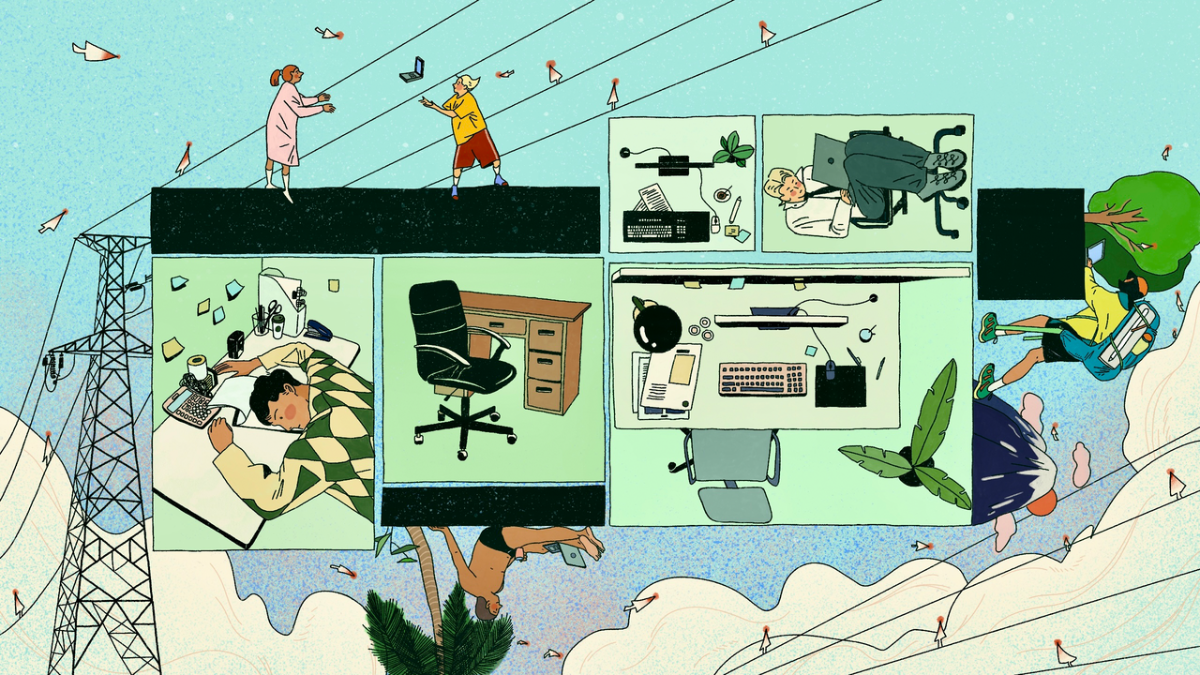
Digital Nomads Beyond the Cubicle by Yutong Liu & Digit / Better Images of AI / CC by 4.0
Modern cities can be contradictory. Sometimes, they seem more like an investment opportunity than a place for people to live. For example, as real estate speculation drives up property values, high costs push residents to the margins. Yet cities remain where we encounter new people, new culture, and new food, too.
Today, many experts—some with a vested interest—worry artificial intelligence and related technologies will transform cities, while tech CEOs warn of massive disruption to labor and the economy. The future that technocrats extoll will likely exacerbate the problem of inequality that’s already so rampant in our cities. It’s now not hard to imagine a paradoxical city where people are underemployed, living near empty downtowns, renting out their bodies to run errands for AIs, and spending what little they have to Waymo around while the stock market soars. The luckiest few may be directing a fleet of AI assistants, and an increasingly small group of elites could have extreme amounts of excess capital to invest.
Such a vision of the future prompts this call to arms for American urban planners, community-based planners, community-engagement planners, and private sector planners to fight against and alleviate the shock of this coming change. Our chance to support a new type of city, one that values residents over capital accumulation for the increasingly small few, has come. Planners should consider what AI-caused mass un- or underemployment will mean for cities, from the way projects are financed to the role of the city in providing welfare to the social implications of having communities of unemployed residents. This may even be an opportunity to exercise imagination and resistance, as urban planners have failed to do in the past.
In my graduate studies at Harvard Graduate School of Design (GSD), I hear plenty of conversations about data centers, about their climate impact, about the resources they use and their health impacts on humans, as well as concerns about sovereignty and sprawl. These are important conversations, but the data center issue is a canary in a coal mine. The field of urban planning and urbanism must think about the AI future that the current data center boom portends.
Discourse around data centers illustrates how urban planning is already wedged uncomfortably between idealism and practicality when it comes to AI. As data centers proliferate, they create, to borrow Alan Berger’s term from his book Drosscape, “waste landscape.” They gobble huge swaths of urban outskirts and rural land, and they guzzle resources from nearby municipalities. Construction creates short-term jobs, but once up and running, centers provide few economic benefits. Regulating data centers, especially at the local level, feels hopeless. For example, in Chile, when the government tried to put reasonable regulations on data centers, the centers threatened to move abroad. In US cities and towns, data centers may relocate to a friendlier jurisdiction or even abroad to a city with less capacity to resist. New mobile data centers make such movement easier.
At the same time, data centers have inspired practical, creative urban infrastructure and mobilized community organizing. Architect Marina Otero Verzier, in her Wheelwright Prize lecture at the GSD, shared examples of heat generated by data centers warming chicken coops and nearby houses in winter. Though connecting urban infrastructure to data centers in this way may lead to dependence on them, something Otero Verzier cautions against, it also embodies a creative optimism that urban planning should embrace. As for mobilization, activists in New Jersey, galvanized by AI threats, just successfully blocked a new data center, and an anti-data center movement is taking hold nation-wide. It is this ground-up energy that I urge planners to encourage and nurture; urban projects should emerge from social movements instead of capitalist investment, as geographer David Harvey argues, in service of a more just future.
Because if AI continues on its path, we may be on track to have a future marred by unfathomable inequity. This future is plausible. Dario Amodei, Anthropic’s co-founder, has predicted AI could replace half of all entry level white collar jobs within 5 years. METR, an organization that “evaluates frontier AI models to help companies and wider society understand AI capabilities and what risk they pose,” confirms that ChatGPT and Claude powered AI Agents continuously and exponentially improve in the ability to complete complex tasks, even tasks that take a series of days for humans to complete. Amodei and the economist Noah Smith, who writes the Substack Noahpinion, have each argued that without policy intervention, AI-driven automation could sharply widen the gap between capital owners and everyone else, concentrating wealth among the Silicon Valley elite.
Jobs that were once the bread and butter of the 21st-century city (like ‘consulting,’ that slippery term, or entry level law jobs) may disappear. Residents of cities will face unemployment even as the cost of living remains high. City budgets and processes will also feel the impact—look at the aftermath of the pandemic, where high vacancy rates rattled downtown districts in cities like New York and Washington, DC. Cities may have to cater even more to private developers to encourage or finance projects, which means less democratic control and likely fewer positive community impacts. A reduction in jobs may also cause social depression and alienation, with huge swathes of the public feeling unimportant and unneeded. We know how dangerous that is.
The first defense against this possibility in the United States should be federal regulation, but it seems unlikely that the federal government will act. Amodei cautions that the regulatory “pendulum has swung,” and we are “closer to real danger in 2026 than we were in 2023” because regulation has shifted from mitigating AI risk to chasing AI opportunity, leaving AI risks to compound. Additionally, as the government increasingly relies on AI for its military, the federal government is likely to protect AI interests over the public interest. Given this trajectory, cities may well be left to their own devices to manage the consequences. But cases like the data center stopped in New Jersey offer a path forward. Planners can encourage mobilization for federal oversight and against policy that favors tech oligarchs. This could be through education campaigns, or through task forces at the city level. It could also mean supporting and nurturing existing community actions against AI’s impact or against AI products and infrastructure specifically.
Local government may be the last and only governmental group working in defense of people. Urban planning is, at its roots, not a radical profession, but with the arrival of AI, planners must be prepared to rebel. In “On Planning the Ideology of Planning,” David Harvey argues that urban planning takes class relations (and therefore capitalism) as “fundamental.” The city is built for capital accumulation with every space and feature designed to make work possible. The job of the planner is to make things just okay enough that the whole capitalist experiment can continue. Under a guise of pragmatism, planners maintain or reinforce systems that oppress. Historian Tracy Neumann, in her book Remaking the Rust Belt, argues that planners allowed cities to become testing ground for neoliberal economic policies when cities de-industrialized in part because planners were overly pragmatic. As federal policy shifted away from Keynesian welfare and toward corporate responsibility, city governments adapted quickly, testing neoliberalism’s viability through public private partnerships because it made the most financial sense in the short term. Her interpretation suggests that planners have agency to fight against what might be capitalism’s most dangerous iteration yet. Planners should not be complicit in urban development that primarily serves investments by the increasingly few, as development historically has.
I do not know what the future will look like, but I do know that planners must begin careful scenario planning now. We should not leave things on the table as AI takes hold. City governments should double down on fixing regressive tax structures to do whatever small part they can in ensuring the oligarch class pays their fair share. City governments should not cow. The oligarchs have threatened to leave places where taxation has increased, like California, but cities have leverage. Living in a quickly disappearing estuary is not the same as living in the Bay. People want to be in vibrant communities with art and culture, and that’s what cities can be when they prioritize workers and artists and immigrants. Planners should facilitate coalition building and help social movements navigate to successful outcomes.
American cities are already implementing visionary initiatives that in the past may only have been proposed at the state or federal level. For example, New York City is rolling out a targeted guaranteed income program to support young people without secure housing. It’s this sort of bold initiative that should inspire meaningful change in other places, too, as we enter an uncertain future transformed by AI. Urban planners can create spaces for people affected by technological disruption—and potentially mass unemployment—to find purpose in building community, transforming the city into a community built on care and connection.
Read other aticles in this series
Authors