All Smokescreen, No Fire in Data Center Foreign Influence Claims
Grayson Richards / Sep 15, 2026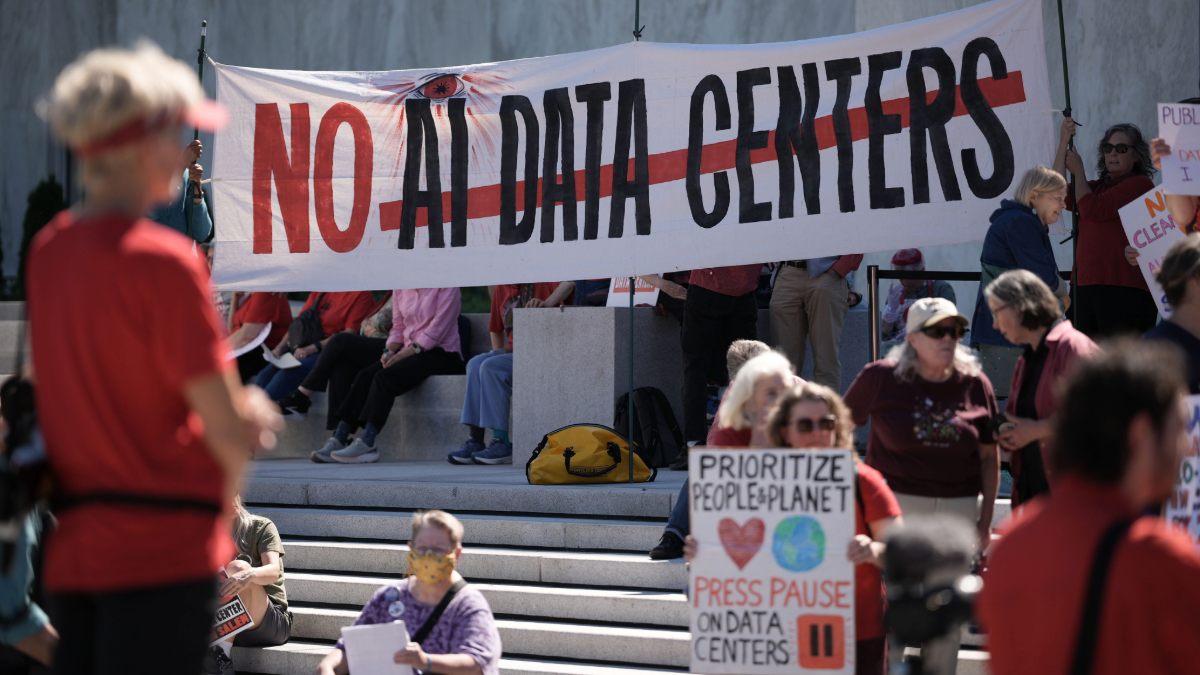
Protesters rally on the steps of State Capitol in Salem, Ore., on September 8, 2026, calling for a moratorium on new data center development in the state for three years. (Photo by Alex Milan Tracy/Sipa via AP Images)
Earlier this year, hundreds of Utahns gathered in Box Elder County to protest the approval of the Stratos Project, a planned 40,000-acre data center they say was pushed through without adequate public consultation. In the following days, Canadian TV personality and lead Stratos investor, Kevin O’Leary, took to social media and Fox News, claiming to have “irrefutable” evidence that protest organizers were “proxies for the Chinese government.” While O’Leary would later say he had “no evidence” for those statements (over which he now faces a defamation lawsuit), such claims are an increasingly common tactic in a broader narrative battle around data center development—and AI in general—in which concerns over foreign meddling and the authenticity of domestic opposition have come to predominate. It’s a strategy with an obvious appeal: once tied to foreign influence, dissent becomes easier to dismiss.
O’Leary isn’t alone in raising the specter of outside influence. In July, the New York Times published an article with the headline “China, Russia and Others Seek to Inflame Debate Over A.I. Data Centers” which reported that foreign state media and covert social accounts have been amplifying (and in some cases fabricating) opposition to data center development across the United States. While the reporting includes quotes from Jessica Brandt, a former US intelligence official who tracked foreign influence efforts under the Biden administration, and Doug Burgum, current US Secretary of the Interior, it is centered around an analysis from Alethea—a DC-based company specializing in "threat intelligence and narrative risk."
Based on research conducted in the first half of 2026, Alethea’s analysis includes accounts of pro-Kremlin social media amplifying claims that data centers are spiking electricity costs for US consumers, Chinese state media outlets republishing satellite imagery of data centers built near residential neighborhoods, and Iranian media framing the ongoing US buildout as a reckless great-power race, among other examples. Alethea presents these findings as evidence that foreign adversaries are amplifying opposition to AI infrastructure projects in order to undercut America's pursuit of AI dominance through a well-worn foreign influence “playbook” it describes as “find a raw nerve, flood it with content that echoes what people are already saying, then let the fracture widen on its own.” Despite describing data centers as “the first industry where the playbook has fully played out,” the company does not directly attribute any material impact to the activities it tracks. Alethea is careful to keep its individual empirical claims narrower than the causal narrative produced by the analysis as a whole. In a response to a request for comment, the company was explicit: “The analysis does not attempt to measure impact. To suggest so would be dishonest.” Yet the firm’s analysis warns that, if “left unchecked,” this activity could lead to “stalled permits, radicalized opposition, and projects that become too politically toxic to finish.”
There's nothing factually wrong with the analysis. The posts are real, the accounts exist and the authors haven’t projected motivations onto the foreign actors they track. Some examples of behavior cited in the analysis, such as inauthentic pages and accounts which appear to be run out of Bangladesh, are concerning. But the conclusions drawn from these findings often flatten important differences between the kinds of information and activity grouped under the umbrella of foreign influence.
One such distinction is between disinformation and malinformation. Whereas disinformation is false content deliberately created and spread to mislead or manipulate, malinformation refers to damaging but otherwise truthful information shared with the intent to harm. Having become something of a catch-all for “bad info,” the former often absorbs the latter, but the distinction between them is important for evaluating reports like the one produced by Alethea and understanding how very different kinds of information can be assigned similar significance once categorized as foreign influence.
Very little of the evidence Alethea presents involves outright fabrication directed at domestic US audiences or data center projects. Most of it is neither false nor objectively misleading: in my assessment, it includes what appears to be pro-Russian accounts reposting thermal imagery of data centers originally filmed and aired by PBS; Chinese reporting on concerns about US data centers raising residential utility costs first published by Reuters, Brookings, and the New York Times; and Chinese state media touting the growth of that country’s AI sector in articles repackaging Wall Street Journal reporting on the various logistical delays and other political hurdles holding up the US data center build out. All closer to malinformation than anything else, though if we accept the common requirement that malinformation be exaggerated, manipulated, or decontextualized, much of the media catalogued in the analysis fails to meet even that standard.
Nearly every example of foreign influence documented in the analysis amounts to translating, reposting, or re-editorializing the work of American journalists and researchers—often for non-American audiences. Alethea does not dispute this characterization: “[Our] research on foreign actors over the years has found that foreign actors often do not fabricate falsehoods, likely because they have realized they do not need to.” It is not a question, then, of whether foreign actors are participating in contentious debates over AI and data centers, but of what can reasonably be deduced from that participation. By grouping fabricated content alongside amplified but otherwise credible journalism under the umbrella of foreign influence, Alethea’s analysis—and the New York Times article citing it—risk blurring the line between foreign meddling and ordinary flows of information in a globalized mediascape. While neither points to a specific outcome or explicitly labels these phenomena as disinformation, the grouping nevertheless borrows the term’s rhetorical force, casting doubt on the origins and authenticity of domestic data center opposition.
States like China, Russia and Iran have real interests in these debates, but their strategies needn’t rely on fabrication. Even the former US official quoted by the Times, Jessica Brandt, concedes as much: foreign actors “aren’t manufacturing American debates ... they are exploiting them ... to dent our appeal and weaken [the US] from within.”
The vulnerability they seek to exploit is a real fault line. In many democracies, citizens with material concerns about environmental and economic disruption face establishments that treat AI’s rapid development as inevitable and beyond deliberation. Foreign operations seek to deepen what these citizens already believe: that they’re being steamrolled by government and Big Tech alike. The vulnerability, then, lies in a homegrown crisis of legitimacy, where public concerns are deferred or circumvented altogether in a push to “win the AI race,” paradoxically justified as a defense of democracy, with foreign influence research providing cover.
Look closely, though, and the narrative turns in on itself. Alethea discusses a post by the Russian-language Telegram channel Rybar that repeats the popular understanding that domestic resistance to US data centers exists independent of foreign influence, both real and imagined. Yet Alethea presents this claim as evidence of a Russian attempt at “preemptively delegitimizing any foreign-interference attribution” to data center opposition—such as those made by Alethea, the Trump administration, and developers. But the foreign influence “playbook” described in the Alethea analysis (find a grievance, amplify it, and let the fissure widen) is more likely to succeed when governments and corporations dodge accountability to the public by hitching dissent to foreign interests so they can proceed with a vision unencumbered by politics.
We can see this playbook at work in the rhetorical collapse of foreign/domestic into a single, undifferentiated threat, as Alethea presents a vague account of “domestic actors” who “seed” the anti-AI narratives that “foreign-linked networks amplify.” The analysis never quite specifies who those actors are, save for one example: a “state-level candidate” whose anti-data center messaging—said to borrow from a “foreign-originated” playbook—is cited as proof that “the line between foreign propaganda and domestic political messaging is increasingly dissolving.” (That playbook: using “AI-generated Lego-style video” similar to those published by Iranian social media accounts during the recent conflict in the Middle East.)
Proponents of the foreign influence narrative also routinely insinuate that “domestic actors” skew left, tying them to figures like Neville Roy Singham and elected officials like Senator Bernie Sanders (I-Vt.) and Rep. Alexandria Ocasio-Cortez (D-N.Y.). But the actual demographics cut against that framing: Data Center Watch, a project by corporate intelligence firm 10a Labs, found that 55 percent of politicians publicly opposed to data centers are Republican, and Alethea’s “state-level candidate,” Georgia state senator Greg Dolezal, is a self-identified Trump conservative.
The playbook isn’t new. Versions have run through US politics for the better part of a century, as political and media elites fold domestic opposition into the same threat category as foreign instigators, continuing a long tradition of policy and public relations failure while offering a tidy pretext for the preemptive delegitimation and dismissal of dissent.
The analysis concludes with a pitch for Artemis, an “AI risk management and online threat mitigation platform” which the company presents as a solution for infrastructure companies like those whose projects populate their case studies. Artemis promises to monitor the internet for “emergent risks,” autonomously identifying, countering and/or removing “narrative threats.”
Alethea previously received funding from the US Department of Defense (DOD) to develop a “machine learning tool for proactive disinformation/misinformation detection, assessment, and mitigation.” It’s a growing market: through its Argus and Nebula Social platforms, New York-based Accrete AI provides comparable capabilities to enterprise clients and DOD. When asked, Alethea declined to say whether its clients include data center developers, utilities, AI infrastructure companies, investors, or industry associations.
Any company selling a platform to detect and neutralize foreign influence has an interest not only in finding it, but in conveying its significance. After all, the market for tools like Artemis depends on the information environment around issues like data centers being perceived as compromised enough to require monitoring and intervention. So, Alethea’s research performs two functions at once: presenting the influence narrative to a wide audience through its citation in trusted outlets like the Times, even as it serves as a pitch to the corporate communications, security, and CISO teams the company identifies as its intended clients.
Alethea explicitly recognizes the distinction between domestic speech and its amplification: “Detecting amplification tells you something about the amplifier and the geopolitical interests at stake, but nothing about the underlying claim; treating it otherwise is an analytical error we warn against,” Alethea told Tech Policy Press when asked for comment, adding that “[b]oth things can be true at once, and neither cancels the other: the opposition is genuine and largely domestic, and foreign state actors are working the seam.”
This distinction, however, raises important questions about the intervention that Alethea sells. If the underlying claims are genuine, and the presence of amplification tells us nothing about their validity, the forensic work of identifying an amplifier matters much less than the determination of what’s ultimately counted as a “narrative threat” when developing effective interventions. Warning that “the window to respond closes fast”, the analysis urges potential clients to “detect it before it breaks, not after,” recommending they respond to fabricated claims “before [they’re] cited in a council meeting or picked up by local news.” Meanwhile, Artemis is pitched as a tool for getting clients “ahead of narratives before they reach the planning board or the local news cycle.”
The Bitcoin Policy Institute and Power the Future—a crypto-friendly think tank and an energy advocacy group run by a former Koch Institute staffer, respectively—have also published reports alleging that opposition to data center and energy infrastructure projects is being coordinated and amplified by foreign interests and “left-wing” domestic actors. Beyond muddying the waters of public opinion, this narrative is also gaining traction with receptive policymakers. In May, Interior Secretary Doug Burgum went on Fox Business to claim that “any place that’s trying to build data centers is getting bombarded with foreign-directed propaganda,” calling data center opposition “just another attack on the US.” In June, Republican members of the House Energy and Commerce Committee sent a letter to the White House and FBI Director Kash Patel, warning that "it is critical that this Administration takes any effort to undermine [US AI]—particularly from foreign adversaries—with a great deal of seriousness." The following week, Senator Tom Cotton (R-Ark.) wrote the acting Attorney General to demand the DOJ investigate and charge a network of US advocacy groups, citing a “recent report” that he says “uncovers a multi-year campaign waged across multiple vectors of foreign influence.”
The stakes extend beyond just data centers. Under National Security Presidential Memorandum 7, the Trump administration has constructed an expanded framework identifying “anti-Americanism” and “anti-capitalism” as core ideological threads animating domestic-terrorism, directing federal investigators toward the funders of NGOs suspected of supporting it. More recently, the administration has expanded this work, launching an international campaign against “far-left political terrorism” while specifically identifying “economic sabotage” as among the activities it seeks to counter. While this framework has not formally associated data center opponents with domestic terrorism or organized political violence, the identification of “economic sabotage,” “attacks on critical infrastructure,” alongside warnings about the convergence of “far-left terrorist networks” with “anti-tech movements,” coupled with wider pronouncements about the importance of AI to national security, meaningfully narrow the discursive gap between domestic opposition to infrastructure projects and the threat of domestic terrorism.
Evidence of foreign amplification is not evidence of its effectiveness. When asked for comment, Alethea acknowledged as much, telling Tech Policy Press that its analysis “does not attempt to measure impact,” leaving open whether the foreign activity it’s documented meaningfully increased the reach or efficacy of the “homegrown revolt” against data centers.
The problem is that the conclusions often drawn from this and other reports of foreign influence consistently outrun the evidence. In its disclosure of accounts “likely originating from China” using its platform to produce anti-data center content, OpenAI itself conceded that the majority of posts “generated little or no observable engagement." More recently, X announced that it had uncovered a network of 200,000 bot accounts it links to China, including roughly 200 posting about data centers; Darren Linvill, a co-director of Clemson University’s Media Forensics Hub, determined that of the accounts he was able to identify, at least 59 showed zero engagement. Based on these findings, Linvill described the attempted influence operation to Business Insider as a “non-story.” Graphika, a media analysis firm, has also shared similar findings, telling Wired its teams have “not yet seen evidence of organized or scaled influence operations or campaigns that can be traced back to a foreign actor,” concluding that data center pushback is of domestic origin. For all the attention paid to foreign influence, the available evidence suggests there is little “there” there.
There’s nothing objectionable about selling tools that allow companies to monitor public discourse, assess reputational risk, and coordinate their messaging—that’s public relations. But conflating run-of-the-mill PR with the heady work of ‘countering foreign influence’ risks turning legitimate domestic opposition—the narratives that demonstrably do reach the news cycle, planning boards, and elected officials—into the practical object of an intervention nominally directed at foreign actors. It is in the cultivated gap between allegations of foreign influence and the available evidence of its efficacy that environmentalists, political organizers, and disillusioned citizens are liable to be recast as threats to national security.
As the Trump administration pursues “global AI dominance,” the foreign influence narrative provides a means to govern more like authoritarians—handing democratic governments and their corporate partners new means to manage the debate when public opinion runs counter to economic or strategic dogma. But trust, once spent, doesn’t return through better narrative management. It has to be earned, the hard way: through consultation and a commitment to the deliberative process that survives contact with its outcomes, until the public believes—correctly—that its concerns shape the decisions about the future with AI.
Foreign influence assumes accountability is a liability—a pain point on the democratic body, easily pressed. It isn’t. In this and other geopolitical struggles, public accountability is the one asset authoritarians can’t replicate. No amount of compute overcomes this. It is misguided to think the only way to outpace authoritarians is to emulate them, minimizing friction and crashing ahead with plans to drag citizens into futures they don’t want. But this is the implicit logic behind the current AI plans of many democratic nations.
A better future with AI will require data centers. But a public is far more likely to support them if it trusts the process and vision of an AI infrastructure that genuinely—and proactively—reflects the values of the people it claims to serve. This also means letting go of the false premise that there is one final, correct way to build and live with this technology—and that the only question is who gets there first. What’s needed is a vision that believes in an AI that is regionally, culturally, and politically diverse in character, not only in application, and that this will be the source of our appeal. A recommitment to democratic deliberation is the only strategy that both defangs and outpaces the authoritarian. If democracies can take that seriously, perhaps they’ll find they were never running the same race to begin with.
Authors