Assigning Responsibility When AI Discriminates Against Job Applicants
Samonne Montgomery / Jul 13, 2026
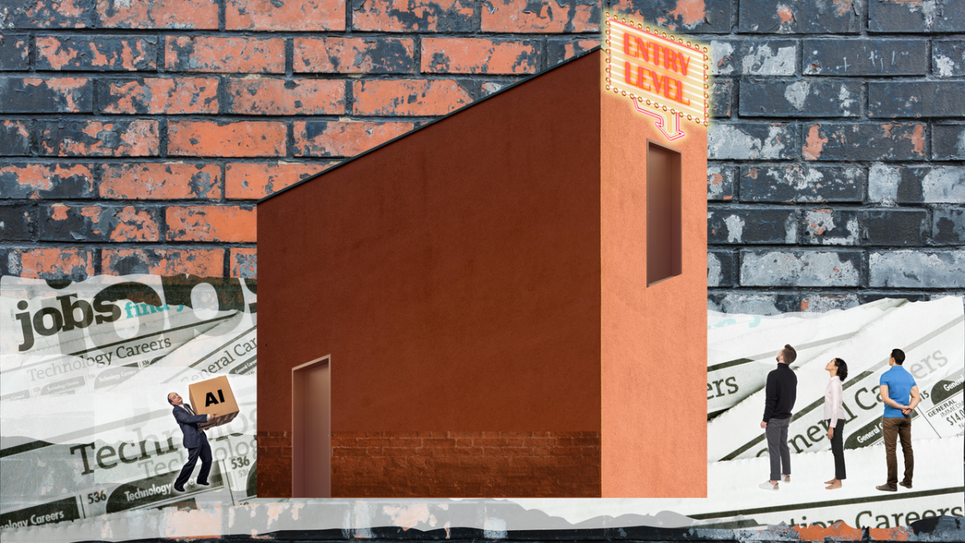
Entry Level by Janet Turra & Digit / Better Images of AI / CC by 4.0
Derek Mobley applied for more than 100 jobs at companies that screen applicants through software provided by a company named Workday. Every one rejected him. Mobley filed a class-action suit against Workday, and on June 22, a federal judge in San Francisco ruled that his case can proceed. Workday must answer claims that its hiring tools screened applicants in ways that violated California civil-rights law and the Americans with Disabilities Act, including by using proxies for disability such as gaps in work history.
As AI systems become more ubiquitous in hiring, courts are beginning to answer the question that policy keeps postponing: who owns an automated decision?
Workday says its software does not make hiring decisions. It evaluates qualifications, and the employer chooses. The vendor stands one step back from the result.
That arrangement is worth following, because a version of it is becoming the standard institutional answer whenever an automated process goes wrong. The institution reaches for whichever account puts the decision out of its hands. Sometimes the system acted on its own. Sometimes a person was in the loop and the call was theirs.
The two accounts sound like opposites, but they are the same move: institutional avoidance of accountability. A decision can be assigned to the software at the precise moment that assigning it to a person would cost the institution something. The software processes the decision. It also relocates the authorship of the outcome to somewhere harder to reach. The question that matters is where the institution sends the cost when the decision becomes indefensible.
These systems rarely have total autonomy: behind most of them sit people reviewing the system’s output, approving it, catching it before it reaches a customer, and repairing any mistakes after the fact. The appearance of autonomy is a convenient drape covering human choices.
Consider an example from 2024, when Air Canada argued before a British Columbia tribunal that its customer-service chatbot was a separate entity, answerable for its own statements. The bot had told a grieving passenger he could claim a bereavement fare after booking, which the airline's policy did not allow. The tribunal rejected the separation and held the airline answerable for the tools it puts in front of customers. That was a fight over one airfare. Workday raises the same question over who gets to work.
Workday is making the inverse argument. Its defense rests on humans: the employer, not the tool, decides. But human reviewers see the system's recommendation after it is formed, not the reasoning that produced it. A 2010 review published in the journal Human Factors found that people, experts included, tend to defer to automated outputs and scrutinize them less than their own judgment. The reviewer can object in principle, but the system is designed for throughput, not refusal. The record logs approval as a human decision. It does not log whether approval was the only practical decision available.
This is agency without authority: close enough to the decision to be blamed for it, too constrained to prevent it.
This position already has a name. Madeleine Clare Elish, in her research on automation, called the human placed to absorb blame for a system outside their control a “moral crumple zone”—the operator who takes the legal and moral force of a failure produced by design. The newer move is that the same institution can also run the opposite account when it serves: the system acted alone, no operator required. The moral crumple zone and the autonomous system are two settings on one switch, and the institution chooses the setting most likely to allow it to escape responsibility.
The constrained reviewer is merely the mechanism that produces the applicant’s rejection. They are part of a system built so that the nearest human can only ratify its recommendations, leaving no identifiable individual fully accountable. The reviewer’s inability to refuse on the inside produces, on the outside, a rejection with no author; “the employer decides” and “the system decided” turn out to be the same sentence, read from opposite ends. One end faces the regulator, the other faces the applicant. Neither end holds a person who will say the decision was theirs.
For the applicant, the injury is rejection delivered through a chain in which every participant can point one step away. By the time the decision arrives, responsibility has dispersed.
The strongest objection to all of this is also the most honest one. An AI system is not a person, and most do not act alone. Assigning blame to software is incoherent, but if software cannot bear responsibility, the responsibility does not evaporate. It stays with the people and institutions that designed the screen, set its thresholds, supplied its data, configured it, bought it, and benefited from it. Non-personhood is not a place where responsibility goes to disappear. It is the reason responsibility has to be assigned somewhere a person actually stands.
The push for comprehensive rules that might clarify where responsibility sits has stalled. On June 16, the European Parliament voted to postpone the AI Act's obligations for stand-alone high-risk systems, including hiring, to December 2027. In the US, lawmakers are moving in a narrower direction. On June 25, Rep. Nathaniel Moran introduced the AI Incident Reporting Act, which would require developers of the most advanced models to report dangerous capabilities to the Commerce Department. That bill aims at frontier systems, not hiring software. The pattern underneath is the same. As systems are increasingly described as autonomous, governance regimes are forced to ask who has to answer when something goes wrong.
However, this question is not waiting for comprehensive legislation to arrive. Litigation is answering it now, on a principle that predates any AI statute: an employer answers for a discriminatory outcome whether it built the screening tool or bought it. The same judge had already allowed an earlier claim to stand: that a vendor can share liability when an employer hands part of hiring to its tools. A handful of states and cities now require bias audits or notice for automated hiring. The early law is less friendly to disavowal than the industry's language suggests.
So the cost does not vanish when a decision is assigned to a system. It lands on the reviewer who approves what cannot be questioned and carries the error home as a personal lapse. It lands on the applicant a system screened out for reasons no one in the building can reconstruct, with no decision-maker to appeal to. It lands on the public record, which fills with outcomes that have effects and no authors.
A tribunal saw the move clearly when the sum in question was one airfare. The harder version is the same move made thousands of times a day, by institutions with better lawyers, while the broader rules are told to wait.
Oversight is real only when someone can challenge the system, override it, or explain it. A human who can only approve is evidence of process, not accountability. And if these early rulings hold, both the vendor that builds the screening tool and the employer that deploys it can be made to answer for the outcome.
Mobley is still on the record. So is everyone the system has sorted since. What has gone missing is the author.
Authors