Black Migrants Bear Brunt of ICE's Facial Recognition Push
Tsion Gurmu, Nekessa Opoti, Fatima Mohamed / Sep 24, 2026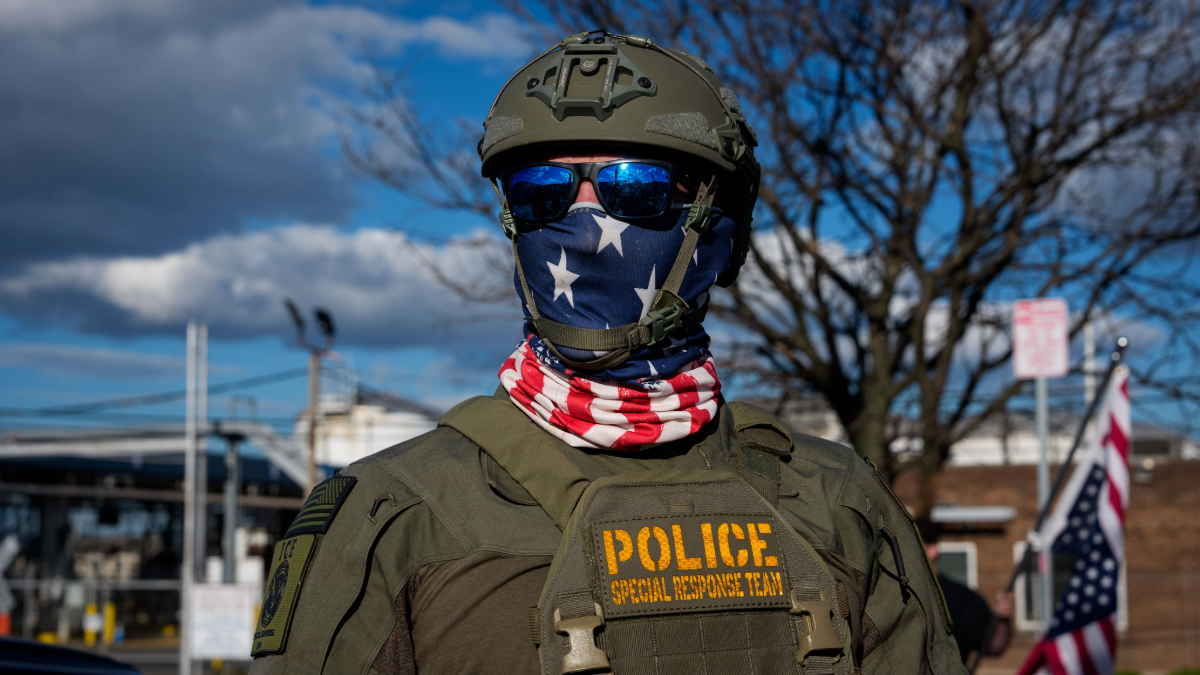
Immigration and Customs Enforcement (ICE) agents face off with protesters during a shift change outside of Delaney Hall Immigration Detention Center on June 7, 2026 in Newark, New Jersey. (Photo by Adam Gray/Getty Images)
Earlier this year, thousands of United States Immigration and Customs Enforcement (ICE) and Customs and Border Protection (CBP) agents were deployed across the Twin Cities and Minnesota in a massive federal immigration enforcement campaign launched by the Department of Homeland Security (DHS). The campaign, Operation Metro Surge, extended beyond borders and brought immigration enforcement directly into Minnesota’s communities, inciting widespread terror among communities and their families. According to Human Rights Watch, community members were so terrorized by ICE and CBP agents' excessive and unpredictable use of force, they restricted their movement and sheltered in their homes for weeks.
This siege disrupted nearly every aspect of daily life in Minneapolis, threatening residents’ ability to work, attend school, access health care, and seek legal protection. The City of Minneapolis estimates that the campaign resulted in 4,000 arrests and an estimated $700 million impact on the community and City government operations. Facial recognition technology played an integral role throughout this campaign, as federal immigration agents used Mobile Fortify, a smartphone facial-recognition tool that allows agents to scan the face of individuals they encounter and search it against multiple government databases. The use of this technology in this campaign reflects how facial recognition can be used to expand ICE’s reach, transforming immigration enforcement into a broader surveillance dragnet capable of reaching immigrants and citizens alike.
The expanded use of this technology is particularly concerning for Black migrants and other migrants of color, since facial recognition performs differently across racial groups. Black migrants are disproportionately exposed to the surveillance systems using facial recognition in the first place. Drawing on a submission by the Black Alliance for Just Immigration (BAJI) and the Immigrant & Racial Justice Solidarity Clinic and International Justice Clinic at UC Irvine School of Law to the UN Special Rapporteur on contemporary forms of racism, this article examines how facial recognition has become embedded throughout US immigration enforcement, including ports of entry, ICE enforcement, and biometric databases; how its deployment reproduces and amplifies existing racial inequalities; and why that expansion raises concerns under international human rights law, particularly the International Convention on the Elimination of All Forms of Racial Discrimination (ICERD).
The use of facial recognition during Operation Metro Surge is not unique nor isolated; it is one example of a much larger system in which the government uses biometric technologies throughout immigration enforcement. Facial recognition is now used well beyond identity verification at airports and ports of entry. The government now uses it across immigration enforcement; from ICE agents scanning faces during street-level enforcement operations, to remote check-ins through apps like SmartLINK, to large-scale DHS databases that store biometric information. These uses of facial recognition do not necessarily operate separately. Biometric information collected in one encounter can be retained, combined with other personal information, and accessed or shared across government agencies, allowing information collected for one purpose to later be used in other immigration and enforcement contexts. This system continues to grow. In July 2025, a Republican budget bill directed roughly $6 billion toward CBP technology, including expanded border surveillance, accelerating the federal government’s investment in the technologies that make this system possible.
This expanded use of facial recognition is particularly significant because there are racial disparities in both its design and deployment. facial recognition has historically been less accurate for darker-skinned faces since it is trained on white data and relies on databases which are more likely to categorize darker skinned people as “risks” or “threats” because of increased enforcement and surveillance of black and Latinx neighborhoods in the US. These existing patterns of racialized surveillance persist in the deployment of facial recognition, since they continue to be disproportionately exposed to surveillance technologies that perform less reliably on them. As a result, expanded use of facial recognition can subject Black migrants and other migrants of color to heightened surveillance, misidentification, wrongful stops or detention, and the collection and retention of their biometric information for further use across multiple enforcement contexts.
Further, as seen during Metro Surge, these harms can extend beyond the individual migrant to their families and communities. During the operation, US citizens were recorded. As federal agents were deployed into Minneapolis and the Twin Cities, they would racially profile residents, target individuals at protests or those observing enforcement activity, or go into public spaces they assumed to be immigrant spaces. When federal agents first encounter an individual in these operations, they do not immediately know their status, so they collect identifying information about them regardless of immigration or citizenship status. This expands immigration surveillance beyond those ICE initially sought. As a result, other people in the same spaces, such as family members and neighbors, can also be subjected to this surveillance. Therefore, facial recognition does not simply reflect existing racial inequalities; its use can reproduce and amplify them.
These racialized harms also implicate the US’s binding obligations under international law, which provides a framework for evaluating both the technologies themselves and state policies that authorize and expand their use. Under the International Convention on the Elimination of All Forms of Racial Discrimination (ICERD), the United States has a binding obligation to (1) prevent both direct and indirect racial discrimination, (2) refrain from engaging in and prevent acts of racial discrimination, and (3) mitigate structural racism by amending policies that perpetuate it. ICERD also requires states to regulate third-party vendors, ensure equal treatment before the law, and guarantee an effective remedy for people subjected to racial discrimination. Applied to facial recognition, this convention requires that the US look beyond whether the technology intends to discriminate along racial lines and examine how the government’s design and deployment of facial recognition impacts Black migrants and other migrants of colors in practice.
Racial bias is a design element of facial recognition
The racial bias inherent to facial recognition technology’s function starts before it is ever used at a border. Facial recognition systems are trained on datasets that are more than 80 percent light-skinned. Since there is not equal representation in the data the technology learns from as it develops, it becomes more accurate when it is deployed against those with lighter-skinned tones than darker skin tones.
Further, the cameras used to capture new images are typically calibrated for lighter skin tones, so image quality for darker faces is degraded before an algorithm processes them. As a result of these design choices, the error rate for facial recognition is as low as 1 percent for lighter-skinned men and as high as 34.7 percent for darker-skinned women. So, facial recognition performs differently depending on race and gender. In the case of one private vendor, errors were attributable to darker-skinned subjects 93.6 percent of the time. For another vendor, the errors were attributable to women 95.9 percent of the time. Further, facial recognition systems compare a person’s face against large databases of stored images.
Since Black communities are policed at higher rates, they are also disproportionately represented in those databases. Therefore, the databases that facial recognition draws from are already skewed against Black people as existing patterns of racialized surveillance are embedded within its design.
Surveillance at the border and ports of entry
Today, nearly every point of entry into the US has become a biometric checkpoint. Through its Traveler Verification Service, CBP now uses facial recognition at all international airports on entry, at 66 airports on exit, across 39 seaports, and at multiple land crossings.
The government’s use of biometric surveillance at such ports is only poised to expand. A proposed DHS rule would allow USCIS to require non-citizens of all ages to routinely submit biometric information throughout the immigration process until they become US citizens. This proposed policy would also expand the types of biometric information USCIS can collect, along with the circumstances in which this information can be reused.
Surveillance inside the country
Facial recognition does not stop at the border; it follows migrants into the interior of the United States. After entering the US, some migrants are placed in ICE's Intensive Supervision Appearance Program (ISAP) instead of being held in detention. Most recently, it has been estimated that the program consists of around 200,000 people. As part of the program, most participants are required to use the SmartLINK app, which uses facial recognition to verify migrants’ identities during ICE check-ins and confirms their location during the check-in. This app is used by roughly 84 percent of the program’s participants. While ICE claims that location is only tracked and recorded during required check-ins, independent testing by The Markup and Documented found that, for two SmartLINK users whose devices were examined, the app accessed location information when it was launched, as well as during required check-ins.
Glitches and malfunctions within the app can have severe consequences for migrants’ immigration processes and possibilities of re-detention: one user missed one check in because his phone died, and another because the app malfunctioned. Technological malfunctions like this can potentially lead to findings of non-compliance, that may ultimately result in increased reporting requirements, re-detention, and separation from family and community. Users are aware of these risks. Some users state that they feel “constantly exhausted and anxious” living under this app’s surveillance. In one law review account, a woman placed in the program—a composite of the author's clients—stated that she was scared that, should the app malfunction, she would be re-detained and separated from her siblings.
The underlying databases
The facial recognition systems discussed above, such as CBP Home, airport scans, and SmartLINK, do not operate independently. They all feed into a larger DHS system for collecting, storing, and sharing biometric information. IDENT, DHS’s current biometric database, is being replaced by the Homeland Advanced Recognition Technology System (HART). Instead of only storing fingerprints and faceprints, HART goes further, connecting those biometrics with other information, including political affiliation, religion, location, and known associations. The database is not just for CBP; it can be accessed by the Department of Defense, the Department of Justice, state and local police, and foreign governments.
The lack of transparency surrounding this database has led watchdogs to call it a “black box,” since people are not notified before their information is collected, and they don’t know what information is stored within the database and who has access to it.
The expansion of facial recognition throughout immigration enforcement is also largely driven by private corporations, who develop and operate key parts of this surveillance structure. Clearview AI, which scrapes photos from social media and the open web, holds a sole-source contract with Homeland Security Investigations (HSI) contract for and was founded by a figure who has documented associations with white-nationalist and far-right figures. Palantir Technologies builds the data-integration infrastructure that lets ICE fuse biometric, location, and biographic data into a single profile. These companies consider key information about how their proprietary technology works as confidential business information that competitors should not be able to access, so they argue that they are not required to disclose training data, error rates, or the methods the systems relied on to produce particular results. This makes it very difficult to challenge or independently evaluate these systems, limiting the companies’ accountability.
Further, data-sharing extends beyond the US border. At the time our report was submitted to UN Special Rapporteur, the government had biometric-sharing agreements or letters of intent with five countries: Mexico, Colombia, Belize, Chile, and Ecuador. Since then, the government has expanded biometric data sharing throughout the region. Most recently, in July 2026, DHS entered into an agreement with the Caribbean Community’s Implementation Agency for Crime and Security (CARICOM IMPACS), creating a framework for sharing biometric and biographical information across the Caribbean. The agreement includes particular cooperation with Caribbean countries that operate Citizenship by Investment programs, including Antigua and Barbuda, Dominica, Grenada, Saint Kitts and Nevis, Saint Lucia, and Saint Vincent and the Grenadines. This means that US immigration enforcement no longer begins when someone physically reaches the US border. Instead, because biometric information is shared with other governments, US authorities may identify and monitor migrants while they are still traveling through Latin America, exposing migrants to profiling and refoulement long before they reach US soil.
From historic Black Codes to facial recognition Black codes
The racialized, uneven consequences of these technologies often go unscrutinized. This, in part, is because the government justifies facial recognition by arguing that it is preventative rather than punitive. More specifically, it argues that facial recognition is necessary for national security, prevention of fraud, management of borders, and minimization of crime. However, in doing so, these technologies make determinations about who is considered as a “risk” or “threat.”
These determinations are not neutral; they often reflect older racialized assumptions about riskiness that predate facial recognition by centuries: lantern laws, which required Black, Indigenous, and mixed-race enslaved people in colonial New York to carry lanterns after dark so they could be more easily monitored; slave patrols, which monitored and controlled enslaved Black people; Black Codes, which criminalized Black life after emancipation; and COINTELPRO, which surveilled Black civil rights and liberation movements. In this reading, facial recognition does not simply police the border; it helps construct it, transforming it into a network of surveillance that digitizes colonial logic and sorts bodies into categories of belonging and threat along racial lines.
A path forward
In their report to the United Nations Special Rapporteur, BAJI and the UCI Clinics propose that the solution to decolonizing this technology is embedding a collectivist rather than individualistic worldview into how it is designed and governed. An individualistic approach asks how a system may efficiently identify an individual. On the other hand, a collectivist approach asks how a system may affect relationships, communities, and human dignity.
Recalling the 2001 Durban Declaration and Programme of Action, which identified colonialism as one of the historical roots of contemporary racism, the report argues that addressing discrimination in facial recognition technology requires confronting the historical structures that continue to shape its design, deployment, and use. This approach mirrors Jose Cossa’s contribution, Cosmo-uBuntu, an approach derived from the African philosophy of Ubuntu, which is rooted in the idea that “a person is a person through persons.” In other words, Ubuntu understands personhood as fundamentally relational rather than individualistic. Applied to technology governance, that means evaluating systems not only by whether they function efficiently, but also by how they affect human dignity, communities, and relationships.
This decolonial praxis offers an alternative to the individualistic assumptions that often shape Western approaches to technology design, asking developers and agencies to examine not just what a system does, but why it was built that way, and to give the communities most affected by it, including the African Diaspora, a meaningful role in its future design and oversight.
Communities under surveillance
The consequences of expanding immigration surveillance are already visible, as facial recognition technology has become an additional tool of oppression employed against our country’s most vulnerable communities. In Springfield, Ohio, in the aftermath of the revocation of hundreds of thousands of Haitian immigrants’ Temporary Protected Status (TPS), ICE agents detained at least thirty local Haitians at the Butler County Jail. Haitian immigrants in Springfield have been shackled with ankle monitors, have had their biometric information collected through facial recognition technology without their consent, have been zip-tied in front of their children, pulled off of their job sites and out of their homes. They are now scared to leave their homes, go to grocery stores, or take their children to school. Through these methods of intimidation and oppression, it is evident how facial recognition technology has expanded the scope of the subjugation Black and Brown people can experience at borders, in their homes and communities, and as they move through the world.
While the racialized error rates associated with facial recognition technology are indeed concerning, facial recognition technology still causes real harm when it operates as intended, as it functions within existing systems of power. In these systems, it furthers existing patterns of over-policing communities of color that are disproportionately subjected to immigration enforcement. Therefore, the question is not simply whether the technology is accurate. Rather, we must examine who is subject to the increased surveillance it offers and what happens with the information it collects.
Authors