Cape Town is Approving Data Centers with Rules That Still Treat Them Like Warehouses
Eunice Masson, Lyse Comins, Athandiwe Saba / Sep 9, 2026This story, first published by The Continent, was made possible with support from the Pulitzer Center and is part of the Big Tech’s Invisible Hand, a cross-border collaborative investigation led by Brazilian news organization Agência Pública and the Centro Latinoamericano de Investigación Periodística (CLIP) with partners including Tech Policy Press.
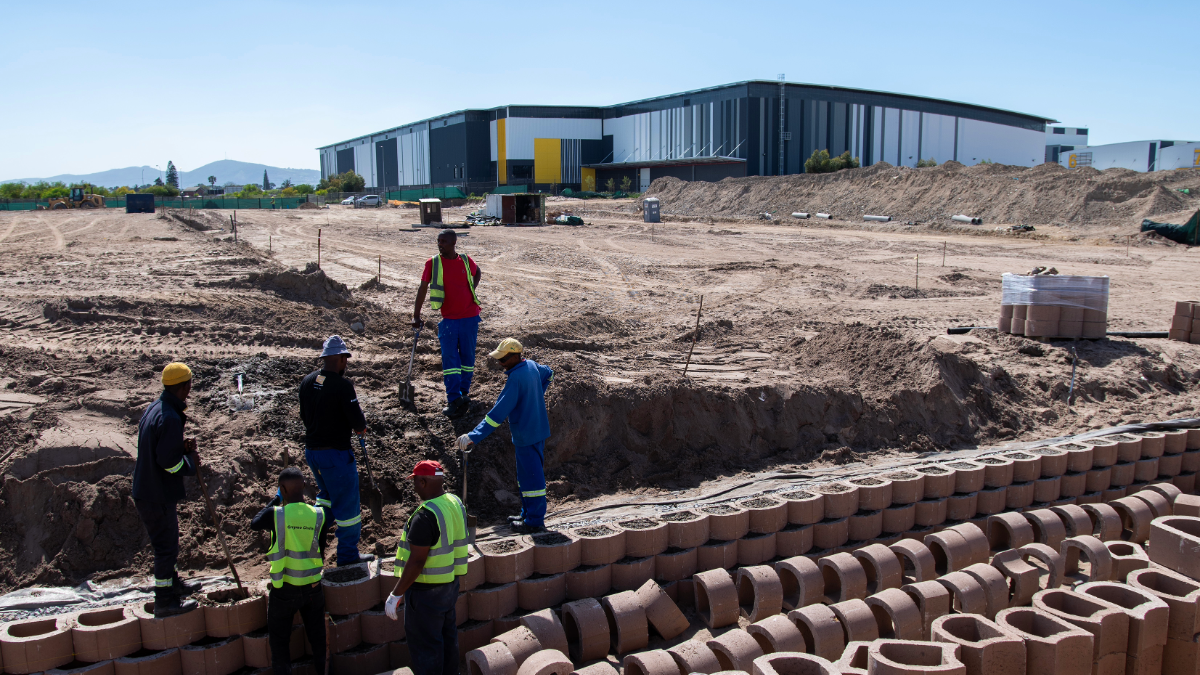
A major data center project underway in Cape Town, South Africa. Photo: David Harrison/The Continent
For 66-year-old Ncediwe Vanqa, water comes one trip at a time. She walks from her less than 200 square foot dwelling in Barcelona, an informal settlement in Gugulethu, Cape Town, to a communal tap as many as seven times a day. She uses a communal pit latrine and, in emergencies, a bucket. To save electricity, she bakes bread using a paraffin heater and uses its heat to warm her home.
Yet across the freeway, less than a mile and a half away, the city of Cape Town has opened the planning door to infrastructure operating at an entirely different scale. In July, the City's Municipal Planning Tribunal approved a planning application by King Air Industria, a multi-billion-rand industrial and logistics park, for two proposed data centers that planning documents identify as intended for Equinix, a US multinational.
Equinix, one of the world’s largest data-center operators and a key infrastructure provider for hyperscalers such as Amazon, Microsoft and Google, disputes that characterization.
Its expansion in Cape Town is the focus of this story, part of Big Tech’s Invisible Hand, a cross-border investigation examining how global technology companies are influencing the rules, policies and public infrastructure.
The company told The Continent it “has not submitted any planning or development applications for a data center in Cape Town” and that “there are currently no development applications under consideration for the site.”
But the city’s own account shows that Equinix met officials at least three times to discuss its data-center plans. Dozens of planning documents also link the King Air land-use application to Equinix’s proposed development of the site.
At the center of the King Air dispute is the question of how much water and electricity the proposed Equinix hyperscale data centers will require. Hyperscale data centers are notorious worldwide for consuming inordinate amounts of water and/or electricity to cool the machines.
In its appeal against the building of one of these in Cape Town, the Legal Resources Center (LRC), a public-interest law organization, estimated that, if conventional evaporative cooling were used, the two data centers could consume about 1.2 billion gallons of water a year. That is almost 3 million gallons a day, roughly equivalent to the daily water use of 68,500 Cape Town residents, based on the city's average consumption benchmark. For a city that narrowly avoided “Day Zero” during the 2018 drought, the potential demand is significant.
Equinix did not respond to questions relating to the proposed data center resources. However, in its papers, King Air told the Tribunal that the final amounts of resource usage would be made available in the site development planning phase.
In the US, data center expansion is facing growing community resistance. According to Data & Society, an independent nonprofit research and policy institute in the US, global data center energy consumption has grown 12% in five years and could double by 2030. Water use is also rising. The organization says consumption by Meta, Apple, Microsoft and Google has increased 60% since 2020. As data centers expand into communities, the organization argues that where they are built has become an increasingly political decision, with consequences for local economies, health, water and energy supplies.
According to the documents before the Municipal Planning Tribunal, the proposed system could need about 157 megawatts. “If operated continuously near this level,” throughout the year, the data centers could consume roughly 1.4 to 1.5 billion kilowatt hours of electricity annually, explained Dr. Chantelle van Staden, a senior lecturer at the Stellenbosch University’s Department of Electrical and Electronic Engineering. “This could amount to the annual electricity use of a quarter of a million average Cape Town households,” said Van Staden.
That lack of information troubled at least one member of the tribunal when it considered the land-use approval in July. “Most of us here today actually do not know what is required in respect of water and electricity demand for a facility that we are asked to approve, as no details thereof have been made available,” Municipal Planning Tribunal panel member Wally Johnstone said at a July 14 meeting. Johnstone was the only one of five panel members opposing the approval of land use for data centers.
The city disputes that the development was approved without adequate consideration and that its energy department had concluded that there would be sufficient supply. The tribunal papers also revealed that Equinix has already paid shared network charges for 144 megawatts of capacity amounting to R33 million (around $1.9 million). The city said some technical details would be assessed later.
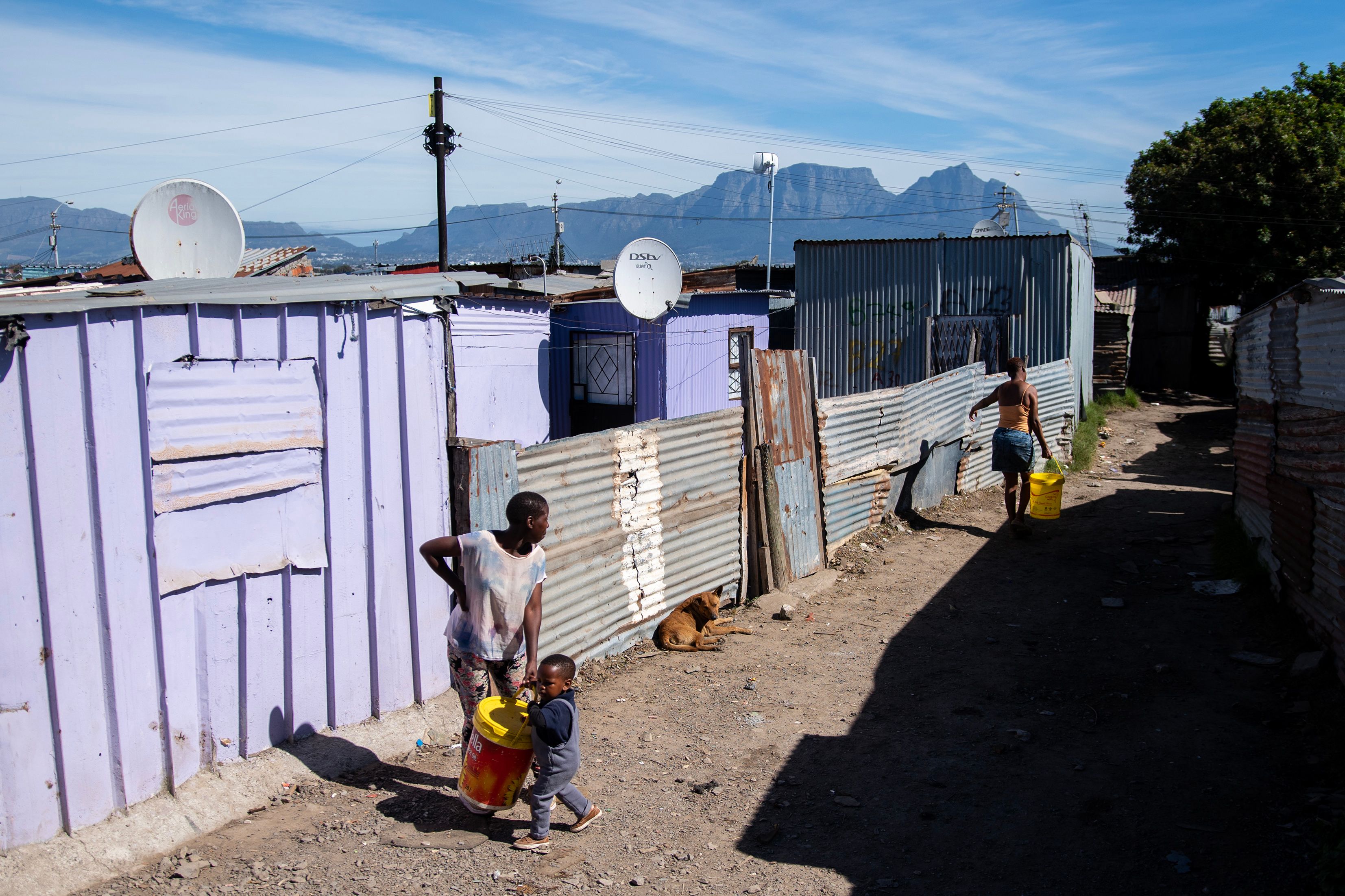
In Barcelona, residents have to walk and use buckets to get water just a little more than a mile away from Equinix's data center. Photo: David Harrison/The Continent
The people on the other side of the grid
Weeks before the tribunal approved the King Air application, Public Protector Kholeka Gcaleka released findings concerning municipal service delivery to informal settlements Langa and Khayelitsha, which are in close proximity to Equinix’s proposed data centers. Khayelitsha and Langa are both high-density, mostly poor townships less than 6.2 miles away from the proposed site. In June, after a four-year-long investigation, the public protector found that Cape Town had failed to provide adequate basic services to residents of the two townships, including water, sanitation and electricity. The failures were serious enough to amount to “maladministration” and “prejudice”.
The city told the investigation that budget constraints, infrastructure backlogs and competing service-delivery demands had prevented it from fixing some of these problems. The public protector acknowledged the financial pressures but found they did not absolve the City of its constitutional obligations, with systemic service-delivery failures continuing despite some improvements.
For residents and Housing Assembly members such as Vanqa, the argument is about who gets scarce resources. The LRC told the tribunal that their objection originates from “a context of acute and overlapping resource constraints in the City of Cape Town where land, water and energy systems are already under significant pressure.”
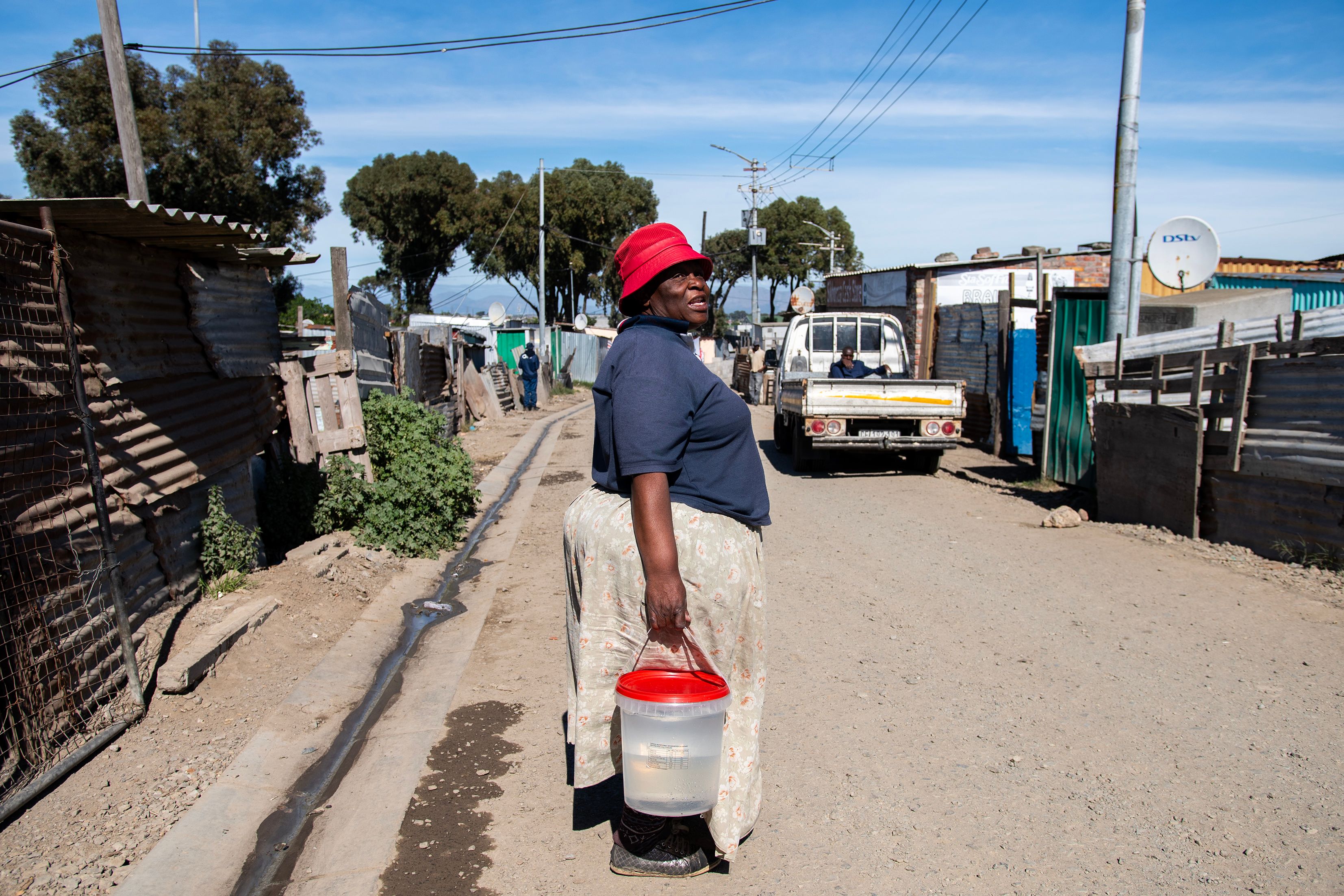
Seven times a day: Ncediwe Vanqa uses buckets to access water in Barcelona, an informal settlement in Gugulethu, Cape Town. Photo: David Harrison/The Continent
Hyperscale, not a warehouse
South Africa is not new to data centers. Data Center Map, an industry directory, lists about 64 operating data centers in South Africa and another 10 planned. But hyperscale facilities bring infrastructure demands of a different order, with electricity requirements that can run into hundreds of megawatts. The regulations have not kept pace. South Africa has no dedicated national data-center policy, while Cape Town has no separate land-use category for hyperscale facilities. The city said data centers are “typically grouped under commercial/industrial users," the city told The Continent. They are assessed under existing industrial or warehousing rules.
Johnstone called this “wholly inadequate” and added that it was “simplistic to consider a data center as a warehouse that only stores computer systems.” The LRC went further, describing the classification as “patently incorrect and possibly misleading.”
Speaking on how the application before the tribunal uses legislation that classifies data centers as warehouses, Grant Oosterwyk, a senior lecturer in information systems at the University of Cape Town who previously worked at a small-scale data center, said the current approach creates an artificial blind spot.
“This allows these facilities to avoid the rigorous, baseline industrial impact assessments that a facility of this scale would normally trigger under a modern planning framework,” Oosterwyk said.
“Treating a 100 megawatt facility with industrial-scale cooling, heavy diesel backup, and continuous heavy vehicle movement as a simple storage warehouse is a profound regulatory mismatch. The category has simply not caught up with the infrastructure being built inside it.”
What Cape Town won't disclose about its data center pipeline
The proposed Equinix development is also not the only hyperscale project being contemplated in Cape Town. Brett Herron, a member of the Western Cape Provincial Parliament, told The Continent that Cape Town is "courting" four hyperscale projects.
He identified Equinix's proposed King Air facilities, Teraco's planned 60 megawatt expansion and Cavaleros Group's announced 360 megawatt Cosmas Data Cities project. Herron calculates their potential combined demand at approximately 580 megawatts. Based on publicly available information, he calculates that if all the projects were built at the stated capacities, their combined demand would equal roughly 35% of Cape Town’s current peak electricity demand.
Deputy mayor Alderman Eddie Andrews said Cape Town has approved five data centers and has another two under assessment. But the city would not name the companies behind those projects, citing the Privacy of Personal Information Act (POPIA). However, it did not explain under which provisions of the act prevented it from disclosing electricity-load information or why project-level demand could not be released.
Aside from legislation, the city’s Lance Greyling, the City’s Director of Economic Development and Investment, confirmed that he met Equinix three times between July 2025 and June 2026, all at the company’s request.
At the first meeting in July 2025, Greyling said, Equinix told him of “their intention to invest in data centers in Cape Town.” Four months later, Greyling, mayoral committee member James Vos, city officials and Western Cape government representatives met the company after it had bought land at King Air Industria. Greyling said Equinix discussed “their intentions in relation to the way forward for the proposed business.” At a third meeting in June, the company provided a further update on its planned data-center investment.
Greyling said, “I have met Equinix before at their request but have at no stage held discussions on statutory approvals.” Yet there were no agendas or minutes kept. He said his role is to engage potential investors and promote Cape Town as a place for economic growth, provided they meet the necessary legal requirements.
In South Africa, meetings between officials and private investors are not routinely disclosed or regulated. There is no evidence Equinix influenced the statutory approval process, but the company met Cape Town’s investment-promotion office repeatedly as its data-center plans developed. With no minutes kept, there is no detailed public record of what was discussed.
The Continent interviewed two city councillors who said the implications of data center expansion had not been widely debated in the city council. Khalid Sayed, the ANC’s leader in the Western Cape, told The Continent that data centers, including their water and electricity demands, have barely featured in political forums. He said this may reflect both a lack of understanding and oversight failure.
Not just Cape Town
Cape Town is not alone. eThekwini Municipality acknowledged that its planning scheme has no specific definition for hyperscale or AI data centers and said it was still considering how to regulate their infrastructure demands.
Yet the municipality in April said that its full council had authorized the city to enter into an agreement with the Korean South Power Consortium to explore a proposed AI data center on municipal land in the south of Durban. Council documents estimate the development could cost between $3 billion and $10 billion and state that the municipality would provide the land and infrastructure required for the project. The city said the project's water and electricity requirements have not yet been determined.
Marketing and communications director Mandla Nsele said the issues raised regarding data center demands "are the subject of internal discussions," meaning the municipality is unable to provide detailed data.
One of the council members against the development, Andre Beetge, said a council report regarding the project does not “adequately address the energy demand trajectory associated with AI data centers—projected to escalate dramatically over the next few years.”

Big Tech's Invisible Hand is a cross-border, collaborative journalistic investigation led by Brazilian news organization Agência Pública and the Centro Latinoamericano de Investigación Periodística (CLIP), together with Business Day (South Africa), Crikey (Australia), Cuestión Pública (Colombia), El Diario AR (Argentina), El Surti (Paraguay), Factum (El Salvador), ICL (Brazil), Investigative Journalism Foundation - IJF (Canada), LaBot (Chile), LightHouse Reports (International), N+Focus (Mexico), Núcleo (Brazil), Primicias (Ecuador), Tech Policy Press (USA), The Continent (Pan-Africa), and Tempo (Indonesia). Reporters Without Borders and the legal team El Veinte supported the project, and La Fábrica Memética designed the visual identity.
Authors