China Is Running a Different AI Race
Prince Osaji / Sep 17, 2026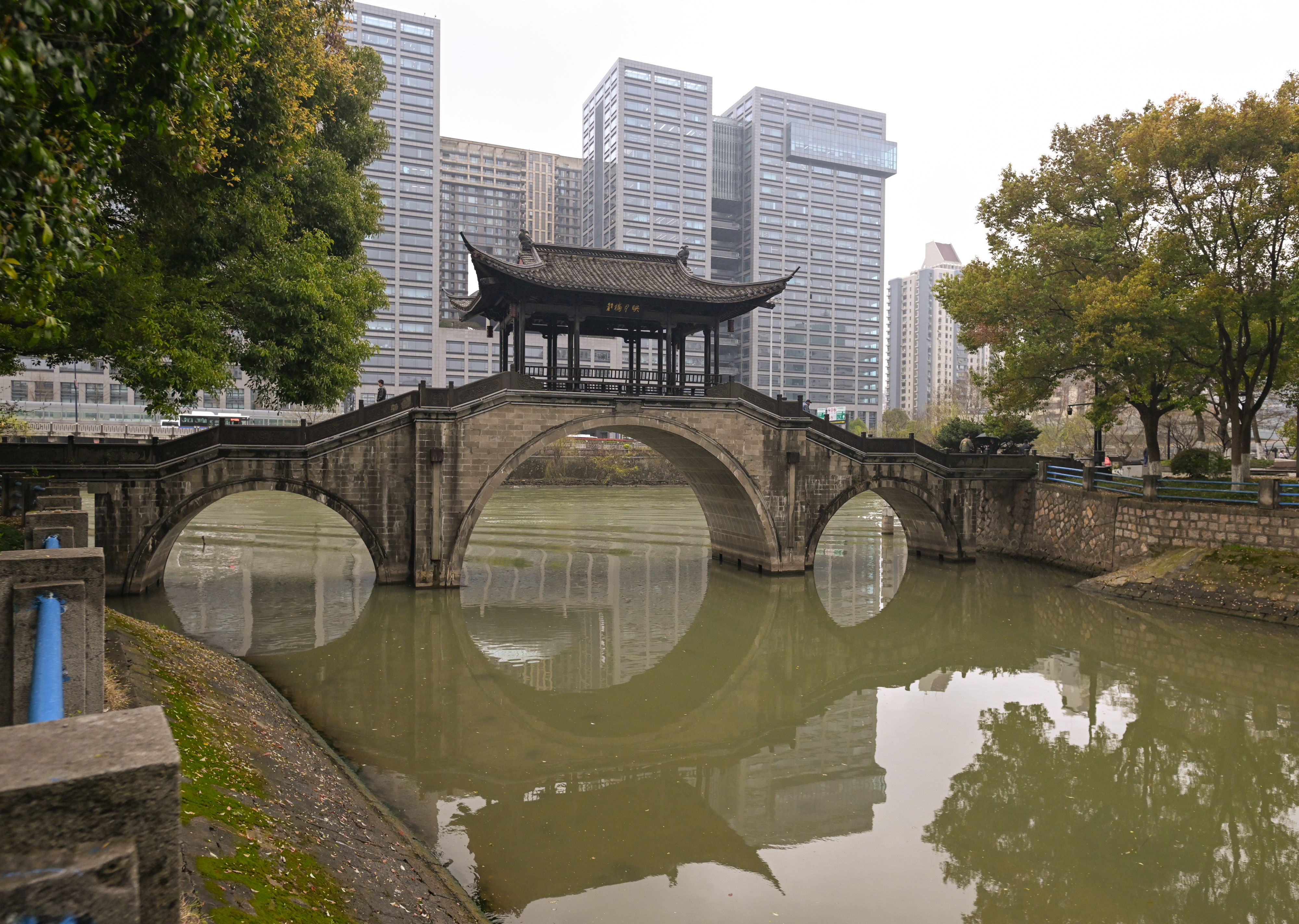
A traditional Chinese arch bridge sits in front of the 'Huijin International Building' — the building that hosts DeepSeek's headquarters, in Hangzhou, Zhejiang Province, China (2026). (Photo by STR/NurPhoto via AP)
In just a few days, President Trump is slated to host Chinese President Xi Jinping for a high-level bilateral summit. Several topics will be discussed, including artificial intelligence, as confirmed by Treasury Secretary Scott Bessent at the recent G20 Finance Ministerial. In order to ensure a successful and productive meeting, it is imperative that the Trump administration goes in with a clear awareness of China’s goals and intentions with AI. This requires developing a comprehensive understanding of the AI race China is running and how it differs from the one the US is running.
Like the US, China recognizes AI as one of the most transformational tools of this generation and has committed itself to becoming a world leader in this technology. Yet, unlike the US, China recognizes that the dominant AI power may not be the one with the most powerful model. While Beijing is still investing in AI innovation, it is pursuing a multifaceted AI strategy that strongly promotes widespread international usage of its systems. As a result, China is prioritizing the development of AI systems that are cheap, open-weight, and diplomatically exportable.
To provide open-weight models, China has sought to lower the cost of training these models in the first place. Because these models can be downloaded locally without any connection to the original cloud provider, they are harder to monetize, requiring the provider to lower the initial cost to make them viable. China accomplishes this objective in three main steps: control, coordination, and creation.
The first step, laid out in China’s 15th Five-Year Plan, consists of centralizing control over where data centers are built. The central government recognized that local governments were racing to build poorly considered data centers with no realistic idea of local demand or electrical capacity, so the government enacted this measure to curb that inefficiency.
China has also focused on coordinating how its AI resources are being used. China is currently building the National Unified Computing Power Network, which pools compute infrastructure together and allows companies to use underutilized data centers. By better coordinating the use of computing resources, China ensures that its companies can cheaply access computing power without immediately resorting to the extremely costly effort of building new data centers. China also launched the “Eastern Data, Western Compute” initiative in 2022, which concentrates workloads requiring high levels of compute in more rural western provinces where energy is more easily accessible. The result is cheaper electricity, which leads to cheaper compute.
The final step is creation: the Chinese private sector has developed new approaches, and at times popularized existing architectures, to enable models to produce high-quality outputs with significantly less compute. The mixture of experts architecture—which works by running only the necessary parameters for a given input as opposed to every parameter—is one example of a design most Chinese models have adopted. Multi-head latent attention, a compression method introduced in DeepSeek-V2 to save memory, and multi-token prediction, which speeds up large language model (LLM) inference, are also used by many Chinese models to maximize output quality with minimal computing cost.
These measures have driven down the cost of training and running AI models immensely. US models can cost up to 10 times the cost of running comparable Chinese models. Moonshot’s Kimi K2.6, China’s top model until the launch of Kimi K3 in July, runs at around $1.71 per million tokens, while GPT-5.5, the top model in the US, runs at approximately $11.25 per million tokens. There is an even bigger pricing gap with DeepSeek’s models, which operate at less than one percent the cost of running comparable systems in the US. Chinese models as a whole are significantly cheaper than US models, allowing them to be more freely distributed.
This cost advantage enables both the public and private sectors to prioritize the development of open-weight models. On the government side, several AI policy documents promote the importance of these types of models. China’s 2017 New Generation Artificial Intelligence Development Plan (AIDP) highlighted open-weight sharing as one of the four basic principles that should drive China’s AI approach. In September 2024, the central government announced the “AI Capacity-Building Action Plan,” a program by the Ministry of Foreign Affairs to share its open-weight AI models, technical expertise, and digital infrastructure with developing countries. The next year, China’s AI+ Initiative repeatedly emphasized global cooperation for AI and promoting open-weight models.
These principles have played a central role in the development of AI systems from the private sector. Many of China’s leading-edge AI models, including Alibaba’s Qwen, DeepSeek’s R1, Zhipu AI’s GLM, and Moonshot’s Kimi K2.6, are all open-weight models. As a result, Chinese models are widely popular. Earlier this year, Chinese models surpassed US models both in the number of monthly and overall downloads on their platforms. By October 2025, Alibaba’s Qwen family of models became the most adopted open-weight AI system on the planet, and by one industry estimate, up to 80 percent of developers using open-weight tools used Chinese models as the base layer. China’s open-weight strategy is reducing the barriers to adoption and encouraging rapid growth in the usage of its AI systems.
Individual provinces themselves have also worked to stimulate the adoption of China’s AI stack. While provinces with robust AI industries—such as Beijing, Shanghai, and Anhui—have primarily focused on becoming AI innovation leaders, provinces with less robust industries have focused on using AI as a way to bolster international ties. Yunnan, for example, plans to place a high priority on developing AI products for Southeast Asia. Gansu stated that its goal is to provide cross-border e-commerce and other AI services to the Central Asian and West Asian markets.
Guangxi, in particular, has made clear its goal to use AI to strengthen ties with the Association of Southeast Asian Nations (ASEAN) and turn itself into an ASEAN base for AI innovation. Over the past few years, Guangxi has hosted multiple ASEAN AI conferences, including the China-ASEAN AI Summit and the Forum on China-ASEAN Technology Transfer and Collaborative Innovation. In early 2025, Laos and Guangxi jointly established the China-Laos AI Innovation Cooperation Center to enhance Laos’ AI capabilities and share China’s AI models and expertise. Later that year, the central government announced the opening of the China-ASEAN AI Application Center—again in Guangxi—which would build AI infrastructure and provide ASEAN countries with access to Chinese AI.
Going into this summit, the US needs to recognize that it is not simply the best AI systems that will win out: it is the systems that are the most popular and most accessible. China understands this, which is why it will likely approach the summit with the goal of preserving or expanding the reach of its AI technology. To counter this effort, the US must develop a concrete strategy to accelerate adoption and ensure that US AI systems become the global standard.

Authors