Copyright Law Wasn’t Built for the AI Era. We Need ‘Learnright.'
Thomas W. Malone, Frank Pasquale / Jul 16, 2026The authors, along with Andrew Ting, are the co-authors of “Learnright, and Fair Use: Rethinking, Compensation for AI Model Training,” a research paper published in the Northwestern Journal of Technology and Intellectual Property.
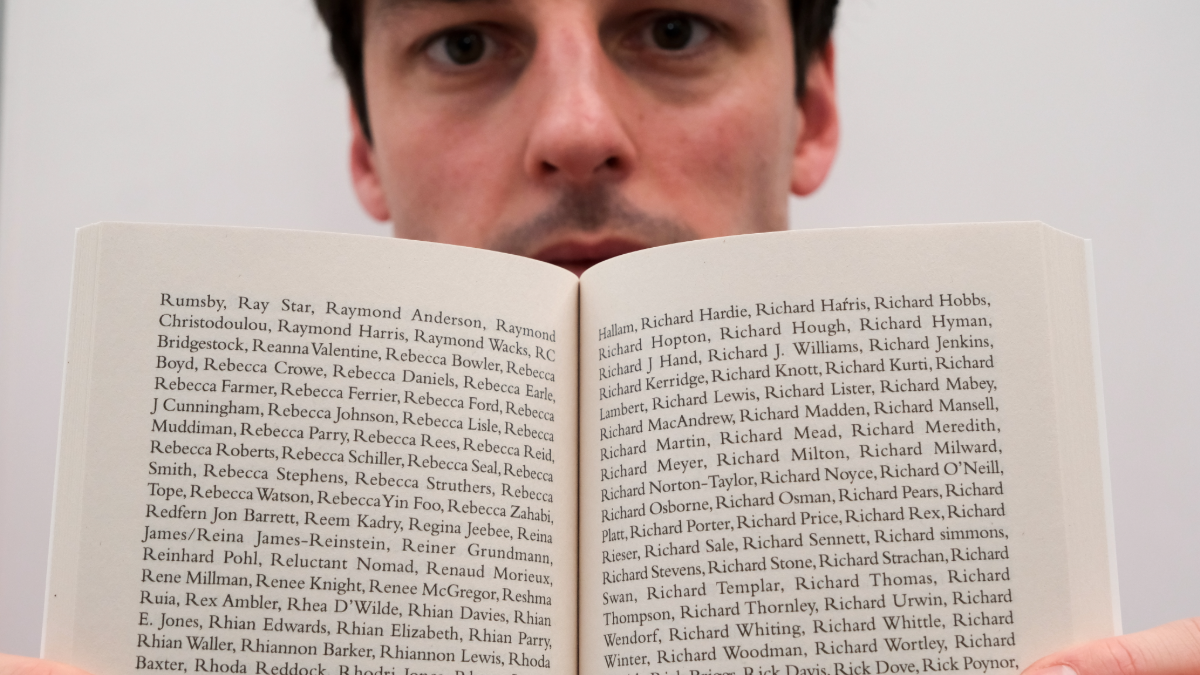
March 10, 2026: The London Book Fair (LBF) at Kensington Olympia. Names of authors in an otherwise blank book titled Don't Steal This Book protesting against AI companies taking authors’ works. (Matthew Chattle/Future Publishing via Getty Images)
Throughout 2026, artists, actors, writers, and others have joined together to protest against companies using their creative output to train AI without authorization. Founders of the Creators Coalition on AI stressed that “technology should strengthen human creativity, not undermine it.” The Human Artistry Campaign followed suit with a “Stealing Isn’t Innovation” initiative. And nearly 10,000 writers contributed to the publication of a book titled Don’t Steal This Book that was empty of text except for the names of the authors. The book seeks to represent AI’s impact on authors’ livelihoods if left unchecked.
As of March 2026, there are 87 copyright suits vs. AI companies in the United States, but litigation and protests alone won’t solve these problems. AI has changed what it means to “learn” from content, and current copyright law wasn’t designed for this reality.
Copyright law has long drawn a clear line: you can't copy someone's work without permission, but you can learn from it. This bargain was premised on the limits of human learning: for example, no one person could instantly access, memorize, and produce variations of thousands of artists’ works. AI systems break this model by ingesting millions of articles, books, and images at speeds and scales that were once impossible and can then generate content that directly competes with the originals. When an AI system can instantly mimic or paraphrase creative content it reduces the incentive to purchase original work. As such, it’s hard to imagine many current markets for creative human expression surviving.
That’s why we need a new intellectual property protection — a “learnright law,” that gives creators control over whether AI systems learn from their work. We can do this by adding a seventh exclusive right to copyright law: AI companies would need to license content before using it for training, compensating creators through market-based fees.
Learnright would benefit both creators and the AI companies that rely on them. True, licensing would cost AI companies in the short term. But if they continue using copyrighted work to train AI without paying for it, they'll erode the very incentives that drive creation in the first place.
Learnright would change this. It wouldn't require the government to set prices or micromanage the market. Instead, it would work through licensing systems similar to those that already exist in other industries. For instance, ASCAP, a non-profit organization, collects performance royalties from radio stations and venues, then distributes them to songwriters and publishers. A similar clearinghouse could manage learnright licensing.
Or specialized brokers could emerge. Some might focus on news, others on fiction, or art—there are already examples, such as ProRata.AI and Tollbit. Creators would choose brokers to negotiate deals on their behalf, and pricing would be determined by supply and demand.
Large companies with vast training needs, like Google and OpenAI, would pay more; small startups would pay proportionally less. The key idea is to assure some equitable distribution of the “AI bounty” now reflected mainly in record high stock prices of AI firms.
Of course, any law needs enforcement mechanisms. We propose three:
- Mandatory auditing of AI company training data, focusing only on inputs rather than trying to trace from inputs to outputs. Companies would need to document for auditors all the data sources they used for training.
- Whistleblower reward programs, in which employees who report unauthorized content use would receive significant financial incentives, creating internal compliance pressure.
- Meaningful penalties beyond just licensing fees, with steep enough costs that make compliance the obvious choice.
The good news is that a constituency to support learnright already exists. Plaintiffs in lawsuits and groups like Creators Coalition Against AI are organized and mobilized. They're natural allies for this legislative push, as are small-scale artists and authors and, frankly, anyone who values original writing, art, and music. We all have a stake in preserving the incentives that produce them.
What’s more, as AI regulation becomes a political priority, learnright offers a market-based solution that doesn't require government price-setting or heavy-handed intervention. And since content creators would need to opt in to protect their work, the system wouldn’t be clogged by content whose creators didn’t think it was valuable enough to register. It's a framework both parties could support.
To be sure, some legal scholars remain skeptical, arguing that collective licensing would be too cumbersome. However, useful compensation schemes have emerged in many new technological contexts. They can do so again.
There's also an important legal principle at play: unjust enrichment. This doctrine holds that when a court finds that someone has received an unfair benefit at another's expense, they must make restitution, even without a formal contract. AI companies are profiting from copyrighted works while creators receive nothing. That alone makes a compelling case for compensation, regardless of copyright law’s present limits.
AI has evolved faster than the law. It's time for the law to catch up.
Authors