Data Minimization is Imperative for the Age of AI Agents
Brett Frischmann, Bruce Schneier / Nov 18, 2026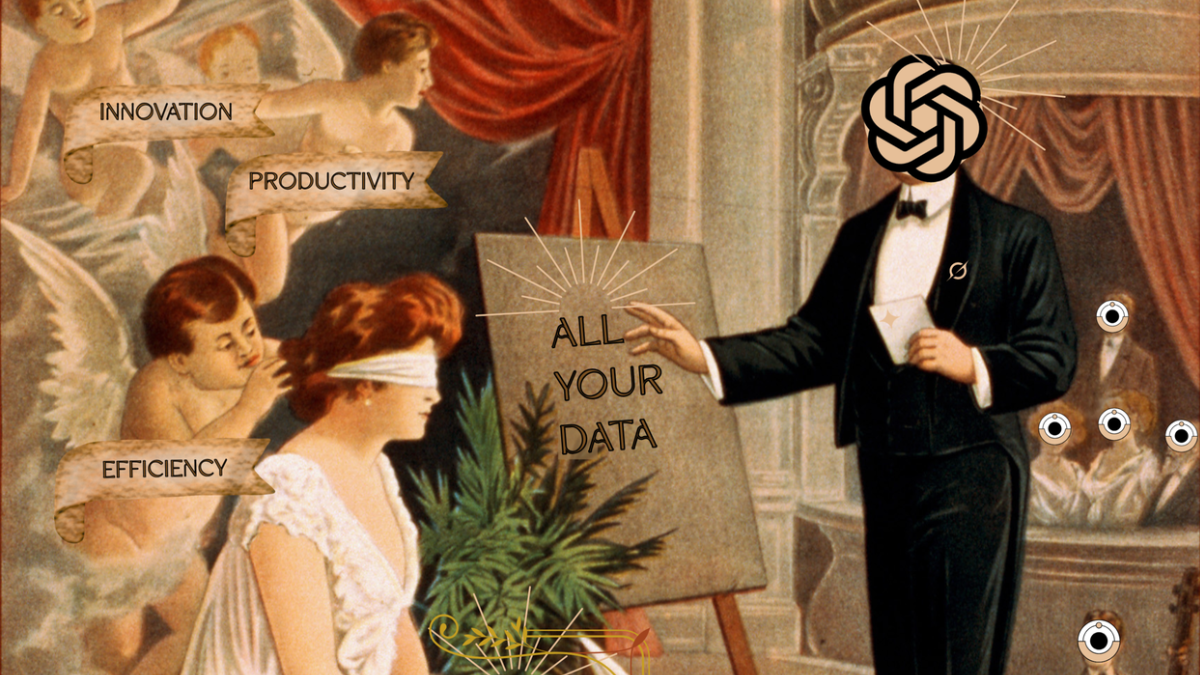
The AI-Deal by Daniela Zampieri / Better Images of AI / CC by 4.0
Surveillance is the business model of the internet. Personal data drives the advertising industry, which in turn drives the surveillance economy. This data is exploited in other ways as well, ranging from personalizing social media feeds to training AI. Curbing industry's use of our data is essential to solve the problems of engineered addiction, manipulation, and decaying democracy. We failed to regulate surveillance in social media; we have a limited chance to make a different choice with AI agents. We need robust data minimization rules for AI agents.
Pretty much any industrial application involving the internet collects as much personal data as possible. Sometimes users can express a limited set of privacy preferences through browsers, apps, and plug-ins. There are small pockets of privacy: both technical ones provided by tools like encryption, and legal ones involving laws like Europe’s GDPR and California’s CCPA. But in most situations, people are allowed to “consent” to the basic exchange with notice and a few mindless clicks, which is a way to pretend people exercise meaningful choice when they don’t. Data maximization, and surveillance capitalism, reigns supreme.
The rapid push to build and deploy AI agents presents many of the same privacy issues. The allure of advertising revenues remains, as does the thirst for data to personalize pricing and — of course — to train future AIs. Industry will double down on the same surveillance strategies while pretending to respect/protect user privacy. Companies have already revealed their hands, flush with consumers’ personal data. Sycophantic chatbots offer personalized advice and even companionship. Personal AI agents, like market darling Instinct, obtain access to consumer accounts, messages, and even keystrokes and swipes.
To make matters worse, AI agents present a series of new privacy concerns. They promise to be more intimate than your browser, your e-mail and text feeds, or your phone. They’re autonomous and work unsupervised. They persist over time, giving them access to a much wider range of personal data across tasks and contexts. They will delegate tasks to other tools and agents in a manner that doesn’t respect organizational, institutional, or jurisdictional boundaries and is more difficult to monitor and supervise. And they can use personal data in ways that manipulate people.
States should reject data maximization and, instead, demand the opposite. Data minimization should be a strong, legally enforceable default, with exceptions only when demonstrably informed consent exists. It is a necessary foundation for what researchers call Privacy Preference Controls for Agentic Systems. Surveillance capitalism, and the maximal data collection it implies, is not essential to innovation, enhanced services, and so on. Contrary to arguments that privacy is not valuable and already dead, people care intensely about privacy, and even though it can be complicated, people can learn to appreciate and reason about their privacy. Better consent mechanisms are technically feasible; relying on the cheap trick of mere notice and assent by a few clicks is not justifiable. Most important of all, weaponizing personal data to manipulate users is an even greater threat to user autonomy and democracy in a world inundated with AI-enhanced software.
Data minimization is not just about privacy. It is also essential for trust. It’s required to ensure that agents only perform specific tasks authorized by users, and are not free to roam wild, searching for things to do without boundaries and enforceable constraints (safeguards). Explicit authorization and delineation of tasks constrains the scope and scale of agential task performance. This “transactional friction” is a good thing for conventional privacy concerns, and it also mitigates a broader range of risks to cognitive security, safety, and accountability. More generally, we’ll never truly have trustworthy AI without data minimization rules.
Enterprises recognize and insist upon such protections, which is why they can often negotiate better privacy protections from software vendors. So should the rest of us. When engaging with AI agents, law firms, hospitals, and banks, for example, significantly limit personal data collection, use, retention, and sharing and require explicit use cases, task delineation, and authorization. Yet consumers are told to give the personal AI agents access to everything and grant blanket authority to the software to act on behalf of the consumer, who will, of course, be left holding the bag when things go wrong.
Data minimization also improves security. In a world where hacking and theft of personal data is routine, data minimization reduces the risk by reducing the number of copies of our data in others’ hands. There’s no better way to prevent a bad actor from stealing data than to delete it.
None of this will come from the market, filled with companies relying on surveillance capitalism to maximize profits. Personal AI agents will pursue data maximization while pretending otherwise in marketing and publicity statements. Tech companies want the range of tasks agents perform to be wide open: Let the tech manage everything in our lives, even the things you didn’t ask for or even know “needed” to be done. The familiar pitch is consumer convenience by complete outsourcing of our humanity.
And despite what the AI companies say, data maximized surveillance is neither inevitable nor desirable for AI agents. There is still time for governments to adopt strict privacy rules that embrace data minimization for AI agents, but they do need to act.
Society needs to establish a strict, legally enforceable data minimization rule for AI agents. This means that AI companies must only collect and use data that is strictly necessary for a user-specified and authorized task. With appropriate privacy controls, we have the possibility of trusted AI agents that effectively represent user privacy preferences both in classic web and agentic contexts.
Authors