Despite Huang Scandal, US-China AI Safety Dialogue Still Seems on Track
Mark MacCarthy / Nov 13, 2026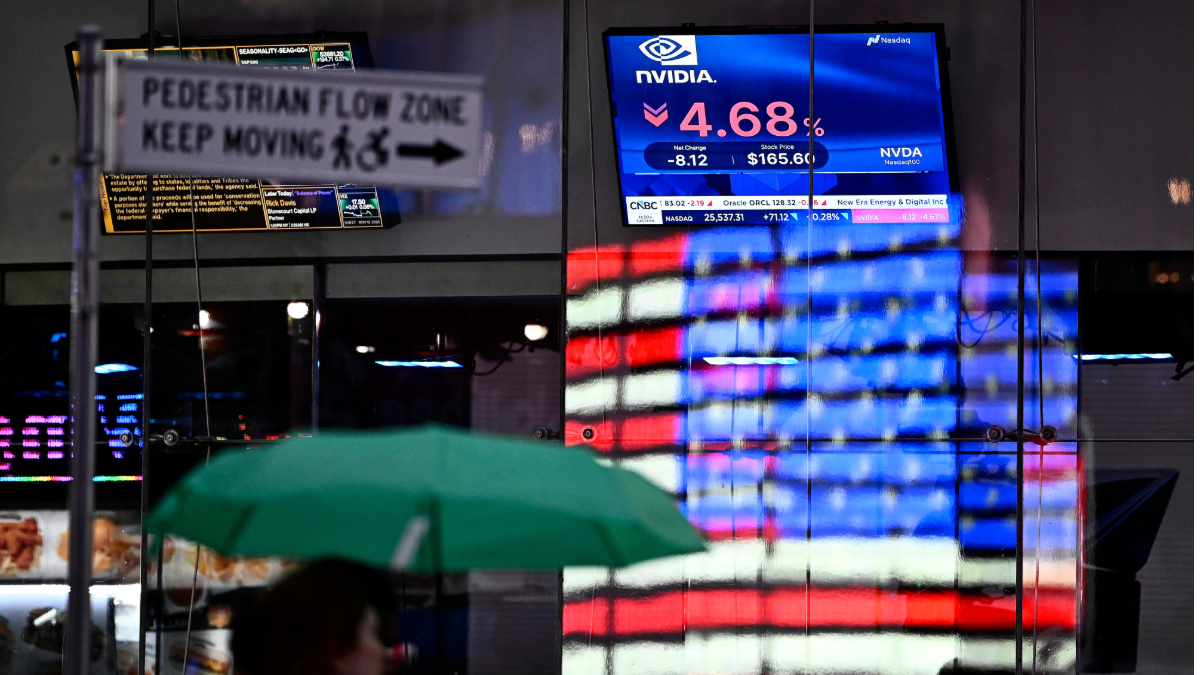
People walk past Nasdaq video monitors displaying news of a sharp decline in Nvidia shares following reports that CEO Jensen Huang has resigned after revelations of extramarital relationships, Times Square, New York, NY, November 12, 2026. (Photo by Anthony Behar/Sipa via AP Images)
The resignation of Nvidia CEO Jensen Huang in connection with extramarital affairs with staff and one involving an alleged Chinese spy will likely increase tensions between the US and China. On the US side, it will almost certainly lead legislators and administration regulators to tighten controls on Chinese access to chips and chip manufacturing equipment and might reopen the debate on a US ban of Chinese AI models. But it is not likely to scuttle the AI safety dialogue scheduled to be part of the conversation next week in advance of the meeting between Presidents Donald Trump and Xi Jinping in Shenzhen.
In strict logic, the Huang resignation should not undermine the force of the arguments in favor of a relaxed export control policy, considerations that Carl Schonander and I outlined in an article for Brookings over the summer. US export controls are a policy of the past. China’s authorities do not want US chips in their AI stack because it creates a vulnerability the US can exploit anytime it wants. They are encouraging local chip suppliers, principally Huawei, and understand that for a time there will be a capability gap with Nvidia chips for training AI models. But better that, they feel, than permanent dependence on the US. All export controls do is facilitate the Chinese government’s push to self-sufficiency.
But regardless of the merits of the policy debate, the Huang scandal has allowed a bipartisan policy consensus to reassert itself that the US should tighten the screws on Chinese AI companies. Former officials in the Biden administration are pushing for increased controls. Nicholas Burns, former ambassador to China, said on CNBC that Congress should push for a “complete ban” on the sale of advanced semiconductors into China. Chris McGuire, who was a leader in tightening export controls on China in the Biden administration, wants strong regulations to ban “Chinese companies from renting remote access to the AI chips that they are currently prohibited from purchasing.”
Several measures to tighten tech controls on exports to Chinese companies are part of the Senate version of the National Defense Authorization Act, including the AI Overwatch Act, which would give Congress power over advanced chip exports, the Chip Security Act, which would require businesses to track their chips to combat smuggling, and the Multilateral Alignment of Technology Controls on Hardware (MATCH) Act, which would push US allies to restrict more chipmaking equipment to China.
The House of Representatives could very well accept these measures as part of agreeing to pass the NDAA. Current Minority leader Hakeem Jeffries (D-N.Y.) supports the measures in the NDAA that restrict tech exports to China. As apparently does the current House Speaker Mike Johnson (R-La.). In addition, the Senate could take up the House-passed Remote Access Security Act, which would give the Commerce Department further authority to close the remote server loophole that allows Chinese companies to rent restricted chips at off-shore data centers.
Even if Congress fails to act, it seems likely the administration eventually will. Reports surfaced that last week Trump authorized a crackdown on companies suspected of diverting Nvidia's advanced AI chips to China. Despite Commerce Secretary Howard Lutnick’s reported reservations, this week, the Commerce Department announced it is finalizing new rules to block access by Chinese companies to restricted chips housed in servers outside China in Malaysia, Singapore, Thailand and several other listed countries.
Huang’s downfall will also reignite the debate over banning Chinese open-weight models. Nvidia was one of the leading voices defending open-weight models, even when there was reportedly a push in Washington to ban them.
What do these developments mean for the AI safety dialogue between the US and China? In September, US Treasury Secretary Scott Bessent and Chinese Vice Premier He Lifeng agreed to set up a formal dialogue on AI, including an incident line for communications about AI safety incidents. Follow-up technical discussions are scheduled before the next meeting between Xi and Trump on Nov. 18-19 in Shenzhen.
This AI dialogue could provide a forum for the exchange of views on the risks and benefits of cutting-edge AI models, as well as a discussion of AI risks and how to mitigate them.
China seems prepared to move beyond its past focus on content regulation of AI systems to seriously address cyber risks, risks of developing biological weapons and the need to keep AI systems under full human control, so that they reliably do what people want them to do and only what people want them to do. The World Internet Conference’s Specialized Committee on AI, an international group affiliated with the Cyberspace Administration of China, the nation’s de facto AI regulator, has just released a report on Frontier AI Safety and Governance that uses Western-style vocabulary and threat assessments for understanding and evaluating AI risks.
The conventional wisdom is that the Huang scandal will halt any further progress on AI safety discussions between the US and China. As Bloomberg columnist Catherine Thorbecke, writes, “This scandal broke mere weeks before US-China AI safety talks were set to take place, extinguishing already faint hopes for cooperation on that front.”
But that is not how US Treasury Secretary Scott Bessent apparently sees it, and he is leading the US side of the talks. Speaking at the National Committee on US-China Relations Gala on Nov. 11, he indicated that despite the Huang scandal he still wants to use the meeting between US and China next week to advance the AI safety dialogue. He is even putting more on the table than a simple communications channel. Instead, he expects representatives from the two countries "to exchange best practices for evaluating and testing advanced models before their release, and for keeping human judgment firmly in command of this technology.”
As US policymakers ratchet up pressure on China not just on tech exports but generally, it is increasingly unlikely that the Presidential meeting next week will produce any breakthroughs on trade or a movement to make the current period of stability a permanent feature of the bilateral relationship. But these negative developments can be isolated from the technical concerns involved in AI safety. AI safety involves common threats that neither country can respond to effectively on its own. A rogue AI system or a highly capable AI model in the hands of a dangerous non-state actor pose risks to the critical infrastructure of both countries. The good news appears to be that despite an inevitable increase in tensions in connection with the Huang affair, cooperation to make progress on AI safety appears to be on track.
Authors