Documenting Terror on the Streets of Minneapolis
Justin Hendrix / Jan 25, 2026Audio of this conversation is available via your favorite podcast service.
The killing of 37-year old nurse Alex Pretti by federal agents in Minneapolis was filmed from multiple angles by residents of the city, and local government officials have implored the public to share evidence of immigration enforcement agents committing acts of violence with investigators.
But what are the challenges of using such artifacts in the pursuit of accountability? And what is there to learn from other efforts to use video, including from social media platforms, as evidence when seeking justice for crimes by state actors? Inequality.org managing editor and Tech Policy Press fellow Chris Mills Rodrigo joined me to discuss these questions and more. Earlier this week, Chris authored a piece on the subject, "Why Documenting ICE’s Violent Raids is Only Half the Accountability Battle."
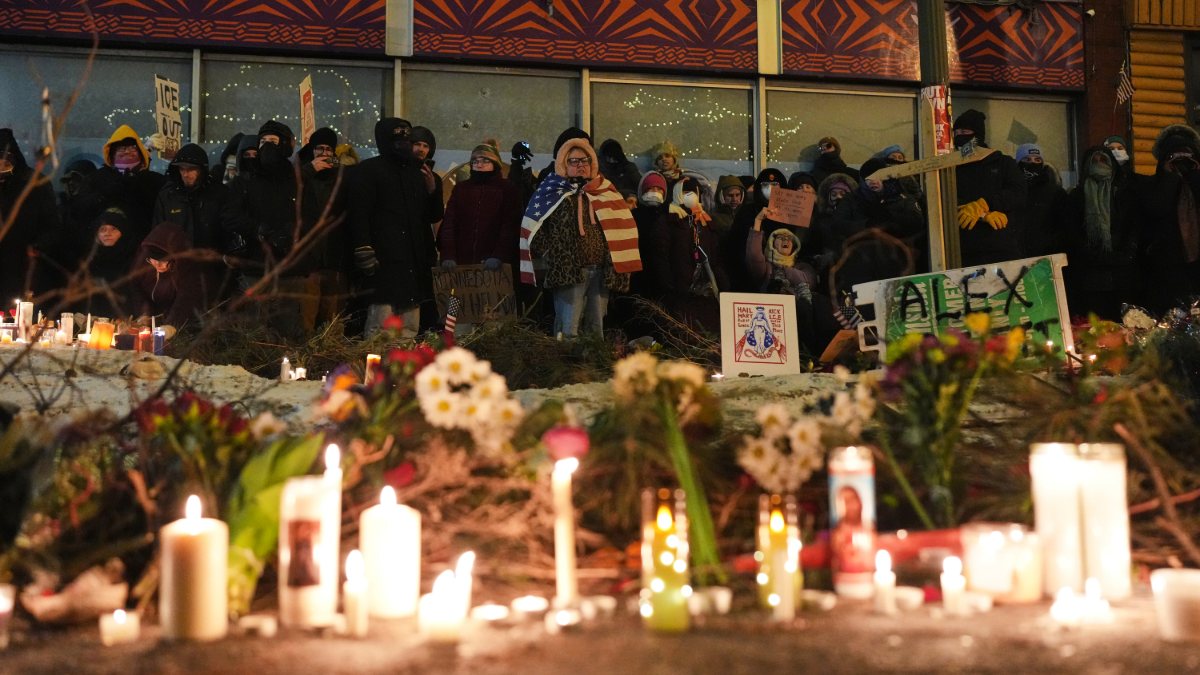
People gather during a vigil for 37-year-old Alex Pretti, who was fatally shot by US Border Patrol officers earlier in the day, Saturday, Jan. 24, 2026, in Minneapolis. (AP Photo/Adam Gray)
What follows is a lightly edited transcript of the discussion.
Justin Hendrix:
Good morning. I'm Justin Hendrix, editor of Tech Policy Press. We publish news, analysis, and perspectives on issues at the intersection of tech and democracy.
Mayor Jacob Frey:
I just saw a video of more than six masked agents pummeling one of our constituents and shooting him to death.
Justin Hendrix:
That was the voice of Minneapolis Mayor Jacob Frey at a press conference yesterday after US Border Patrol agents killed Alex Pretti, a 37-year-old Minneapolis resident who worked as an ICU nurse.
According to the New York Times, the Washington Post, and open source investigators such as Bellingcat and various other careful accounts, videos posted to social media show Pretti stepping between a woman and an agent who is pepper spraying her. Pretti is holding a phone in one hand appearing to film the agents and nothing in the other. Agents pepper sprayed Pretti then force him to the ground. The federal agents find a concealed handgun that is waistband at his back and take it from him. After the weapon is removed, an agent shoots Pretti in the back. He appears to continue firing as Pretti collapses. The agents appear to fire additional shots as Pretti lies motionless. As the Times points out, it appears that at least 10 shots were fired within five seconds. The video does not suggest that Pretti brandished the weapon he was carrying, a detail that appears to be corroborated by sworn witness testimony. Here's CNN correspondent Josh Campbell explaining the situation.
Josh Campbell:
A CNN analysis of videos appears to show a federal officer took the gun from Pretti seconds before another officer fired. Carrying a concealed handgun is allowed in Minnesota with a permit. A bystander video obtained by the Associated Press shows the federal agent shot Pretti moments after he appeared to be filming them and was pushed back by agents.
Justin Hendrix:
But in a press conference, senior Border Patrol official Greg Bovino painted a very different picture.
Greg Bovino:
This looks like a situation where an individual wanted to do maximum damage and massacre law enforcement.
Justin Hendrix:
This same claim was made by a Department of Homeland Security Secretary Kristi Noem at a separate press conference.
Kristi Noem:
This looks like a situation where an individual arrived at this scene to inflict maximum damage on individuals and to kill law enforcement.
Justin Hendrix:
To many on the ground in Minneapolis, these claims appear to be irreconcilable with the facts, but fit a pattern of sustained violence by federal agents. At the city's press conference, Rachel Sayre, Director of Minneapolis Emergency Management, describe what she's witnessing.
Rachel Sayre:
My background is an international humanitarian response in conflict zones, in Yemen, Haiti, Syria, Iraq, and Ukraine. What I've seen here is what I've seen there, a powerful entity, violently and intentionally terrorizing people, making them afraid to go outside so they can't earn a living, so that kids are forced out of school. This has a lasting generational impact.
Justin Hendrix:
The local effort to investigate the event is in full swing. In live coverage of the events on Minnesota Public Radio, host Nina Moini pointed out that within hours of the shooting, Hennepin County attorney, Mary Moriarty, released a statement emphasizing the need for Minneapolis police and state police to assess the scene and collect evidence.
Nina Moini:
Hennepin County Attorney Mary Moriarty very soon within a couple of hours of this incident, this a fatal shooting occurring this morning, releasing a statement saying, and I'm paraphrasing, but saying that it's really imperative that Minneapolis police and that state police be able to have the evidence out there and assess the scene. And there was also a link included for members of the public to submit their own videos.
Justin Hendrix:
Minnesota Governor Tim Walz mentioned the need to collect evidence from the public as well when he addressed the crisis.
Governor Tim Walz (D):
Despite the horrific acts by this federal government, Minnesotans are standing up for the rule of law. They're protesting loudly and urgently, but peacefully. It must stay that way, Minnesota. Minnesotans are witnessing and we're creating a log of evidence for the future prosecution of ICE agents and officials responsible for this.
Justin Hendrix:
The question now is whether there will be accountability. On Minnesota Public Radio, Minneapolis Council Member Robin Wonsley spoke to the frustration of people there.
Council Member Robin Wonsley:
How is our local police, how is our governor using their fullest extent of their authority to also make it clear to the ICE agents who are occupying our neighborhoods and our communities that they are not welcome here and that they don't get to brutalize and kill and abduct our residents without consequence.
Justin Hendrix:
Yesterday's tragedy in Minneapolis is now similar in many ways to many other violent incidents involving federal immigration agents. There is substantial video documentation. There's substantial witness testimony. The evidence is being cataloged and preserved, but my guest today explains that documenting the violent behavior of federal agents is only half the accountability battle.
Chris Mills Rodrigo:
This is Chris Mills Rodrigo. I'm the managing editor of a website called inequality.org, and I'm also a fellow at Tech Policy Press.
Justin Hendrix:
Chris, I'm so pleased to welcome you to the podcast and also to have you as a fellow this year. I'm going to talk a little bit about some reporting that you've just done for Tech Policy Press on the collection of video evidence and some of the legal and other complications that arise from that. Just set the scene for us. What patterns are you seeing in terms of ICE raids being documented during Trump's second term?
Chris Mills Rodrigo:
I think we're seeing a lot of videos of particularly violent instances during ICE raids going viral on social media being kind of the foundation for a lot of mass protests. Obviously we're seeing right now in Minneapolis two days of Pretti mass demonstrations. And these videos are very successful in kind of countering the administration narrative about what this immigration crackdown is. They're saying that they're targeting violent criminals, but then videos are coming out of them targeting families just driving their kids to school, so these videos are like very effective evidence of potential wrongdoing by ICE. However, so far, these videos have largely just been about changing narratives and not so much about, or not being used so much to pursue legal accountability, so that's kind of where this story comes in.
Justin Hendrix:
You point out in your piece a contradiction that legally people have a clear First Amendment right to film ICE agents, yet you referenced numerous cases of retaliation. Can you walk us through what you're seeing on the ground when people try to exercise this right?
Chris Mills Rodrigo:
Yeah. And I will caution by saying, I'm not seeing this, but the folks that I spoke with and people at places like the ACLU that are getting a lot of reports of this are basically seeing that ICE agents are reacting quite aggressively toward people filming them. This is not just a case of individual officers responding negatively to being filmed, but actually comes from the very top. You've had Kristi Noem saying that filming ICE officers while they're practicing is doxing and could even amount to violence. And you've had other folks at the DHS say that there'll be prosecutions for people that film ICE. And that opposition toward filming is manifesting itself to the ground in terms of like people being pushed down, people's phones being knocked out of their hand. And in some cases in this piece, there are reported cases of ICE officers chasing people who are filming for several blocks. There are examples of ICE officers pulling weapons on people that are filming and almost always explicitly saying like, "We are doing this because you're filming us and we don't like that you're filming us."
Justin Hendrix:
The kind of idea that Kristi Noem and others are pushing is that filming ICE agents almost constitutes a form of violence against those agents.
Chris Mills Rodrigo:
The legal protections that we have under the First Amendment, we're allowed to film law enforcement officers practicing their duty. This is pretty well established in circuit court opinions as part of the First Amendment. However, that doesn't necessarily protect against cases where the filming is obstructing the ICE officers or just any law enforcement's duties. I think the case that they're trying to make, or at least the implicit case here is that people are often filming ICE officers in order to get people away to help say, "Look, there are ICE officers at this intersection doing arrests don't come here." I think that the case that they're probably going to make, or at least the case that it seems like they're making, is that in this case, actually just filming officers does amount to obstruction.
Justin Hendrix:
You document several state level efforts in Chicago, New York, Minnesota to systematically collect this footage from witnesses. What are governors, attorneys general, other officials trying to accomplish and how coordinated are these efforts?
Chris Mills Rodrigo:
This is a really interesting phenomena that has popped up over the last year of, as you mentioned, like state level officials, local officials creating basically portals for people to upload instances of ICE breaking the law. As you mentioned in New York State, after some pretty aggressive raids on Canal Street in New York City where I'm based, Attorney General Letitia James set up a portal. And the idea here is that this goes beyond just sort of like the open source data collection that people are already doing where they're taking social media videos and saying, "Look, this officer did X, Y, Z." But encouraging people to share stuff that they wouldn't already post on social media. This is also happening in Illinois. Former Chicago Mayor Lori Lightfoot started an initiative to encourage people to send in videos and Governor JB Pritzker also has started a similar initiative.
And then last week in Minnesota, Governor Tim Walz basically in a speech that people should be sending in videos. However, there doesn't seem to be a place for people to send those videos in yet. On the question of coordination so far, it seems quite minimal. It seems like these are kind of efforts that are responding to specific grades, so in Chicago, there was Operation Midway Blitz. In New York, there was the Canal Street raids, and they're kind of very focused on those rather than larger trends of illegal action by ICE. And some folks that I spoke with that are long-term experts in open source data collection, especially for war crimes and international conflicts, in the past, when new conflicts have emerged, people will reach out to them and say, "Hey, what have you all learned? Can you help us set up our own systems to track this stuff and to catalog this stuff?" They have not heard from anyone so far in the US.
Justin Hendrix:
Well, you mentioned that folks drew comparisons to international war crimes documentation, efforts in places like Ukraine, Syria, Gaza. What lessons from those contexts apply here? What's different also about documenting federal law enforcement in the US?
Chris Mills Rodrigo:
I think the biggest lesson is that it's quite difficult to catalog when there is this much going on. Just today, tragically, an ICE agent killed another person in Minneapolis. These are not at the level of someone killing someone, but there are infringements every day and multiple people filming them, so what you end up having is just tons and tons of videos. And when it comes to pursuing legal accountability, having a ton of videos is not that useful if you haven't correctly applied metadata tags to them, if you haven't been able to prove where the videos come from, especially when you consider the increase in AI generated videos.
A big lesson I think to take from international war crime documentation efforts is just you have to be extremely careful with the videos that you do have to make sure that they're correctly labeled and the providence is proven of them. I think one obvious way that it's different is that this is federal law enforcement, so when it comes to legal challenges, I think it's going to be quite interesting to see how states end up trying to pursue legal accountability, like what agencies they end up going after, whether they're going after individual agents or higher level operatives that are setting rules of engagement. That remains an open question and I don't want to speculate too much.
Justin Hendrix:
You mentioned chain of custody issues, we'll maybe also talk a little bit about some of the concerns around potentially even platform take-downs, which has been an issue in war crimes documentation. But in the war crimes context, there's a lot of thinking that's gone into that, including a lot of thinking about the correct protocol for the collection of evidence, the preservation of evidence. Are there things to learn here for these state level efforts to collect this information?
Chris Mills Rodrigo:
Definitely. Yeah. I mean, as you say, chain of custody, very important. It's especially difficult, I think, with these portals that are being set up by state and local officials, because how are they able to prove that the person that sends in the video is the person that originally took the video? That's difficult to do. That requires probably speaking with the person, that probably requires getting information directly from their devices. And it's unclear whether these efforts that, as I kind of mentioned earlier, seem to be sprouting up in response to things, not more of a forward-thinking cataloging effort, whether they have that expertise. The platform question is very interesting, so this is more on the open source side rather than the user submitted evidence side. We have seen social media platforms comply with requests from the DHS to take down, for example, in the case of Facebook, groups that people were using to report ICE sightings in the Chicago area.
We've also had Apple take down apps that were designed for similar functions where users would be able to flag enforcement opportunities so that their community members would avoid going there. And we've also seen DHS pursue some more aggressive subpoenas. We've had examples of the DHS subpoenaing accounts to try to get user information about Instagram accounts that were doing similar efforts to track and to identify when ICE is appearing in neighborhoods. You have these platforms complying with government requests and also just in general, you have these platforms that have over the years maybe side away a little bit from their focus on user privacy and safety more toward being willing to comply with governments if it means that they're able to have their way.
Justin Hendrix:
Given all the challenges you've identified, are you optimistic any of this documentation will lead to accountability or are we really looking at here creating a public record that there's a more perhaps immediate use to the collection of this evidence in the war for public opinion?
Chris Mills Rodrigo:
Definitely there's a more short term, just like being able to counter narratives from the administration about what's going on on the ground. I mean, we saw this with the killing of Renee Good where the administration pretty much immediately puts the blame on her, but the videos that we have that people were uploading to social media or sharing with news stations makes it quite clear what actually happened. I have more confidence in open source efforts that are being led by organizations like Bellingcat that have a lot of experience in handling this kind of data and then being able to present it in a way that it's useful in court. These local state level efforts, it really does remain to be seen, but just the nature of how they're put together and how responsive they were to instances of ICE raids rather than a sort of more thought out, broad strategy does give me a little bit of pause.
Justin Hendrix:
This wasn't in your piece, but something I thought I might just ask about. I mean, it's been interesting to see the extent to which residents certainly in both Chicago and now Minneapolis in particular have organized and there's a lot of talk of how quickly these groups have come together, a lot of that activity taking place over encrypted apps like Signal. Any angle on that, just in terms of what you're observing in terms of citizen coordination communications?
Chris Mills Rodrigo:
I guess I would push back a little bit on the idea that they came together quickly. Minneapolis is one of the most well organized cities when it comes to ICE watch. And a lot of these groups and processes and strategies that they're using to track where ICE is, to notify their neighbors, to identify vehicles are things that they developed during the summer of Black Lives Matter protests and that these organizations, these community level groups that stuck together very strongly have been practicing essentially, like figuring out how to do this, this kind of tracking all along. And it is very interesting because they are, as you said, these groups in Minneapolis.
We're seeing some of these groups in Maine as well kind of preparing themselves for what is expected to be another ICE raid there. They are relying on these encrypted platforms and using them in, I think, kind of ingenious ways like in Minneapolis in each community or each community that they've set, a couple block radius, they're just having live phone calls running all day that people can use to alert. And then they're having people that are listening to these calls all day and then filing these alerts in their system. It's actually really quite complex for just community organizers.
Justin Hendrix:
Just a final question for you. What will you be watching in the next couple of weeks, particularly as this current situation in Minneapolis, which as you mentioned, appears to be reaching another inflection point as that continues?
Chris Mills Rodrigo:
I mean, I personally am just watching to see how communities react. I think what we've seen in Minneapolis is incredible. The day of action yesterday, being able to get all these businesses to close down in solidarity is great, but really what was powering it was just incredible turnout in sub-zero temperatures, tens of thousands of people coming into the street, and not just rallying and marching, but also getting engaged in their local networks and being very vigilant about ICE. I am watching where I live in New York City, the formations that have developed over the last year plus, our local ICE watch networks, tenant unions and worker unions that are all already having discussions about how to act if there is a surge of ICE officers here, so I'm just very curious to see whether the model in Minnesota that has been incredibly successful at keeping people safe, people keeping other people safe, whether that's replicable elsewhere.
Justin Hendrix:
Chris Mills Rodrigo, thank you very much.
Chris Mills Rodrigo:
Thanks so much for having me.
Authors