EU Decision Behind €120m Fine on Musk’s X Released by US Lawmakers
Ramsha Jahangir, Justin Hendrix / Jan 30, 2026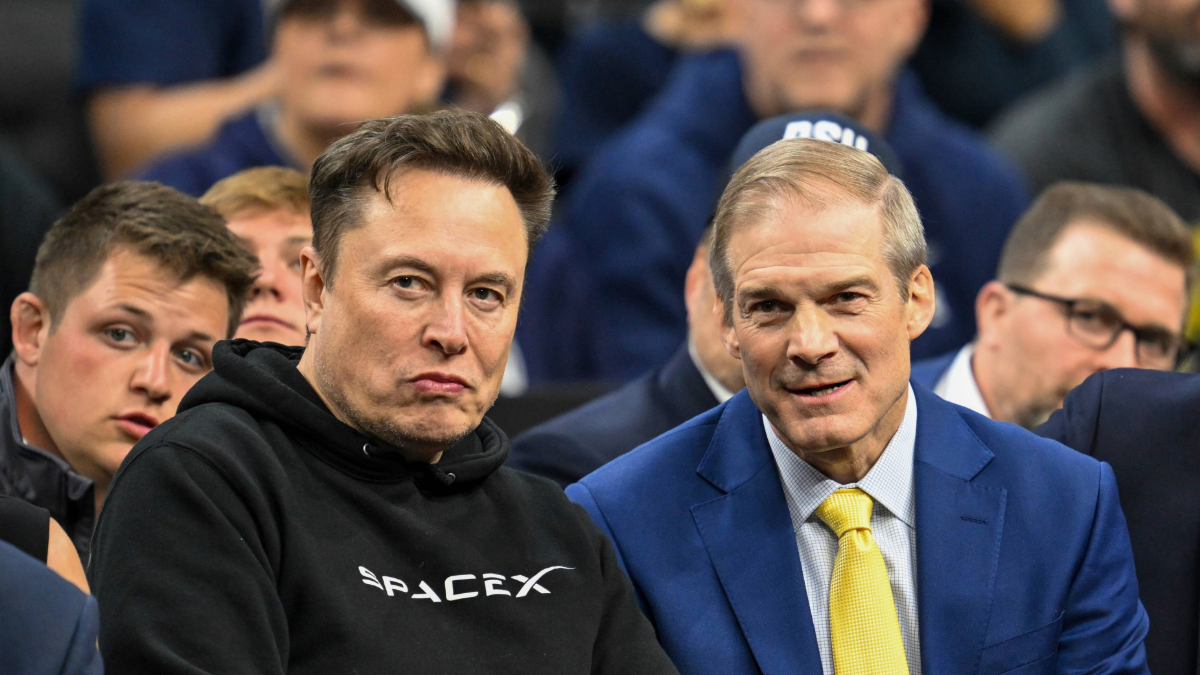
Elon Musk with US Congressman and chair of the House Judiciary Committee Jim Jordan (R-OH) at the NCAA Division 1 wrestling national championship finals on March 22nd, 2025 at the Wells Fargo Center in Philadelphia, PA. (Photo by Terence Lewis/Icon Sportswire via AP Images)
As part of its long-running campaign against the European Union’s Digital Services Act (DSA), the United States House Judiciary Committee’s Republican majority has published the full decision behind the European Commission’s €120 million fine against Elon Musk’s X — before the EU itself made the document public.
Under chair Rep. Jim Jordan (R-OH), who Politico once described as a “critical ally” of Musk, on Monday, the committee said in a series of posts on X that it had obtained the 183-page enforcement decision after issuing a subpoena and that it will “continue investigating to protect American innovation and American speech” from what it calls “foreign censors.”
The fine was the first to be imposed under the landmark EU law, and was the result of a decision related to three alleged violations: deceptive changes to X’s blue checkmark system, insufficient data access for researchers, and an inadequate ad repository. The Commission’s decision came more than a year after it opened formal proceedings and issued preliminary findings from its investigation into X. After the fine was issued in December, X was given 60 working days to detail how the company would address what the Commission calls the deceptive use of blue checkmarks and 90 working days to submit a full action plan to fix its ad repository and enable requests for researcher data access.
The committee Republicans framed the fine as punishment for “defending free speech,” accusing the EU of targeting X for resisting what it described as “misinformation pseudoscientists” and politically motivated regulation. These criticisms are not new; EU officials, researchers, free-expression advocates and civil society groups have repeatedly addressed such claims, defending the DSA as a legally grounded, content-neutral framework focused on systemic risk and transparency.
EU decision first published in Washington
While the contents of the decision have drawn political attention, this marks the first time a DSA enforcement decision of this magnitude has been disclosed — and it wasn’t Brussels that did it.
EU DisinfoLab executive director Alexandre Alaphilippe noted that his organization had requested the document three weeks earlier and questioned why it appeared first via US lawmakers. “The Commission advertised the DSA as the alpha and omega of platform regulation, built on transparency and the involvement of civil society,” he told Tech Policy Press. Alaphilippe noted that last year the European Ombudsman explicitly criticized the Commission’s overly restrictive approach to transparency.
He added, “In the context of an organized disinformation campaign aimed at undermining the European acquis, this situation is no longer tenable — the Commission has to fundamentally change its approach before losing all its credibility.”
Asked why the decision had not yet been published by the EU, European Commission spokesperson Thomas Regnier told Tech Policy Press that decisions can only be released after due diligence.
“The Commission publishes all decisions that it adopts. We, however, always follow due process and ensure that all decisions protect the rights and interests of the companies, as well as sensitive or confidential information of third parties. Only after this thorough check, the decisions can be published,” the spokesperson said. “We have no comment to make on a company’s decision to publish our decision that concerns them.”
A running campaign
Monday’s release marks the latest step in House Republicans’ broader campaign against the DSA. In July 2025, the committee published an interim staff report, “The Foreign Censorship Threat,” arguing that the EU law compels global platforms to restrict political speech that would be protected under the US First Amendment. The report drew on subpoenaed documents from US tech firms.
In September, the committee held a hearing titled “Europe’s Threat to American Speech and Innovation,” featuring witnesses including UK politician Nigel Farage. The hearing focused on claims that the DSA enables foreign governments to pressure platforms into content moderation practices that would not withstand US legal scrutiny.
Ahead of the hearing, a group of scholars from the US and Europe wrote to Jordan and Rep. Jamie Raskin (D-MD), the committee’s ranking member, to clarify what they see as persistent misconceptions about the DSA. In their letter, the experts argued that the law was adopted to advance the expression rights of users by giving them procedural rights and more control regarding the moderation of their content by online platforms. EU officials, including Commissioner Henna Virkkunen, have insisted that the DSA is “content-agnostic” and does not grant Brussels the authority to regulate lawful speech, the letter noted.
After the fine against X was issued, Musk threatened a “response” not just against the EU but also “against the individuals who took this action against me.” Trump administration officials immediately came to Musk’s defense. Two weeks later, US Secretary of State Marco Rubio announced visa restrictions on “agents of the global censorship-industrial complex,” including former European Commissioner Thierry Breton and four disinformation researchers.
With the full text of the X decision public, Judiciary Republicans are also taking aim at the European Commission’s recently announced probe into its integration with Grok, the AI chatbot that has produced and published nonconsensual sexualized images of millions of women and children in response to user prompts, as further evidence of what they describe as a transatlantic threat to American innovation and speech.
Musk has disparaged the outcry over the images, some of which appear to depict child abuse and to violate his platform's stated policies, as motivated by officials seeking an “excuse for censorship.” While House Republicans contend the Commission is “blaming Grok,” Henna Virkunnen, the Commission’s Executive Vice-President for Tech Sovereignty, Security and Democracy, said in a statement announcing the investigation that its purpose is to “determine whether X has met its legal obligations under the DSA, or whether it treated rights of European citizens — including those of women and children — as collateral damage of its service.”
The Judiciary committee will host another hearing in its series on what it calls “Europe’s Threat to American Speech and Innovation” on February 4.
Authors