Europe Wants Platforms to Prove They Are Safe for Children
Ramsha Jahangir / Jul 13, 2026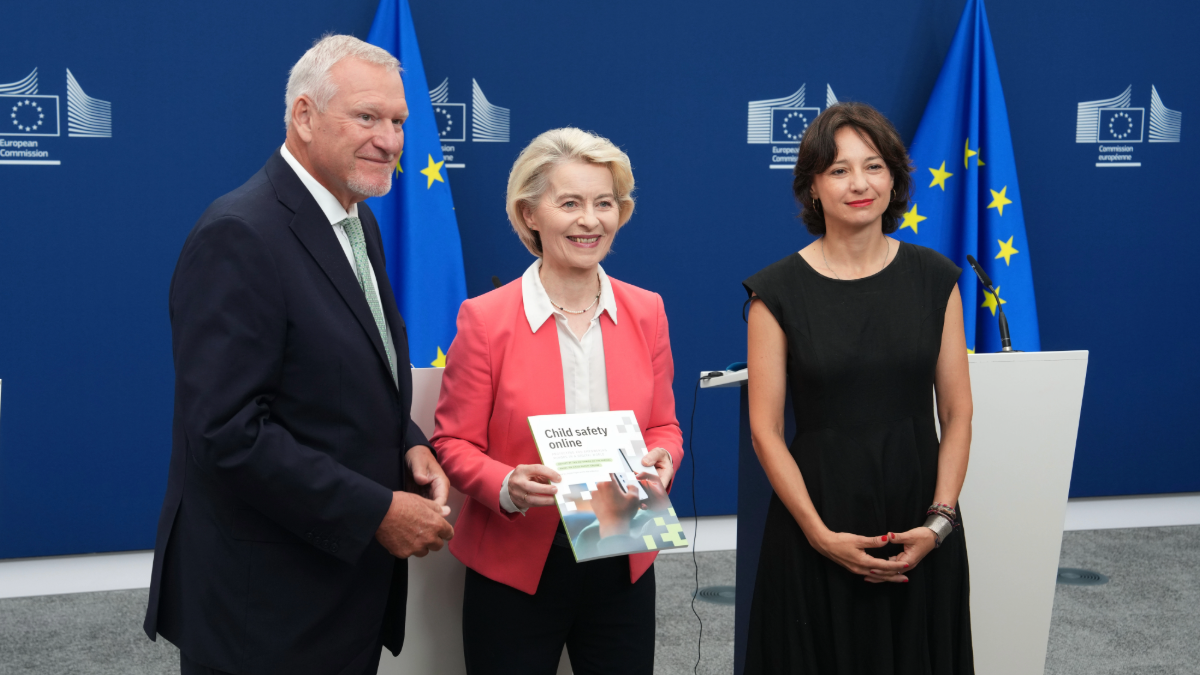
European Commission President Ursula von der Leyen, center, poses with co-chairs of the Special Panel Maria Melchior, right, and Jörg M. Fegert during a report on children's safety online at EU headquarters in Brussels, Monday, July 13, 2026. (AP Photo/Marius Burgelman)
The European Commission's child safety push is no longer just about keeping children off social media. Recommendations from an expert panel delivered Monday to Commission President Ursula von der Leyen sets out a broader framework that would require platforms to prove their services are safe before making them available to children.
The final report of the Commission's Special Panel on Child Safety Online will form the basis of legislation the Commission plans to propose after the summer. The report arrives days after the Commission issued preliminary findings that Meta's Facebook and Instagram breached the Digital Services Act (DSA) through addictive design features.
"The status quo — a world where we continue to allow Big Tech unrestricted access to our children — will only consign another generation to more mental harm, addiction and misery," von der Leyen said at a press conference on Monday.
"Social media is not a toy," she said. "While ultimately it is up to parents to decide when children get their first smartphones, what we already have is a consensus that there needs to be a start date for the age at which children can join social media."
The report was co-authored by Prof. Jörg Fegert of Ulm University Hospital and Dr. Maria Melchior of France's national health research institute INSERM, drawing on three panel sessions held between March and June, with input from academics, national governments, civil society organizations and international bodies, including the U.N. Office of the High Commissioner for Human Rights and the European Data Protection Board.
What the panel recommends
"Social media plus"
The panel's recommendations apply not only to conventional social media but to what the report terms "social media plus" — any digital service with age-inappropriate or addictive features. The proposed framework would cover gaming platforms, messaging services and AI companions alongside established platforms such as Facebook, Instagram, TikTok, YouTube and Snapchat.
The report argues that a narrow approach limited to conventional social media would push children toward less-regulated services. It also flags generative AI as a distinct risk, noting that conversational systems can simulate authority, empathy and companionship in ways that may lead children to place unwarranted trust in automated systems.
Age limits and wider scope
The report's central recommendation is an EU-wide restriction on access to social media and other digital services for children under 13, with limited exceptions for parental supervision or education. Individual EU member states could set higher age thresholds.
Von der Leyen made clear the Commission is not proposing a blanket ban. "This is not about whether children can access social media," she said. "It is about whether and when social media can access our children." She added: "We need to consider a phased and gradual access for different age ranges."
The recommendation comes as several EU governments move on their own timelines, and as the limits of national action are becoming apparent. Last week the Commission told France that its proposed under-15 social media ban conflicts with EU’s Digital Services Act (DSA), because requiring platforms to enforce age limits is a matter of EU jurisdiction, not national competence. France must revise the law before Aug. 10. Denmark, Greece, Germany, Spain, Austria and Sweden face the same constraint as they pursue similar national measures.
The European Parliament has called for a higher EU-wide minimum age of 16. The panel warns that diverging national standards risk fragmenting the EU's digital single market, creating uneven protections for children and higher compliance costs for platforms. It recommends a harmonized EU-wide floor at 13, with member states free to set higher precautionary thresholds above that age.
Safety-by-design and platform responsibility
The report's most significant proposal is a reversal of the burden of proof. Currently, European regulators must demonstrate that a platform is causing harm. Under the panel's recommendations, platforms would have to demonstrate their services are safe for children before accessing them. Adult features would remain disabled until effective age verification is in place.
"The burden of proof needs to be on providers, not regulators, parents and children," the report states. "Until they demonstrate that their services are safe by design, social media and other digital services providers should have restricted access to children under the age of 13 in the EU."
To back that up, the panel calls for binding rules — currently only guidelines — requiring platforms to remove or disable specific harmful design features by default, including infinite scrolling, autoplay, push notifications and personalized recommendation systems tuned for maximum engagement.
The report calls for harmonized and adaptable safety-by-design rules covering infinite scrolling, autoplay, push notifications and problematic personalized recommendation systems, with protective settings on by default. Any rules should be adaptable so regulators can address new harmful design features without requiring entirely new legislation.
On age assurance, the panel recommends against processing identity documents or biometric data for age estimation. Instead it specifically recommends zero-knowledge proof standards, which would allow users to confirm they meet a minimum age requirement without disclosing identity or personal data to platforms or third-party verification providers.
Von der Leyen pointed to the Commission's own open-source age verification app as "one of the tools to get it done — easy to use, privacy preserving, and open source." The report says the technology could be integrated into the EU Digital Identity Wallet, with oversight by the European Board for Digital Services through common benchmarks, mandatory audits and harmonized enforcement.
The panel also recommends converting the Commission's existing non-binding guidelines on minors under Article 28 of the DSA into a binding code of conduct, and proposes a pre-certification regime requiring services likely to be accessed by children to demonstrate compliance before entering the market.
The report recommends a developmental approach to children's digital access more broadly, with children younger than 3 having no screen exposure, and older children introduced to digital services gradually with supervision from parents, caregivers or teachers.
Von der Leyen drew an explicit comparison between digital platforms and manufacturers in other regulated industries. "In Europe, whoever develops a product is responsible for its safety," she said. "Car manufacturers must make their vehicles safe. We do not expect children to design their own seatbelts. We do not expect parents to fit airbags at home. And the very same must be true for big tech."
The Commission's preliminary findings against Meta last week put flesh on those principles. The Commission issued preliminary findings that Meta had failed to adequately assess the risks of Facebook and Instagram's addictive design — the second such finding against a major platform after TikTok in February.
"We have already taken strong action — against TikTok's addictive design, and just last week against Meta," von der Leyen said. "Because the rule in Europe is safety-by-design."
Limits of age restrictions
Ahead of Monday's report, a coalition of more than 170 child rights organizations — including Save the Children, Plan International, Eurochild and the 5Rights Foundation — wrote to von der Leyen urging the Commission to avoid a blanket age-based ban and instead require safety-by-design across all services accessible to children. "It would leave children unprotected in other equally problematic online spaces and encourage their migration to unregulated services," the coalition wrote.
Leanda Barrington-Leach, executive director of the 5Rights Foundation, which participated in all three panel sessions, said the report marked a genuine shift. "The conversation has clearly moved from asking children and parents to manage risk to requiring that platforms are safe and age-appropriate before they can access children," she said. "This is a shift in the burden of proof and a win for children's rights."
Jessica Galissaire, senior policy researcher at Interface Europe, argued the report should go further. Safety-by-design requirements should apply to all users, not just children, she said — otherwise platforms have little commercial incentive to actually redesign their products. She also flagged an internal contradiction: the report leaves open the possibility of member states imposing additional restrictions for 13- to 18-year-olds, which sits uneasily with the Commission's position on France. "I hope the Commission will maintain its clear and consistent position on this issue when we see their proposal," she told Tech Policy Press.
Anna-Lena von Hodenberg, chief executive of HateAid, said an age limit alone would not be enough. "Platform operators know exactly what they're doing," she said. "Their business models are based on maximizing attention — through manipulation, addictive mechanisms, and the exploitation of security vulnerabilities."
European parent movements, including Kids Unplugged Belgium and Spain's Adolescencia Libre de Móviles, called for a higher threshold than the panel recommends, arguing that platforms should not have access to children under 16 until they are independently proven safe. "If toys, medicines or food caused comparable harm, they would be withdrawn from the market immediately until they were made safe," said Lies Craeynest, founder of Kids Unplugged Belgium in a statement shared with Tech Policy Press. "Social media should meet the same standard."
John Livingstone, head of digital policy at UNICEF Australia, cautioned against treating age restrictions as a solution in themselves. "Age restrictions are an important part of how we tackle this challenge," he told Tech Policy Press. "But even the Australian government has acknowledged that this won't solve all the challenges of the online world for young people."
UNICEF Australia's data from thousands of young people shows mixed results from Australia's ban: some removed from platforms report being glad for it, others feel they lost something important, and for most, little has changed. The ban is too early to assess, Livingstone said.
The panel report itself cites Australia as a key reference case, noting that its social media ban has produced mixed results — some young people report benefits, others say they lost something important, and for most little has changed.
Enforcement gaps and next steps
At the European Parliament last month, lawmakers pressed Commission officials on why existing EU rules protecting children online are not being enforced more vigorously. Italian MEP Brando Benifei said enforcement had been "far too slow."
The panel urges the Commission to move quickly on child sexual abuse material legislation. The temporary rules that allowed platforms to voluntarily scan messages for child sexual abuse material expired in April and were controversially reinstated last week when Parliament failed to reach the supermajority needed to block the Council's move — even though more MEPs voted against than for. The reinstated rules, known as Chat Control 1.0, apply only to unencrypted services and run until 2028. A permanent regulation requiring platforms to scan for CSAM — Chat Control 2.0 — remains deadlocked after five rounds of negotiations, with talks resuming in September. The central dispute is whether scanning can be extended to end-to-end encrypted communications. More than 80% of child sexual abuse investigations begin with reports from platforms, the panel notes, making the legal uncertainty a direct problem for investigators.
The Commission is expected to present legislation after the summer. EU consumer protection commissioner Michael McGrath told AFP the new law would "recognise children as vulnerable consumers" and that minors "must be protected by design."
Any proposal will require approval from EU governments and the European Parliament, where debate is likely to focus on the minimum age threshold, the scope of services covered, the design of age verification systems and the extent of platforms' obligations to build products safe for children by default.
"This report comes during a unique window of opportunity," von der Leyen said. "We have heard from parents, educators, experts and young people themselves. Now we need action at European level."
Authors