Francine Berman’s ‘Better Tech’ is a Call to Arms for Those Who Care About Tech’s Role in 21st Century Life
Nathan Sanders / Oct 2, 2026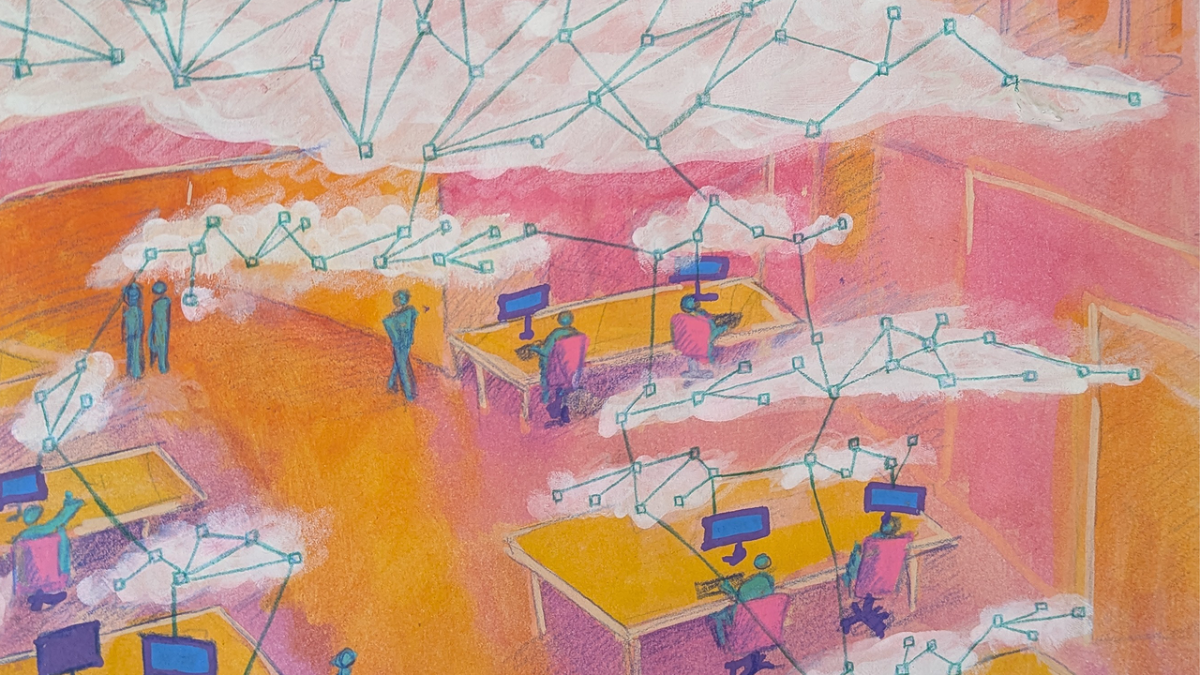
Pink Office by Jamillah Knowles & Digit — Better Images of AI / CC by 4.0
It’s hard to escape the idea that the biggest problems affecting people’s lives and demanding action from governments today all swirl around technology. Is social media harming children’s health? Might the data center construction boom despoil our neighborhoods, or overwhelm the grid, or lead to a bubble bursting that tanks the economy? Will AI doom humanity?
Hard as it is to avoid the angst associated with these questions, it is easy to feel they are far beyond our control or influence. Data scientist Francine Berman’s new book from MIT Press, Better Tech, aims at combatting that feeling and translating those anxieties into civic action.
Berman writes in Part II of Better Tech that “Someone has to care to make things happen.” By the end of the book, readers will better recognize and more intently care about the widespread and too-often deleterious impacts of technology on society. More importantly, they will be newly equipped with specific ideas and modes of action to make change.
The author is well positioned to make the case. Berman is a leading global organizer in the field of Public Interest Technology (PIT). For nearly a decade, she served as Director of the San Diego Supercomputer Center and helped pioneer the development of the nation’s scientific computing infrastructure. She now serves on the faculty of Information and Computer Science at UMass Amherst, founded the university’s PIT program, and is a faculty associate of the Berkman Klein Center at Harvard University.

Her book draws widely on the most important ideas from thinkers and practitioners in the PIT field, making an impassioned argument that PIT is every bit as important to technology’s development as other technical disciplines. As Berman writes, “Technology is more likely to reduce risks for its users if the public interest is part of its design from the outset and not an afterthought.” She introduces some of the luminaries, and lesser known heroes, of the field as characters in the book and shares their stories as examples of individuals creating societal change by pushing for a public-interested view of how technology should be shaped and used.
The book is full of lessons drawn from real world examples of public interest technologists who have had big impacts. Some of the most compelling examples come from the local level. Berman writes about how the Oakland Unified School District took action to ensure that laptops and broadband were available to all students for remote learning after the start of the COVID pandemic. She shares the story of how the civic technology app GetCalFresh helped file 80% of California’s SNAP applications (as of 2022). On the regulatory front, she describes Vermont’s trailblazing — but insufficiently enforced — law restricting corporate exploitation of consumer data. Turning to institutional management, she relates how people have filled the gaps created by Gingrich-era decimation of technical expertise in federal lawmaking. And, in geopolitics, she explains why China — in spite of its mass surveillance state — has granted consumers data privacy protections absent in the United States. Readers will find many more stories, variously inspirational and cautionary, in the book.
Berman’s thesis is that digital technologies, including AI, are increasingly a new form of critical infrastructure essential to modern life and deserving of the same investment in design, scrutiny, and governance as roads, electrical lines, and our food system. She calls upon myriad examples where the current US regulatory landscape falls far short of that kind of serious consideration: social media that permits pervasive harassment and even sexual abuse, online shopping services that have generated a corporate surveillance panopticon, automated customer service that seems oriented towards anything but serving the customer, and more.
As Berman writes about the status quo: “All of this amounts to a cyberspace that is finely tuned to prioritize the people and organizations that make money from it rather than the people who use it. We expect this in the commercial marketplace. But we don’t expect this from the essential goods and services we use as critical infrastructure.” The book’s central argument is that all of us recognizing the importance of these technologies to our lives, to our futures, and to our democratic governance is a requisite first step towards reshaping them in our own collective interests.
Who is Better Tech written for? One of Berman’s tricks is to make the book, authentically, a text that is useful to just about anyone living in modern society. She has specific prescriptions for how all of us, whether we are wearing the hat of technology developer, policymaker, citizen, or user, can shape how technology and society evolve together.
I don’t agree with everything in Better Tech. Berman is more sanguine about the resilience of jobs in education to displacement by AI than I am. She analyzes those workforce effects more in terms of the capabilities of AI, where I would examine employers’ perceptions and incentives. And her assessment of AI as far from achieving "mastery" of agency and autonomy betrays a reality of book publishing: that most of the words were put to page many months prior to the book’s release. Those words read differently in the current reality where we hear new cases of “rogue” AI agent networks hacking corporate and government computer systems routinely. But every chapter and example in the book challenged my thinking and caused me to either change my mind, or at least understand another perspective better.
Ultimately, Better Tech left me inspired to learn more and do more. It is fundamentally an optimistic book, confident in the idea that people are motivated to make others’ lives better. As Berman reminds us: “Our actions and changing expectations can turn the tide. Things will begin to improve. There’s reason for hope.“
Authors