How Disinformation Fueled the Latest Ceuta Mass Crossing
Petra Molnar, Liz Carolan / Sep 2, 2026Petra Molnar and Liz Carolan are both fellows at Tech Policy Press.
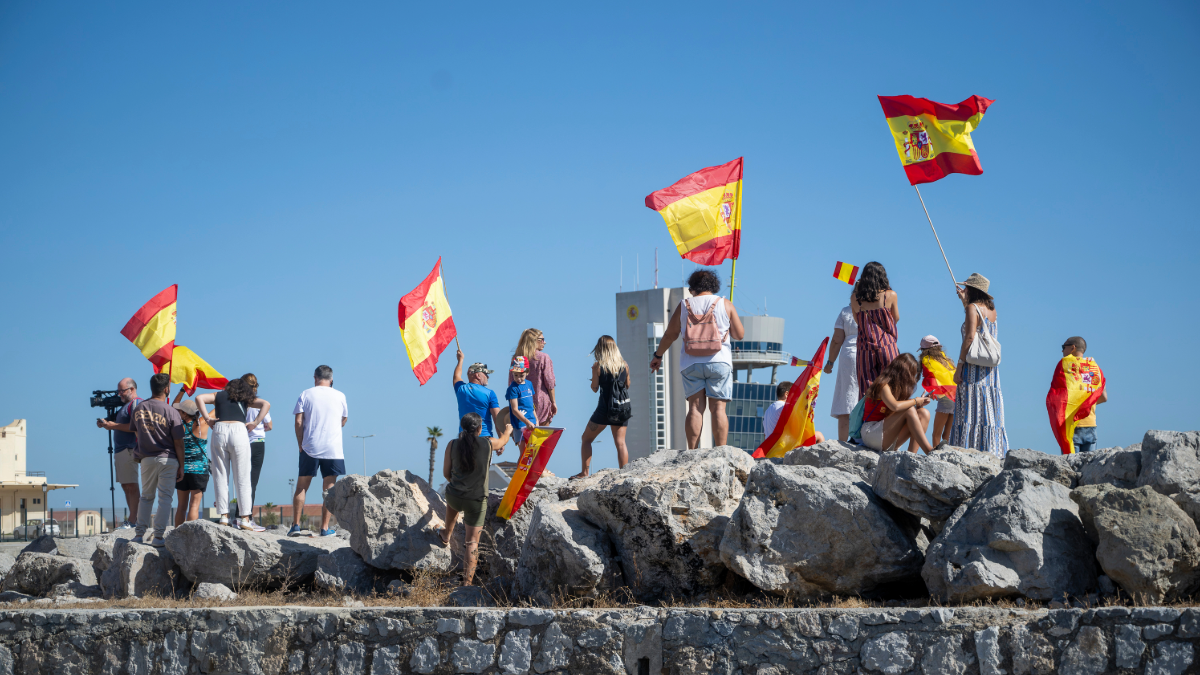
A large number of people took part in a gathering of boats and motorbikes in support of the people of Ceuta on 30 August 2026 in Ceuta (Spain). (Europa Press via AP)
Over two days in late July, an estimated 72,000 people crossed the border from Morocco to Ceuta, a Spanish enclave in North Africa. Many swam a five- kilometer stretch of open sea to make the crossing, and at least 100 people lost their lives doing so, according to the enclave’s mayor. In the lead-up to those chaotic days, a wave of disinformation on social media shared misleading content with young people in Morocco that a recent Spanish Supreme Court ruling had opened the border to Ceuta and onto Europe, and that crossing into Ceuta would be easy.
This week, Spain's Prime Minister Pedro Sánchez named the sources of the disinformation that preceded the Ceuta crossings, citing research by the European External Action Service, the EU’s diplomatic service, that traced the campaign to Russian and Israeli networks operating alongside what he described as an ultra-right international network that "always uses migration to attack both Spain and Europe." Sánchez said the two governments had seized on the issue because of Madrid's positions on the wars in Ukraine and Gaza, and that investigators had so far found no evidence of Moroccan state involvement. Israel's Foreign Minister Gideon Sa'ar rejected the accusation outright, accusing Sánchez of "lying shamelessly," and Russia has also denied any role.
This disinformation effort has striking similarities to patterns seen in content targeting people on the move trying to reach the United States, and in both cases the campaigns worked not because the people who acted on them were credulous, but because the rules governing who may cross a border have been made so opaque, so changeable, and so badly communicated that a video posted by a stranger is often the most accessible account available.
Spanish news outlet El Espaňol, found dozens of burner profiles on TikTok and Instagram that purported to be young Moroccan content creators who had made the journey and were celebrating a newfound freedom in Ceuta. The videos, structured as influencer content, often contained practical advice on making the crossing, from the equipment needed to advice for children and non-swimmers. While many accounts were shut down, they later reappeared under new handles.
Reporting by Reuters suggests that young people traveled from across Morocco in response to online rumors and stories, like waitress Dounia Kherradi, who lived a nine-and-a-half-hour drive away, and 16-year-old Ayoub El Abyad, who told reporters that he and his cousin decided to drive 12 hours to the crossing after seeing videos on Instagram. What they found was drastically different than the upbeat soundtracks of Reels suggested; those who had crossed the border told reporters at DW News that they had to pass dead bodies on the treacherous swim to Ceuta, that they were met with violence when they arrived, and denied food in stores. They then learned there was no way for them to travel on to Europe and that the rumors had been lies. By the end of the weekend, all but a few thousand had returned to Morocco.
None of the mechanics on display at Ceuta are new, and there are clear similarities in the grammar of videos shared of how people on the move try to reach the United States. In March of last year the Associated Press reviewed hundreds of TikTok videos posted by Mexican migration facilitation networks and found similar themes that El Español documented on the Moroccan side of the Strait; upbeat soundtracks, emoji-laden captions, dune buggies racing toward the border wall, jet skis and helicopters and tunnels offered as premium options, facilitators slicing open cacti so their clients can drink, a field of lettuce captioned "The American fields are ready!,” and, at the end, the satisfied-customer testimonial.
In Ceuta as in the Americas, these videos and imagery function as advertisements, painting a picture of border crossing as a manageable logistical problem with a happy ending.
The commercial layer around this content is by now well established. In Spain, the Prime Minister initially blamed human-trafficking networks for the disinformation, as they stood to benefit financially from attempts to cross the border.
Reporting has documented how Meta earned revenue from smuggling and scam advertisements targeting people trying to reach the US, and the pattern intensified once the American asylum system was funneled through a single mobile application. When CBP One became the central route to an appointment at a port of entry, a secondary economy grew up around it involving fake appointment confirmations sold to people who arrived at the border to find nothing waiting for them, paid intermediaries charging anywhere from a few dollars to several thousand, and GPS-spoofing workarounds circulated in WhatsApp groups by people locked out of the app's geographic requirements. The Tech Transparency Project, mapping the same terrain, found Facebook and WhatsApp saturated with false claims about policy changes and invented special provisions for pregnant women and parents traveling with children.
The rumor that circulated in Morocco in July —that a court ruling had quietly opened a route — is a recognizable instance of a well-documented pattern, and the difficulty it presents is one the coverage of Ceuta has largely avoided. Deceptive content does not reach people on the move through a separate channel from accurate content; it reaches them through the same feeds, in the same visual idiom, and often from accounts that are indistinguishable at a glance.
For example, alongside the burner accounts are the Venezuelan and Colombian creators who filmed their own crossings of the Darién Gap, some of whom accumulated tens of millions of views, and whose videos functioned as practical guides to shelter locations, transport costs, river crossings and where along the route it was possible to receive a money transfer. Several of them were explicit that they were warning people off rather than recruiting them. The hashtag was viewed close to half a billion times. This is the same platform and format and for many people it is the only source of information about the journey that is available in a language they read, at a price they can pay, from someone whose position resembles their own.
The framing of the young Moroccans as simply “duped,” therefore, becomes harder to sustain. Scholarship on refugee smartphone use has a precise term for the condition they were operating in. Scholars such as Marie Gillespie, Souad Osseiran and Margie Cheesman describe information precarity, a state of chronic informational instability in which people on the move rely on peer networks precisely because official channels are inaccessible, untranslated, contradictory or actively hostile, and are exposed to rumor and disinformation for exactly the same reason.
The informational vulnerability is a product of a legal architecture that offers almost no authoritative, usable answer to the question of who may enter and how. In Ceuta, Dounia Kherradi drove nine and a half hours on the basis of what she had seen online because there was no other place to look. Agency exercised inside informational scarcity is still agency, and it is worth being careful that any critique of disinformation campaigns does not reproduce the older colonial habit of locating the problem in the so-called gullibility of people from the Majority World rather than in the systems that keep them uninformed by design.
Moreover, states are among the most active participants in this same information environment. In 2025, the US Department of Homeland Security budgeted as much as $200 million for a two-year domestic and international advertising campaign, built around Secretary Kristi Noem telling viewers that "we will hunt you down,” and distributed through hyper-targeted social media placements and text messaging alongside conventional broadcast.
When the spots ran during prime-time football coverage on Mexican television, President Claudia Sheinbaum moved to ban foreign government propaganda outright, reviving a clause repealed in 2014. Deterrence messaging and smuggler advertising run on the same infrastructure, target the same audiences with the same behavioral tooling, and make competing promises about what will happen at the border.
The thousands of Moroccans in July were the target of the same kind of campaign that, in the Americas, is funded to the tune of two hundred million dollars. Neither of these campaigns was an account of what the law actually permitted, and both were persuasion, bought and targeted by parties with a political interest in the outcome. Nobody, in Rabat or Madrid or Washington, was under any obligation to tell people authoritative, timely, and accessible information, and so nobody did.
Authors