How the Supreme Court and Big Tech Both Weaponize 'Race-Neutrality'
Dhanaraj Thakur / Aug 19, 2026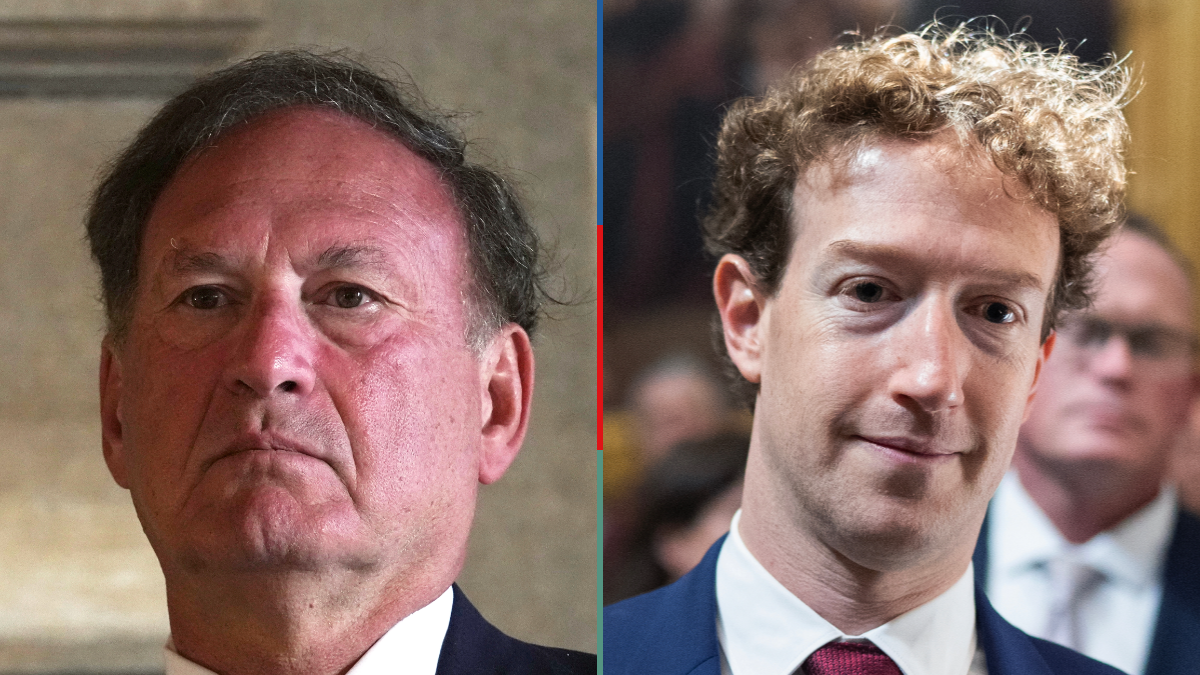
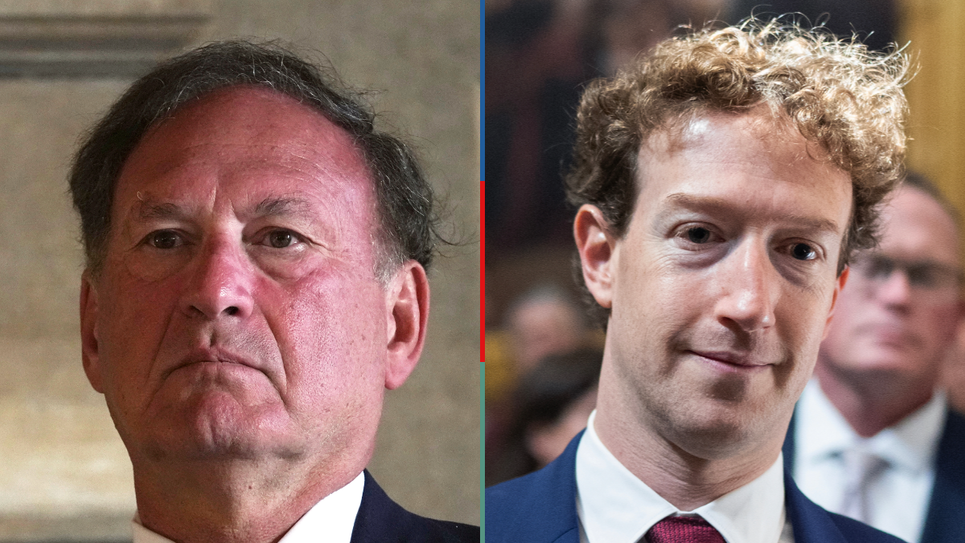
Composite. Left, Supreme Court Justice Samuel Alito attends a meeting in Rome, Sept. 20, 2025. (AP Photo/Andrew Medichini) Right, Meta CEO Mark Zuckerberg, CEO of Meta, is seen in the US Capitol on Thursday, March 26, 2026. (Tom Williams/CQ Roll Call via AP Images)
A dangerous idea is reshaping American democracy. Both online and offline, we are seeing the adoption of a “race-neutral” approach to consequential decisions, even though race plays a defining role in how we relate to one another. This shift harms communities of color and ultimately undermines our multiracial democracy.
In April, the Supreme Court gutted Section 2 of the Voting Rights Act, the nation's most important law protecting voters of color from discriminatory voting maps. Justice Samuel Alito’s opinion for the conservative majority makes it nearly impossible to challenge district lines that reduce the political influence of voters of color. Rather than looking at whether a map unfairly divides communities of color to prevent them from electing their preferred representatives, the majority embraced a race-neutral approach that treats racial inequality as a problem of the past. The practical impact of this decision is that Black representation in Congress will decrease — perhaps significantly — as states sprint to create new voting maps following the ruling in Louisiana v. Callais.
Alito’s failed reasoning does not stop at district boundaries. The idea that racial fairness comes from ignoring race is a fallacy that undergirds a wide range of structures in American society that reify and perpetuate racial inequality — including online.
Many social media platforms employ some combination of AI and human review in their trust and safety systems to protect users and moderate content. This includes identifying and acting on hate speech, harassment, and illegal material. However, because these systems are often implemented in a race-neutral way that mirrors Alito’s reasoning, they result in the same disproportionate harm for communities of color.
For example, one report about Facebook’s internal processes noted that its AI tools treated hate speech the same regardless of whether the target was white or Black, even though the abuse aimed at people of color was more severe. In other words, the platforms treat all users identically regardless of race (and gender, age, etc.), even though society does not. Across social media, trust and safety systems may also downrank or remove posts about racism by people of color because the systems conflate discussion about hate speech with actual hate speech.
A related problem is the suggestion that if there is no intentional racism, then there is no racism. However, attempting to demonstrate intent is virtually impossible in these scenarios. As Justice Elena Kagan observed in her dissent to the majority's decision in Callais:
Now, as then, vote-dilution plaintiffs will have to show more than vote dilution: They will have to show, as well, race-based motive. Now, as then, that requirement will make success in their suits nearly impossible, even if an electoral practice has in fact ‘minimize[d] or cancel[ed] out’ minority citizens’ ‘voting strength.’
Similarly, social media platforms make intent a core element of their content moderation policies around hate speech and other harmful content, yet intent is very difficult for humans — and even more so for machines — to discern in practice. As social media companies increasingly rely on AI-based technologies to analyze content, these models will almost certainly struggle to accurately assess context and intention, potentially leaving race-based hate speech online.
Historically, legal doctrine has therefore looked to outcomes or impact, and not just intent, when evaluating racial discrimination. Alito and the conservative majority have not only undermined this legal precedent with regard to voting rights but have also moved the Supreme Court to be more in line with how AI-led trust and safety systems operate: prioritizing race-neutrality. We are left with an increasingly pervasive ideology that promotes race-neutrality dressed up as law or algorithm, which has and will continue to lead to disproportionately negative outcomes for people of color.
How can we move toward greater racial equity when those who make consequential decisions for hundreds of millions of Americans subscribe to an illusory, race-neutral version of reality that harms people of color — and indeed, all of us? Or when companies like Meta choose race-neutral trust and safety systems to avoid potential conservative criticism or to better align with the Trump administration?
One path forward is to adopt alternative structures that rely less on these decision-makers. Voting rights experts, for example, have called for proportional representation systems, which could help overcome the challenges to equitable representation in voting post-Callais. In the private, corporatized world of social media, alternatives may be less clear. Suggestions include different structures, such as decentralized networks — an interconnected set of social media networks, where each community sets its own moderation policies — including platforms centered around Black communities. We can also demand that companies give users greater control over the recommender systems that shape their feeds. These could reduce systemic harm for communities of color. However, there remains an immense opportunity for trust and safety experts to develop more contextually aware and race-conscious content moderation systems.
About three-quarters of Americans agree that people of color experience a lot or at least some discrimination across various aspects of their lives. We need laws and algorithms to prevent this racial discrimination. But when those deciding on such rules — whether on the Supreme Court or in large social media companies like Meta — refuse to see the problem in the first place, we must advance alternatives. The viability of our multiracial democracy depends on it.
The author wishes to thank Spencer Overton, G. Michael Parsons, and Lisa Bornstein for their helpful comments.
Authors