How to Use Your Community’s Data Center Moratorium
Dean Jackson, Tim Bernard / Aug 18, 2026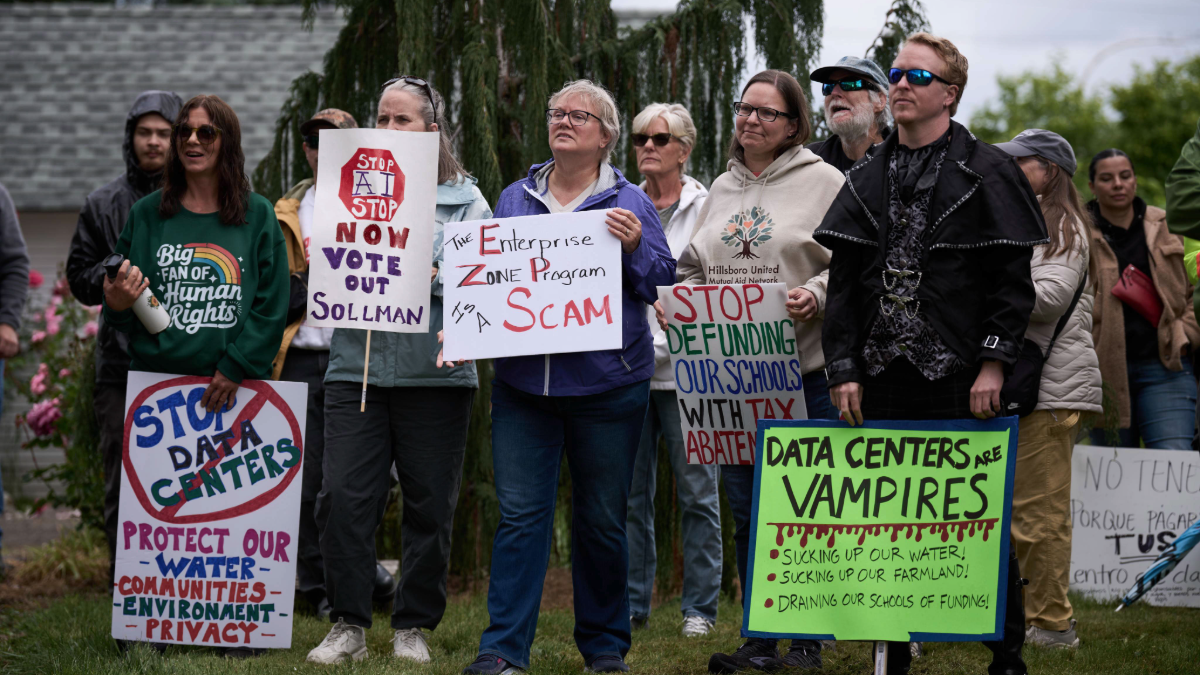
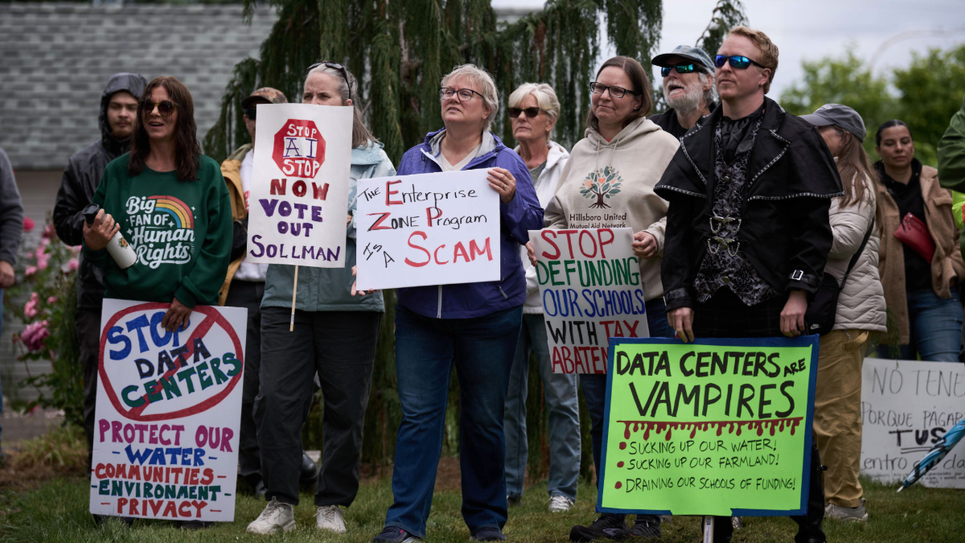
Protesters rally against data centers in Hillsboro, Ore., on May 16, 2026. (Photo by Alex Milan Tracy/Sipa via AP Images)
On July 14, New York Governor Kathy Hochul signed an executive order establishing the first statewide moratorium on hyperscale data centers in the United States. The pause on permits could last up to one year, applies to facilities drawing 50 or more megawatts of power, and is meant to provide a study period during which Albany will “build a nation-leading regulatory framework that protects ratepayers, the environment, the energy grid and communities across the state,” according to the governor’s announcement.
New York’s moratorium follows a growing number of similar resolutions from local governments across the country. Many officials in those communities have also expressed their intent to use these pauses to collect information and develop guidelines on data center development. Moratoriums have bought time for such reflection. What questions are most critical?
Fortunately, guidelines concerning data center development are already available for local officials and can serve as a solid foundation for a study period like New York's. For example, in May 2026, Cuyahoga County, Ohio—which contains Cleveland and its surrounding suburbs—published a set of “recommendations for local communities” across several issue areas. It also provides tips for recognizing a data center developer’s permit application, including vague project descriptions like “light industrial” or “technology park,” the use of LLCs, large land parcels, high electric and water use, and early contact with economic development organizations—as well as questions local officials should ask prospective developers before proceeding.
This guide is far from the only resource available to local decision-makers. Below, we draw from 17 publicly available resources from governments, researchers, and advocacy organizations to provide a list of potential policies and questions local officials can consider during their own data center study periods—most of which are bespoke to data centers, though some draw on trends from negotiations with other industries.
In addition to these resources, we also reviewed proposed state legislation that directs the development of model zoning codes; authorizes or requires the local regulation of data centers; or sets out moratorium procedures. Local government documentation of moratorium plans provided a third set of recommendations. The following are policy choices that government bodies may choose to take.
Transparency and community involvement
- Prohibit the signing of non-disclosure agreements (NDAs), a common practice in economic development that can erode public trust in development and oversight processes and can obscure energy and water use.
- Require disclosure of all corporate entities involved, including an identified end-user.
- Create reporting requirements for ongoing noise assessments, environmental impact monitoring, the value of all tax abatements sought or received, jobs created, median wages (important because inclusion of managers can raise mean wage rates in misleading ways), and other impacts.
- Require disclosing baseline water and energy use and mandate public reporting for large water users. Such disclosures should be considered public records, not trade secrets.
- Involve the public proactively through hearings, online hubs, and regular communication about the process, actors involved, and any agreements under consideration. Be prepared to provide answers about environmental impact, the developer and end-users, their history of community engagement and benefit, power generation and infrastructure costs, noise levels, and other issues.
Establish zoning rules and processes
- Exclude data centers from by-right zoning, which does not require approval from elected officials or the public.
- Create new zoning classifications for data centers with “specific, measurable, and enforceable” standards for landscaping, screening, and other factors. Restrict variances to prevent developers from sidestepping the rules.
- Confine data centers to industrial zones as well as requiring setbacks from property lines, especially residential property lines. The use of hedges and other buffers or screens should be required. Be mindful that confinement to industrial zones alone may not fully mitigate environmental impacts on nearby residential neighborhoods.
- Regulate noise not just for volume but also for constancy, and create regular monitoring and resident complaint processes for noise violations.
- Avoid placing data centers on sites with more valuable development options, such as near transit hubs or in historic buildings.
- Require studies, reports, plans or site assessments as part of the data center permitting process to enable greater confidence about expected impacts and ensure proper mitigations. Independent and/or expert third-party authors may be stipulated.
- Protect public infrastructure, including roads during the construction phase as well as the electrical grid, drainage systems, and gas lines.
- Plan for decommissioning or abandonment. Define standards and timeframes for site restoration, require advance planning, and collect financial assurance to cover all related costs.
- Include plans for stranded infrastructure and site restoration as part of the zoning approval process.
Managing power and resources
- Coordinate with utility providers early in the process, and consider requiring a “will-serve” letter affirming that utilities have sufficient capacity.
- If additional generation or transmission capacity is required, establish rules and agreements requiring data center developers or end-users to pay for it.
- Likewise, institute energy tariffs for large-load ratepayers (a class of energy ratepayer which may need to be created) and require long-term contracts with penalties for early termination, to protect against stranded assets or data center closures.
- Reserve the right to tax or curtail data center power use during heat waves or local emergencies. Legislators across the PJM region have drafted a proposal requiring data center operators in that territory be subject to potential service interruptions.
- Establish a threshold for large-quantity water users, e.g. 10,000 ccf or 7.48 million gallons per month. Create additional requirements for these users, such as recycled water offsets.
- Require closed-loop systems or other high-efficiency systems, and require them to draw from stormwater, wastewater, or public water systems rather than well supply. As stated above, require facilities to report municipal water use and treat that information as public record. Likewise, require them to disclose the sources of their water.
- Create requirements for renewable energy procurement. These can be negotiated as part of community benefits agreements, or CBAs. Procured renewable energy should be in addition to existing renewable capacity available on the grid. Do not provide exceptions for behind-the-meter generation.
- Regulate backup generators, which are often diesel powered, noisy, and pollution-generating.
Taxation and CBAs
- Include corporate investment in the local power grid, exit fees in case a project fails, workforce training programs, support for public health and broadband access, and other benefits in any direct payment scheme included in a CBA.
- Limit and, where possible, repeal tax abatements. Tax revenue is often one of the main benefits local policymakers hope to receive from data center projects, and both economists and corporate officials believe many governments provide more tax incentives than necessary to attract data center developers. Limit the use of PILOT payments, which may yield less than full taxation.
- Seek clarity about revenue projections and the models behind them; most CBA benefits are only seen after a facility is fully operational, if at all.
- Measure CBA progress transparently: economic development agreements are often modified after the fact if targets are not met.
- Specify the number of jobs a project is expected to create, tying tax abatements or other benefits to those targets.
- Include directly-impacted community members in CBA negotiations.
- Avoid fiscal dependency on data centers for tax revenue, which can reduce future flexibility for the local economy.
- Codify common CBA requirements in order to save time across multiple negotiations, strengthen rules and requirements, improve bargaining power, and legitimize them through the legislative process.
Labor protections and requirements
- Require developers to meet targets for local and organized labor sources. Many data center developers use out of state labor, diluting the economic value of even temporary jobs.
- For non-organized laborers, establish a floor on employer benefit contributions and require prevailing wages.
- Avoid misclassification of workers. Most data center jobs are temporary construction roles. These should not count toward jobs created permanently in the host community.
Procedural considerations
- Establish task forces and committees of staffers, experts and stakeholders to coordinate and oversee the process.
- Obtain studies and reports by qualified professionals about data center impacts from prospective developers.
- Consult with government and external experts regarding impacts, and with attorneys regarding proposed ordinances.
- Develop a final evaluation, present it to the public, and gather feedback before taking important votes.
Creating a monitoring and enforcement regime
- Ensure oversight does not end at approval: continued compliance with CBAs, other agreements, and local regulations should be monitored on a continuing basis—including through third-party audits. Resource consumption should be measured regularly and environmental impact—including wastewater discharge and emission of air pollutants—should be monitored continuously.
- Publicly report subsidies provided to data center projects and progress against any conditional requirements.
- Because nominal fines are ineffective against multibillion dollar corporations, governments should create escalating penalties, up to permit and certificate revocation, for hyperscale facilities and ensure that the authority to levy those penalties is vested in boards with meaningful oversight capacity and capability to act.
- Likewise, consider water shutoffs or revocations of certificates of occupancy, which may be stronger enforcement mechanisms than fines.
- Where possible, bar applicants from seeking exemptions to state or local requirements, e.g. emissions standards.
A group of civil society groups, including some whose work is represented in the material above, will host a webinar titled You Passed a Data Center Moratorium; Now What?! on August 19. More information is here.
Authors