India's CJP Protests Meet Internet Shutdowns and Pervasive Surveillance
Amber Sinha / Jul 23, 2026Amber Sinha is a contributing editor at Tech Policy Press.
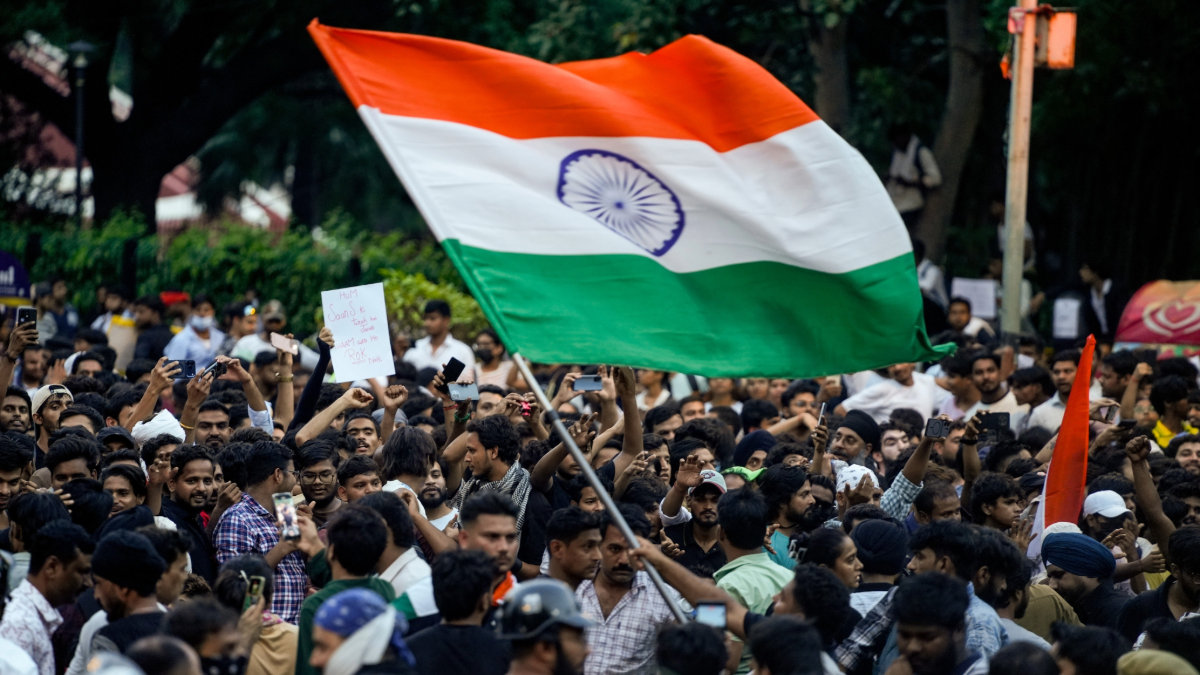
New Delhi: Cockroach Janta Party (CJP) supporters wave the national flag during a protest demanding the resignation of Union Education Minister Dharmendra Pradhan over NEET paper leak issue, in New Delhi, Thursday, July 23, 2026. (Salman Ali/PTI via AP)
In early 2020, as demonstrations against the Citizenship Amendment Act (CAA) spread across India, I was on a Delhi Metro train heading toward Central Delhi to join the sit-in. What began as a routine commute quickly devolved into an eerie experience of the Indian state’s spatial control. As the train moved closer to central Delhi, station after station began shuttering in real time. The transit shutdown radiated outward in deliberate, concentric circles from Jantar Mantar, the heart of protest gatherings in the nation’s capital. My companion and I managed to disembark at Paharganj, a few miles away, slipping through the station gates just moments before security personnel pulled down the shutters, sealing off the entrance behind us. This physical enclosure created by the law enforcement controlled India’s Home Ministry was mirrored in the digital, with mobile internet connectivity cut off in large parts of central Delhi.
Over the past week, as I follow the student protests led by the satirically named Cockroach Janata Party (CJP) in New Delhi from afar, I see a more sophisticated version of this infrastructure of control and surveillance play out. When citizens assemble at Jantar Mantar or march through Central Delhi, their physical presence is intrinsically mediated by mobile connectivity, real-time broadcasts, and online coordination. The Indian state’s response to public dissent has evolved into a sophisticated strategy defined by two mutually reinforcing tactics: preemptive network blackouts and automated biometric surveillance.
The procedural minimalism of network shutdowns
Protestors in Delhi, currently raising their voices against the litany of incompetence in the Indian state’s management of key competitive examinations, are experiencing the outcomes of the routine deployment of mobile internet suspensions and signal jammers around protest sites. Framed by law enforcement as precautionary measures to maintain public order, these disruptions cut off the vital flow of live updates, citizen journalism, and emergency communication.
In the 2020 Anuradha Bhasin v. Union of India judgment, India’s Supreme Court held that internet access is constitutionally protected, establishing that any suspension must satisfy strict tests of necessity and proportionality accompanied by publicly reasoned, published orders. In practice, telecom suspensions frequently lapse into procedural minimalism. Orders are either withheld from the public domain or published retroactively, shielding administrative decision-making from timely judicial review. By severing connectivity, the state does not merely manage public order; it actively limits demonstrators' capacity to document and in real time share state conduct.
The 2024 Rules (notified under Section 20(2)(b) of the Telecommunications Act, 2023) replaced the older 2017 regime (Temporary Suspension of Telecom Services Rules, 2017, derived from the 1885 Telegraph Act). They grant Union or State Home Secretaries, or a designated Joint Secretary in urgent cases, the authority to suspend telecom services. Where the state previously relied on indiscriminate, district-wide blackouts under the 2017 Rules, the 2024 framework's emphasis on "defined geographic areas” has been operationalized during the current CJP protests as tactical micro-geofencing.
These protests, much like those in the last few years, highlight a crucial evolution in civic resistance. Recognizing that cellular networks and centralized platforms are vulnerable to administrative kill-switches, student demonstrators have pivoted toward offline, Bluetooth-aided mesh messaging protocols (such as Briar and Bitchat).
Widespread use of facial recognition
Deployment of automated facial recognition systems (AFRS) in New Delhi, highlighted by a Public Interest Litigation (PIL) currently before the Delhi High Court, illustrate the use of facial recognition technology with chilling clarity, particularly concerning the ongoing CJP protests.
At the center of this judicial scrutiny is the Delhi Police’s sprawling AI-powered surveillance network. The public interest litigation (PIL) filed by former Jawaharlal Nehru University Students’ Union (JNUSU) president Aishe Ghosh paints a disturbing picture of how this network is operationalized at Jantar Mantar, where demonstrators are subjected to relentless, indiscriminate filming from permanent surveillance towers capturing not just political speech, but mundane actions like eating or resting. The petition also highlights coercive intimidation, claiming police personnel threatened to disseminate footage of young protesters to their parents and educational institutions.
During court hearings, the Solicitor General appearing for the state dismissed the PIL as "luxury litigation," equating state-operated biometric logging with the routine filming done by protesters on their cellphones. This defense reflects a profound and deliberate mischaracterization. When a citizen records a protest, it is a localized act of documentation. When the state deploys AFRS, it exercises structural power.
Crucially, the composition of these underlying databases remains dangerously opaque. In a recent story, the News Minute reported that official accounts have fluctuated wildly, citing anywhere from 20,000 to over 350,000 criminal records. However, earlier investigations have revealed a far more concerning dataset: an unregulated category described as "rabble-rousers and miscreants," populated by harvesting images from previous public demonstrations. This arbitrary cataloging effectively criminalizes the constitutional right to assemble, treating every protester as a prospective security threat.
The state’s strategy to render citizen dissent invisible to the outside world while hyper-legible to the state has so far failed miserably on the first front as the movement appears to be rapidly assuming a national character. Yet it is on the second front that I fear the data collected by the state may prove to have lasting damage on select demonstrators targeted in the months to come.
Authors