India’s SIR Voter Purge Shows Digital Authoritarianism in Action
Apar Gupta / Oct 12, 2026Apar Gupta is a fellow at Tech Policy Press.
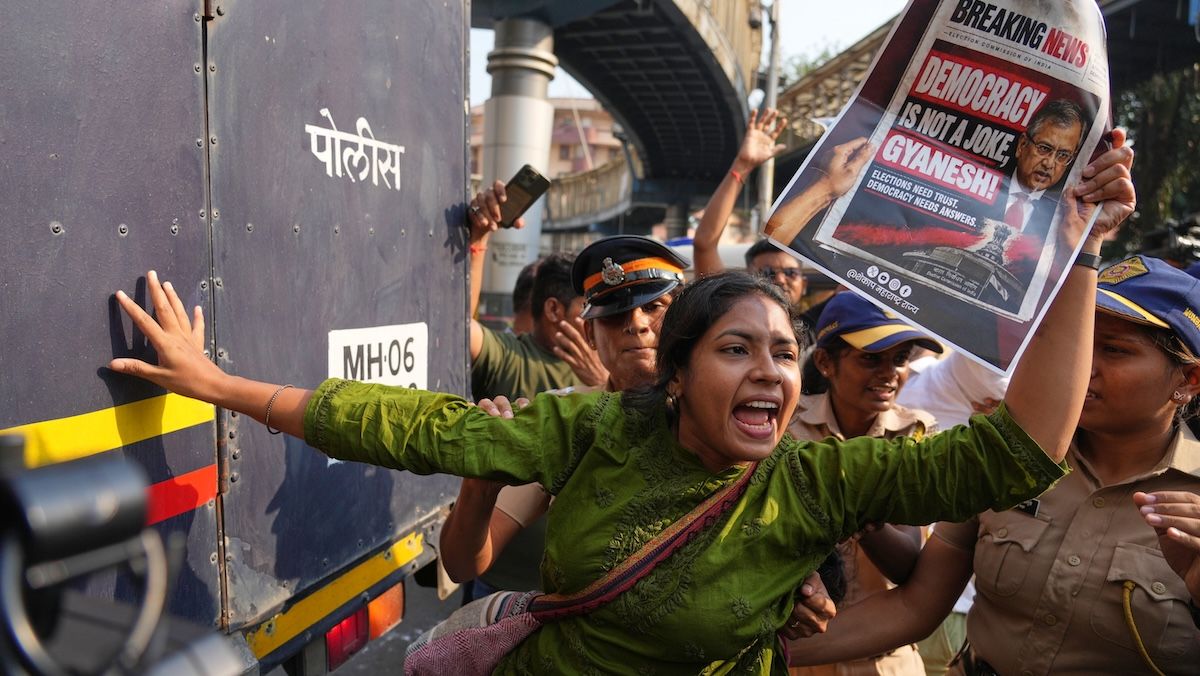
A protester in Mumbai, India is detained by police during a protest demanding the resignation of the country's chief election commissioner Gyanesh Kumar on Oct. 10, 2026. (AP Photo/Rafiq Maqbool)
There is a genre of international commentary on India that ruminates on its democratic backsliding but inevitably concludes with a call to pragmatism. It goes something like this: Yes, the press has been cowed and bought while the courts are subverted. Yes, Hindu nationalism has led to violence against minorities and the growth of authoritarianism. Activists and opposition parties are protesting on the streets, but can we call it an authoritarian country if Prime Minister Narendra Modi keeps winning election after election? After all, he won in 2014, returned with a bigger mandate in 2019, and secured a third consecutive term in 2024, even if with fewer seats in Parliament. Add to this the ruling Bharatiya Janata Party (BJP)'s victories in state after state in between, and who are we, as distant observers, to lecture India on human rights?
This acceptance rests on the premise that the register of voters is honest, as certified by an Election Commission that has, for seven decades since independence, largely been regarded as a non-partisan institution. In a country of nearly a billion electors, where ballots follow caste, religion and language, the roll and who gets to be on it goes a long way in determining the outcome. This premise is now being challenged, and not only by India's opposition parties, whose calls for electoral reform and transparency in the past have been improperly rejected as the cries of a sore loser. But also through more than a year of dogged journalism that has questioned the propriety of the Election Commission’s Special Intensive Revision, or the SIR.
Since June 2025, the SIR — which aims to re-verify almost the entire electorate through a centralized database — has left more than 130 million names off draft rolls, 61.5 million of them in the latest phase alone, which covers 16 states and three union territories. The process has often been conducted on the eve of a state election. In West Bengal about 9 million names, or 12 percent of the electorate, came off the rolls shortly before the April election that gave the BJP control of the state for the first time. The Supreme Court blessed the exercise on May 27 when it decided the case of Association for Democratic Reforms v. Election Commission of India. Then, on Sept. 23, The Indian Express reported that two of the Election Commission's three members had objected on the record at least 14 times in 10 months to how the exercise and its database were being run. These were objections from inside the commission, made by members whom the present government had itself appointed.
Two weeks ago, Amber Sinha analyzed the risks of digital centralization for Tech Policy Press. I ask two further questions. First, how did the clerical exercise of maintaining a list become a software system that nobody outside the Election Commission can inspect? Second, and more important, what happens when such a system is run by a referee picked by the government of the day?
The voter roll has never been clean or neutral
From its first general election, India made the registration of voters the job of the State and not of the citizen, with a view towards its claim of being a democracy that gained independence from colonial rule. But the logistics behind high political principles have been mundane and consist of bureaucratic form-filling based on door-to-door visits. This includes a revision to add newly eligible voters and to remove those who have shifted from the locality or have since died. These processes have always been creaky and inefficient, relying on an imperfect state capacity which has allowed political parties to game them to a limited extent, especially as a strategy for increasing their chances of victory by relying on identity markers of religion, caste and sect for inclusion or exclusion from the electoral rolls. For instance, a 2018 study of Karnataka's rolls by Abusaleh Shariff and Khalid Saifullah found that Muslims were missing at markedly higher rates than others, and that the "cleaning" of rolls has a history of being directed at them.
As Ujjwal Kumar Singh and Anupama Roy recount in the book Election Commission of India: Institutionalising Democratic Uncertainties, in 1992 the Election Commission under T.N. Seshan told its officers that the burden of proving citizenship lay on the voter. An officer in Delhi then declared a slum colony of 18,000 residents to be suspected foreigners, and more than 16,000 of them lost their vote. The Supreme Court stopped the exercise in its 1995 ruling in Lal Babu Hussein v. Electoral Registration Officer, holding that where a name is already on the roll the officer who entered it is presumed to "have gone through the procedural requirements under the statute". The last intensive revision, conducted from 2002-2004, was built on this rule of inclusion. This time when the SIR began, the Commission could not find its own order for that revision and how it was conducted. An official told Scroll, "There was no digitalization in those times." The guidelines, which were produced by petitioners who had approached the Supreme Court in the latest round of challenges against the SIR, show that it was the enumerator who filled in the record, that no form had to be returned by a deadline, and that, in their own words, "it is not the job of the enumerator to determine citizenship of an individual." Bloated rolls and missing voters, the two issues that the SIR claims to solve, are old problems, and the last intensive revision sought to cure them by sending enumerators to do the work while presuming that those already on the roll belonged there.
Technology as the Election Commission's silver bullet
Since the 1990s, successive Election Commissions have answered every challenge with technology, or more particularly digitization, to overcome low state capacity and the problem of administrative corruption and abuse of power. For instance, a former Chief Election Commissioner (CEC), S.Y. Quraishi, records in the book An Undocumented Wonder that face recognition software deployed in Manipur caught a woman who had come to vote more than 60 times in different guises. In 2015, the then-CEC H.S. Brahma began linking voter cards with Aadhaar, India's national biometric ID, with the promise that nearly every complaint about the rolls would disappear. As The Wire later reported, about 320 million records were linked within months, before the Supreme Court restricted the use of Aadhaar in K.S. Puttaswamy v. Union of India. In 2018, journalists reported that this software may have contributed to the removal of 2.2 million voters from Telangana's rolls, and that officers were deferring to algorithms they did not understand.
The intellectual case for such a system came from technologists who have been feted with disproportionate influence in public policy making in India. Its clearest expression is found in the 2015 book Rebooting India where Nandan Nilekani, who built Aadhaar, and his co-author Viral Shah cited an estimate that 85 million entries on the rolls were duplicates or fakes and proposed a cure in four parts. They propose a single, centralized voter management system running the same software across the country, enrolment at banks, post offices and petrol pumps on the model of Aadhaar, the linking of voter IDs with Aadhaar so that biometrics would weed out duplicates, and smartphone services that would one day let a citizen vote from anywhere. "If it can work for your credit card," they wrote, "it should work for your vote." The transactional view of democratic rights is a theme that runs through the book.
What is less remembered from this book, and perhaps not voiced openly even by Nilekani, is that voter lists were to be published in a machine-readable form, with every change visible, so that parties and citizens could audit the database for themselves. India went on to build the centralized system and left out the machine readable rolls that were meant to make it auditable. Such lack of transparency is evident throughout the conduct of the Election Commission. This is further evidenced by how ERONET, the Commission's registration backend, has since 2023 been operated by Tata Consultancy Services, a fact that the Commission never disclosed and that The Reporters' Collective established from the company's shareholder filings. Meanwhile, the Commission itself treats machine-readable rolls as a threat to privacy. With the mindless and opaque deployment of technology, some former Chief Election Commissioners have taken note, with Quraishi writing last year that democracy "collapses also by a thousand tiny exclusions". Nilekani has himself since received a SIR notice to establish his own name in the electoral roll.
Money, muscle and a partisan Election Commission
This centralized voter database is in the hands of the Election Commission, which works within an electoral system already tilted towards the ruling party in three ways. The first is money, for there are no real campaign finance limits in India. This was even institutionalized through a system of anonymous "electoral bonds" that financed political parties from 2018 until the Supreme Court struck the scheme down in Association for Democratic Reforms v. Union of India in February 2024. However, by that time one national election and more than two dozen state elections had been fought on the proceeds, and the BJP had collected far more than any other party.
The second is muscle, which is today exercised through federal investigative agencies. The Enforcement Directorate filed 193 cases against politicians over 10 years and secured two convictions, and 95 percent of the politicians it has pursued since 2014 belong to the opposition. These investigations not only handicap state elections, but also systematically benefit the BJP by splitting and diminishing the power of other political parties, because legislators facing criminal charges often defect from their parties, giving the BJP an advantage when forming governments.
The third is the capture of the referee itself, as per the following sequence of events. In Anoop Baranwal v. Union of India (2023) the Supreme Court directed that Election Commissioners be chosen by a panel of the Prime Minister, the Leader of the Opposition and the Chief Justice of India. Rather than following this decision, within 10 months Parliament replaced the Chief Justice with a minister nominated by the Prime Minister, which gave the government two of the panel's three votes. It is under this law that Gyanesh Kumar, the present CEC, was selected in February 2025 over the dissent of the Leader of the Opposition. An environment of fear surrounds the expression of dissent. In 2019, Ashok Lavasa, who was next in line to head the Commission, dissented from its decisions clearing Modi and Amit Shah, then the BJP president, of violating the model code of conduct. He was overruled — later, members of his family faced tax investigations. He resigned the following year. His phone number was later reported to be on a leaked list of potential targets of Pegasus spyware typically used by governments. Human Rights Watch has since found that at least 110 of the Prime Minister's 173 campaign speeches in 2024 denigrated Muslims, something that could be considered an electoral offence — at least worthy of an investigation — but to which the Commission responded with a mere letter of concern to the BJP's president without naming Modi.
From voting machines to voter rolls
When the referee is not trusted, neither is any machine that it alone can inspect. Here, the opposition's suspicions first attached to the electronic voting machine, which they accused of being intransparent and of manipulating the count, for good reason. A 2017 comparative study by Scott Shackelford, Bruce Schneier and their co-authors, “Making Democracy Harder to Hack,” concluded that no voting machine is impervious to manipulation and that trust has to come from evidence independent of the software, such as paper trails, audits and public scrutiny. Impervious to reason, the Supreme Court has taken the opposite view where in Sunil Ahya v. Election Commission of India (2023) it declined to direct an independent audit of the source code of the machines against a published standard, reasoning in its order that the manner of such an audit is a "sensitive" issue best left to the Commission. In effect, the Court accepted that the code is safe because it is secret. It was after this that the opposition turned to something it could count. In February 2025, Rahul Gandhi of the Indian National Congress, leader of the opposition, pointed out that Maharashtra's roll had grown by 3.9 million voters in five months, more than had been added in the previous five years. On June 7, 2025 he called for machine-readable rolls and for polling day security camera footage, to which the Commission replied through unnamed sources that the charge was “absolutely absurd.”
Seventeen days later, the Commission ordered the SIR beginning with Bihar, where an election was less than five months away. The stated reasons were migration, urbanization, unreported deaths and the presence of "foreign illegal immigrants". Each of Bihar's 78.9 million electors was required to return a form within a month, and the guidelines stated that those whose forms were not received "will not be included in the draft roll". Any person absent from the roll of 2003 was required to produce documents, even though Bihar's roll had been revised as recently as January 2025.
As written submissions filed for Akhtarul Iman, a legislator from Bihar's Amour constituency, put it to the Supreme Court, the urgency was "entirely of its own making," since the Commission had let five general elections pass without an intensive revision and now wanted one within 90 days. Amit Shah, by now the Union Home Minister, later told Parliament that the aim was to "detect, delete and deport infiltrators." The CEC justified the exercise as a response to the complaints of political parties about the rolls, though the opposition had asked for data and was instead given a drive for deletions. When Gandhi returned with evidence of 2.5 million suspect entries added to the rolls in a previous election in Haryana, he was asked to file an affidavit by the Election Commission.
How the software excludes voters
The SIR is a software process that begins with the hastily scanned and digitized paper rolls of 2002 to 2005, printed in several scripts. In West Bengal, they were machine-transliterated from Bengali into English before any matching was done. In late November 2025, the form of each elector was then keyed in by field officers on phone apps, at a rate of roughly 27 million forms a day, and and then compared against the old records. Any elector whom the software could not link to their own or a parent's entry in the old roll was marked as "unmapped". There is no published standard for transcription accuracy.
When only about 3 percent of West Bengal's electors were returned as unmapped, the software was applied to those it had already matched in order to flag "logical discrepancies". The rules, pieced together from litigation, flag a parent's name that does not match the old roll; a parent who is less than 15 or more than 50 years older than their child; a grandparent less than 40 years older; a person with more than six children or with five or more siblings. Also, siblings born less than nine months apart, a rule that will flag most twins. The rules differ between states and were rewritten midway, as in West Bengal where the number of electors under suspicion fell from 13.1 million to about 9.5 million within weeks. No version has been published with a specification, an error rate or an audit. A flag is also not a finding of ineligibility. It only generates a notice, after which the voter must produce documents.
This software flagged 13.1 million electors in West Bengal, or 17 percent of the roll, and 23.5 million in Madhya Pradesh, or 41 percent. In December 2025 the office of West Bengal's Chief Electoral Officer admitted in writing that the software was malfunctioning because the data of 2002 "had not been digitized accurately". Such failures do not fall evenly, since exact matching on transliterated data penalizes names that have more than one spelling. "Xalxo," the spelling used by the Oraon, an Adivasi community, was rendered as "Khalkho" and flagged, while Md and Mohammed, or Sk and Sheikh, (both commonly used abbreviations) were read as different persons. In Nandigram, 95 percent of those struck off were Muslims, though Muslims make up only a quarter of its electorate.
What this means at the doorstep, was recorded by The Wire in Delhi's Chhatarpur in late September. A voter and his six siblings were each served a notice because the software had linked all seven of them to one father, which it treated as suspicious. The notice cited "a likely incorrect match". Their father received a notice as well, since the 2002 roll records him as Kedar while his documents carry the name Kedar Singh, and his handwritten school certificate was not accepted. At Bela Estate, a settlement on the floodplain of the Yamuna, Newslaundry found a polling booth that went from 729 voters to one. When the Delhi exercise came up before the Supreme Court on Sept. 22, Justice Joymalya Bagchi remarked of the 3.3 million notices issued in the city that, "In all probability, they are machine-generated notices."
Nor has the exercise achieved what it promised, as the Commission's own de-duplication software was finally not run in Bihar, and it later told the Supreme Court that the tool had been discarded because "the strength and accuracy of the results were variable". Since the final roll is published in a format that machines cannot read, the Association for Democratic Reforms, the lead petitioner in the Bihar SIR case, stated in its written submissions that it "burnt the midnight oil" with data scientists to convert it. It found more than half a million apparent duplicates, as well as 779 electors who had apparently filed objections against the flagging of their names on the ground that they were not citizens of India.
The CEC has described this design as one that shifts the burden of proof "from the citizens to the database". In practice the burden has moved the other way. Where the database fails to find a person, it is that person who receives the notice, who must stand in the queue and attend the hearing, and anyone left off the draft roll must apply afresh on Form 6 as if they were a new voter. In Delhi, where a third of the electorate was left off the draft roll, The Reporters' Collective found that the app used by field officers had been updated with a "Mark VIP" feature. A notice issued to the Chief Minister was resolved within hours, while a daily-wage worker in the same constituency lost a day's pay standing in a queue over a notice written in English, a language he could not read.
The consequences now extend beyond the ballot, as BJP governments in West Bengal and Bihar have said that those struck off cannot draw on welfare schemes, including food rations.
A Supreme Court that rules after the fact
The SIR was challenged before the Supreme Court in July 2025, four months before Bihar went to the polls. The Court declined to stay the exercise and said it would step in if there was mass exclusion. It delivered its judgment on 27 May 2026, by which time Bihar, West Bengal, Tamil Nadu, Kerala and Puducherry had all voted on the revised rolls. The judgment found the SIR to be proportionate and treated Lal Babu Hussein as a precedent that belonged to a different context. The words "software" and "algorithm" do not appear anywhere in the judgment. It was in West Bengal that the Court did intervene, by having judicial officers decide about 6 million doubtful cases and by setting up 19 appellate tribunals. Yet on the very day these tribunals began work, it held in Mostari Banu v. Election Commission of India that the "mere pendency of appeals" would not entitle excluded persons to vote. Polling began 10 days later with more than 3.4 million appeals that were filed.
The Court's capitulation to the present government has repeatedly taken the form of delay. The challenge to electoral bonds was filed in 2017 and decided in 2024, and the revocation of Jammu and Kashmir's autonomy waited four years. In each case the delay had done its work before the Court ruled. Similarly, the challenge to the 2023 law on the selection of Election Commissioners, Jaya Thakur v. Union of India, itself remains undecided. On Sept. 23 two judges delivered a split verdict on whether it should be heard by a larger bench, and every Commissioner presently in office has been appointed under that law. Nor has the Bench been untouched by the vocabulary of the government. The present Chief Justice Surya Kant, who authored the SIR judgment, asked from the bench in December 2025 whether "intruders" should expect a "red carpet", and in May 2026 compared unemployed young people to "cockroaches". The youth movement that adopted this insult as its name, the Cockroach Janta Party, is now on the streets demanding the resignation of the CEC. A voter who has been deleted and has read these remarks may lack trust in the Court as a neutral forum, whatever, in fact, influences any individual judge.
Dissent within the Commission and the loss of trust
The three-member Election Commission is itself divided, and the public learnt this from reports in the The Indian Express which revealed that Election Commissioners Sukhbir Singh Sandhu and Vivek Joshi, both of whom were appointed by the present government, objected on file at least 14 times between October 2025 and August 2026. One of them warned of the "gradual centralization" of the electoral roll database and sought an audit of who could alter it. Another recorded that the Commission's head of IT had no legal authority to restrict the access of Electoral Registration Officers, who are made responsible for the roll by statute. In Goa, officers found 97 flagged voters to be eligible, but the software could not record their decision and all 97 were left off the roll.
Even though the Commission maintains that all its decisions were unanimous, merely three days after the dissent became public it announced a set of changes through a press note, including a review of its software, which Quraishi described in a discussion hosted by The Wire as an "admission of guilt". The discretion that the law vests in local officers continues to revolve around the Commission’s digital infrastructure. In West Bengal, one analysis by the Institute of South Asian Studies found that deletions exceeded the BJP's margin of victory in 105 of the seats it won, even as it concluded that the overall result would have remained the same. It cannot be shown, then, that the SIR by itself decided any election. However, what is clear is that the SIR has left more than 130 million names off draft rolls, through software that nobody outside the Commission can inspect — staffed and empowered by the government of the day that inevitably ends up winning elections.
Authors