Michigan Offers Handouts for Data Centers Promising Jobs. Will Those Jobs Come?
Nathan Kim, Ira Anwar / Dec 10, 2025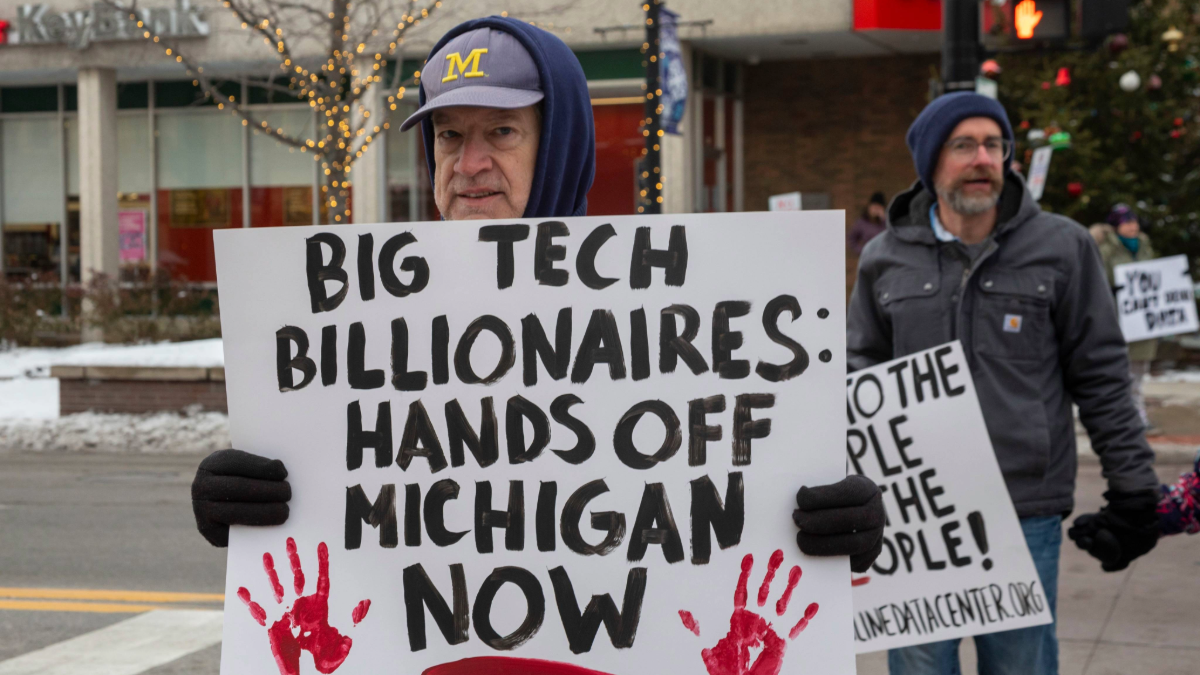
Saline, Michigan, December 1, 2025. Rural Michigan residents rally against the $7 billion Stargate data center planned on southeast Michigan farm land. Protesters say the data center is being fast tracked by DTE Energy, the large electric utility, and that it could raise residential electricity rates and endanger the water supply. (Photo by: Jim West/UCG/Universal Images Group via Getty Images)
The AI investment boom driving roughly half of United States GDP growth in 2025 rests on shaky foundations, demanding extensive reorganization of public and natural resources to sustain an investment in data centers that underlies what some experts regard as an unsustainable AI bubble. Influenced by industry lobbying, thirty-two US states are offering extensive tax exemptions for data center construction, in addition to subsidized electricity and water prices. As employers such as Amazon and UPS report extensive AI-related layoffs and America’s long-term unemployment rate rises, we interrogate the promise of job creation used to legitimize and expand tax incentives for rapid data center development.
Current state incentives reflect a false binary between new jobs and detrimental community impacts. As Tech Policy Press uncovered in its recent survey of over 300 state policy efforts around data centers, many lawmakers consider tax exemptions in the face of the “tradeoffs between investment and jobs on one side and a host of problems on the other.” A separate analysis by NYU Center on Technology Policy director Scott Babwah Brennen from earlier this year concurs, noting that lawmakers are “weighing job creation against added strain on energy grids, increased consumer energy costs, noise pollution, and environmental impact.”
In reality, promises of new jobs that often accompany the announcement of data center projects are rarely fulfilled. Reporting by Business Insider and the Wall Street Journal found the jobs promised by data center developers and AI companies often do not materialize, with even the largest data centers in Ohio and Texas hiring less than 150 permanent employees. As the watchdog group Good Jobs First has found, the promises of job creation often come with a lack of transparency and accountability for both jobs created and the tax breaks received, and job creation costs as much as $2 million in tax breaks per job.
Case study: Michigan
In Michigan, state policymakers are nevertheless particularly intent on linking data centers to job creation programs. Lawmakers passed tax exemptions for data centers in 2015 and extended them in 2024 as part of their economic development agenda. We analyzed Michigan’s policy landscape to understand why, even as the promise of job creation is embedded in the state’s incentive policies, tech companies and lawmakers are unlikely to deliver on this promise.
Michigan legislators primarily offer incentives for data centers through exemptions on the state’s sales and use taxes, and in one unusual instance, grants. The state first passed these exemptions in 2015 to court the digital and AI infrastructure company Switch, specifically for “colocation” data centers, in which a data center operator generally provides services to third-party companies. The Switch data center project also lobbied for a property tax exemption for all colocation data centers; that exemption would have cost taxpayers a minimum of $13.9 million per year, or $139 million over its 10-year lifespan. Though it failed to secure a blanket exemption, Switch successfully won designation as a “Renaissance Zone” from the Michigan Strategic Fund (MSF), which exempts companies doing business at the data center from personal property taxes. Switch then began its construction and operation of a $5 billion data center in Grand Rapids, claiming it would create 1,000 jobs.
Switch representatives and data center lobbyists emphasized that data center development would not occur without tax incentives, arguing that the property, sales, and use tax exemptions were “critical” for its choice to locate its eastern data center facility in Michigan. Switch went on to place these incentives front-and-center on its website to attract businesses that contract space within Switch’s data center.
Motivated by the rise of “hyperscale” data centers being built by the likes of Google, Microsoft, and Amazon in the age of generative AI, Michigan lawmakers expanded the sales and use tax exemptions in 2024 to also include “enterprise” data centers, or large data centers being built by conglomerates for their own use. Exemptions for data centers on state taxes were also extended until 2050, or until 2065 for brownfield sites. Analysis by the nonpartisan Michigan Senate Fiscal Agency estimates that the tax exemptions could cost taxpayers at least $42.5 million, scaling with additional development.
With the passage of the 2024 tax incentives for data centers, Michigan is already witnessing a surge in data center projects, including from Big Tech companies like Microsoft, which is planning to build in West Michigan. Other projects are underway in Southeast Michigan’s Washtenaw County, and last month, the developer Related Companies announced a $7 billion expansion of the Stargate project to Saline Township, which (by our estimate) stands to gain as much as $420 million in sales and use tax exemptions from the 2024 bills signed by Governor Gretchen Whitmer.
Aside from the loss of tax revenue, the Michigan Strategic Fund, an initiative of the Michigan Economic Development Corporation, is also directly giving away public money for data center development. Under its Strategic Site Readiness Program (SSRP), which is tasked with local development and job creation, the MSF recently awarded a $100 million grant to an upcoming $1.2 billion data center project in Ypsilanti, Michigan. The project is led by the University of Michigan and Los Alamos National Labs (LANL) to build the world’s fastest supercomputer, and is intended to be used for various national security-related projects, potentially including weapons research and development. This grant is monumental. It is more than twice the amount awarded to each of the 18 projects that together received $87.5 million in funding from the SSRP. The MSF awarded the Ypsilanti grant unanimously, with the understanding that the project would create 200 jobs and make Michigan a leader in AI. In addition to sales and use tax exemptions for data centers, the project will also enjoy property tax exemptions, given the University of Michigan’s status as a public institution.
The jobs that never came
These projects have collectively won hundreds of millions of dollars in public support, with the promise that “economic development” generally—and job creation in particular—would come to Michigan. But the history of such projects to date suggests these jobs may never materialize. In fact, the 2015 law creating the sales and use tax exemptions for Switch, MCL 205.94cc, required the creation of 400 jobs cumulatively by 2022 and 1,000 by 2026, stating that the exemption would continue to apply after these dates only if these goals were met. However, even as the tax exemptions persist, there has been no state audit to verify the required job growth. Have any of these projects met the mark?
All available evidence points to a resounding ‘no.’ First, advocates for data center sales and use tax exemptions have claimed that the public will benefit particularly from property tax revenue coming from large-scale data center development. However, the state’s two largest data center projects have been able to claim property tax exemptions as described above.
The lack of evidence on job creation is even more jarring given corporate promises. Switch, for instance, could only report a meager 26 jobs by a 2022 reporting deadline. It also promised that these jobs would be high-paying jobs, but the median wage at the Switch data center reported to the state reportedly averages around $38,000 a year. Though MCL 205.94cc stated that the exemption would cease to apply if it did not generate 400 jobs by 2022, the exemption was maintained and expanded through the 2024 expansion described above.
The case of the upcoming Los Alamos project with the University of Michigan appears to be even more inefficient in its approach to “economic development” and jobs creation. As a comparison, at the same meeting to approve the grant for the University of Michigan data center, the MSF approved $27.7 million to the Detroit Diesel Corporation for an initiative creating up to 436 jobs — about $63,000 of state investment per job created. The UM-LANL data center project is projected to receive $1.2 billion in total public investment with a promise to create 200 jobs, and would thus cost $6,000,000 of public investment per job created, making the investments about one hundred times as inefficient in job creation as the public funding received by Detroit Diesel. Moreover, even as the UM-LANL project is more likely to meet its job creation mark through research positions, given the specialized nature of the project and the primary user of this facility being the New Mexico-based LANL, there are no guarantees that local residents would receive these jobs.
Can Michigan learn from its failed data center experiments?
The apparent failures of Michigan’s data center investments are not exceptional. What is particularly striking about Michigan is how legislators continue to tie data center subsidies to substantial job creation and economic development claims despite overwhelming evidence on the contrary from both within and outside of Michigan.
But it's not too late for Michigan. As other states struggle to rein in the data center economy, several large scale data center projects in Michigan are yet to begin construction. Community organizers in Ypsilanti have also succeeded in delaying the UM-LANL project, pressuring Ypsilanti Township to challenge the University of Michigan’s political influence and financial power in the state. Similarly, other communities in Southeast Michigan, like Augusta Township, are resisting large-scale data center projects in their neighborhoods. State legislators in Michigan thus would do well to listen to the activism surging in several Michigan municipalities and the efforts of local officials in regulating, rather than incentivizing, data center development.
Authors