Millions of Volunteers Are Keeping the Internet Human. For Now.
Sarah Gilbert / Sep 14, 2026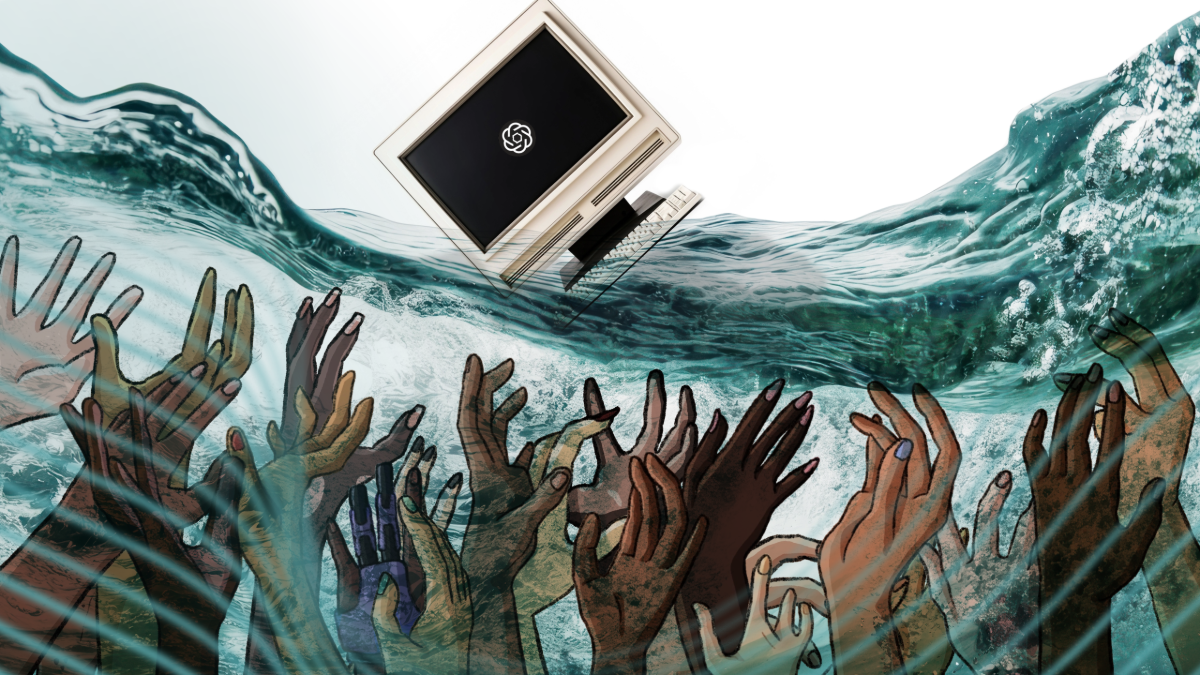
A Rising Tide Lifts All Bots by Rose Willis & Kathryn Conrad / Better Images of AI / CC by 4.0
On November 30, 2022, the Internet became less human. That was the day OpenAI launched ChatGPT, and it didn’t take long for social media to be flooded by a tidal wave of AI generated content from it and other services that launched in its wake. Only three and a half years later, one estimate says the internet is around 16% AI-generated, stoking fears that it is becoming less human every day. But AI-generated content isn’t distributed equally. While some sites, like LinkedIn, may be as much as 40% generated by AI, others sites, like Reddit and Wikipedia have far lower rates: only around 5%.
Why are Reddit and Wikipedia so much more human than LinkedIn? One reason is that they rely on the work of volunteer caretakers, known as moderators, who curate content and protect community members. The launch of ChatGPT and other generative AI models added a new job for moderators: keeping their communities human—a job that’s as grueling as it is fraught.
Why does this matter? If AI content is allowed to drive out human content and prevent people from connecting with each other, we risk dual and intertwined crises of knowledge and community. Without people on the ground fighting against waves of AI slop, the results will be catastrophic. We risk eradicating the digital commons altogether. Supporting these workers means we all benefit from a more human, and trusted, internet.
I know, because I’m there. I am a researcher who studies online communities, and I am a moderator of the Reddit community, AskHistorians, a space where people can ask questions about history and receive comprehensive, trustworthy answers from experts. Since late 2022, my moderation team has struggled to address the influx of AI-generated content that threatens its public history mission. And we’re not alone. Millions of people serve as volunteer moderators worldwide and a growing number are working hard to keep the internet human, but struggling behind the scenes to keep up.
A crisis of knowledge
The internet is the first place most of us turn to access information, but a less human internet means that information is less reliable. A crisis of knowledge occurs when bad content crowds out good content and we lose our ability to trust information.
Generating content using AI is fast—much faster than manual content creation. The consequences of good content crowding out bad is something we have dealt with at AskHistorians for years. To achieve the public history mission of the community, all answers to questions in the subreddit are required to be in-depth and comprehensive. However, writing a good answer takes time. But Reddit’s system of upvoting rewards early content over quality content—the longer content is up, the more upvotes it gets and the more it is promoted by Reddit’s algorithm. To counteract the algorithm and create space for high quality answers, the team removes everything that’s not an in-depth high quality answer, including short, pithy answers, jokes, links, and the ever-helpful, “just google it.” This is also the rationale for the team’s approach to hate-based disinformation, like Holocaust denial. Because lies are told faster than the truth, allowing falsehoods to stand while the truth is written serves to amplify hate. We apply this moderation approach to AI-generated content, too. AI-generated content takes the oxygen—space and attention—from high quality information contributed by experts, replacing it with low quality and even false, misleading, and even hateful information, a phenomenon that is playing out on platforms such as X.
Whether or not we should trust the information we see on the Internet isn’t a new problem, but the task is getting harder. According to Pew, nearly three quarters of Americans think that it is important to distinguish between AI and human generated content, but more than half are not confident in their ability to do so. On AskHistorians, our moderation helps people trust the information they see because they know it’s been reviewed by experts. But our work is changing. Before, we spent our time evaluating expertise; now we also evaluate humanity. Despite playing a key role in verification and trust-building, volunteer moderators are over worked and under supported. Time is a limited resource moderators have less of it to spend on a key mechanism for building trust.
A crisis of community
For better or for worse, the Internet helps us connect with others. We risk losing these connections—and the benefits they bring—when AI generated content erodes our ability to trust others. This happens in two ways. The first is when we can’t find people to connect with amid the slop (see: your Facebook feed). The second is scarier: when we don’t know whether or not people are people. As AI models improve, it’s getting harder to know if you’re talking to a human.
We’re seeing a growing distrust that people are people on AskHistorians, where we’ve witnessed rising rates of people accusing each other of being (or using) AI. While we have our fair share of AI-powered bots on AskHistorians, those are rarely the accused. The accused are often real people with expertise. In one memorable case, the accused was a famous historian with a long history of participation in the community. This is harmful because being falsely accused of using generative AI is distressing. Furthermore, who is on the receiving end of accusations isn’t equally distributed: they’re often English language learners, especially from former Commonwealth countries, and people with disabilities. Such accusations can lead people to withdraw from communities and the benefits they bring.
On AskHistorians we remove all public accusations, but our attempts to keep our community human mean that sometimes we’re the perpetrators of this harm ourselves. Sometimes we ban real people because we thought they were a bot and falsely accuse people of using AI when they haven’t. While our policy on AI allows for some use and includes an appeals system, I have seen first hand how upsetting it is to be falsely flagged by moderators as having used generative AI and witnessed people withdrawing from our community as a result.
So what can be done?
Generative AI may be making it harder to trust the information and people we encounter online are real. But there’s hope. As you read this, millions of volunteers just like me are on the ground, fighting to keep the internet human every single day, largely unseen, through their volunteer roles as moderators, doing work that is stressful, unsupported, and profoundly un-fun. They do it because online communities matter. But moderators can’t safeguard the internet alone.
Volunteer moderation contributes to the massive profits of many commercial platforms. Reddit, for example, sells its data to OpenAI and Google, earning a combined total of $200 million per year. Volunteers curate the datasets used to train the AI-systems that generate even more work for them. Currently, Reddit provides no support for the volunteers keeping its platform human and its data valuable. This work would be more sustainable and less exploitative by building reciprocity into the system. Reddit should also consider whether the long-term impacts of selling its data is worth the short-term revenue gains.
We also need more research. There is a growing field of research into the labor of AI-systems and the impact of AI on online communities; however, recent Trump administration cuts to National Science Foundation funding (particularly for projects involving moderation) have made getting support for that research harder. More work is also needed on developing and auditing tools that flag AI generated content. Otherwise, attempts to keep the internet human could exacerbate alienation through false positives.
And finally, regular people can help too. If you think you see something that is AI-generated on a platform that offers a mechanism to flag it, report it! Reports help moderators respond more quickly and can minimize harmful false accusations.
Helping moderators solve the intertwined crises of knowledge and community by ensuring that AI generated content doesn’t crowd out good information contributed by humans, and that humans can connect with other humans is at the heart of how we safeguard our online communities. We’re never going back to the human internet we had. But we can hope for a better internet than the AI-dominated one that is emerging.
Authors