New Book Challenges Assumptions on Digital Governance in China
Justin Hendrix / Jan 18, 2026Audio of this conversation is available via your favorite podcast service.
A new book titled Governing Digital China offers crucial insights into China's governance ecosystem. Written by Daniela Stockmann, a professor at the Hertie School in Berlin and director of the Center for Digital Governance, and Ting Luo, an associate professor in artificial intelligence and government at the University of Birmingham, the book reveals a more complex reality than simple top-down control.
The authors show how massive tech companies like Tencent and Alibaba have become essential partners to the Chinese state, blending corporate and government power. At the same time, citizens exercise bottom-up influence, shaping how both platforms and the state respond to their needs. The result is what the authors call "popular corporatism"—a form of digital authoritarianism that operates quite differently than you might expect.
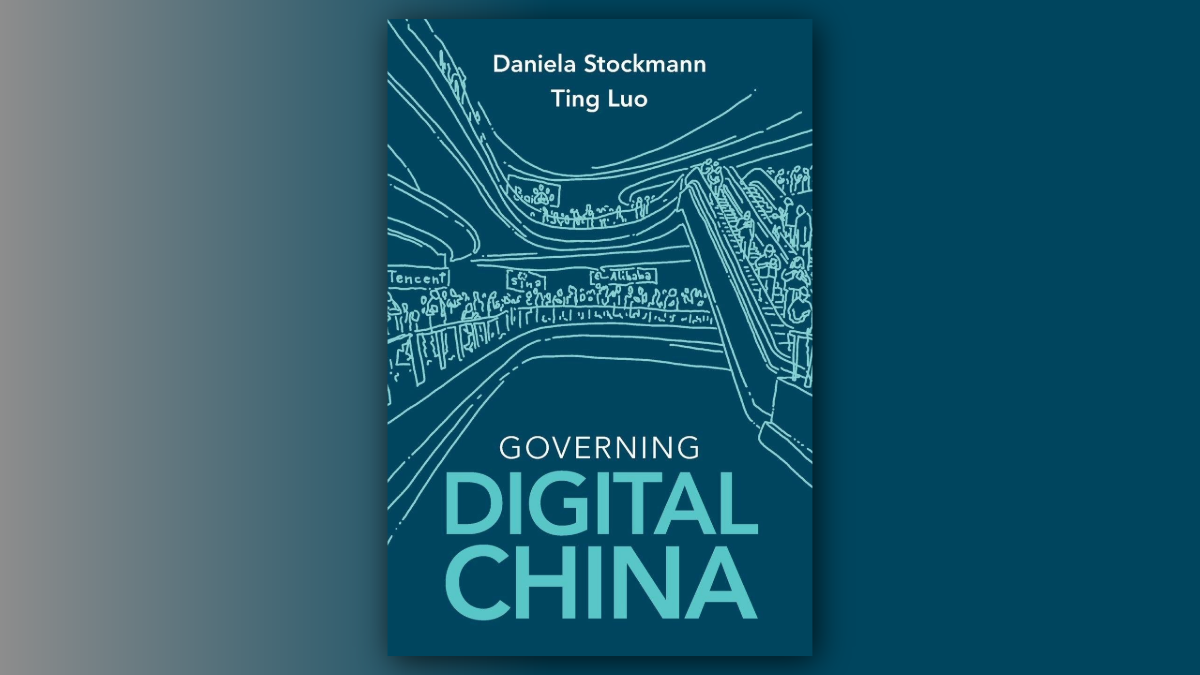
Governing Digital China. Cambridge University Press
What follows is a lightly edited transcript of the discussion.
Daniela Stockmann:
I'm Danie Stockmann. I'm professor for digital governance at the Hertie School in Berlin, and I'm also the director of the Center for Digital Governance.
Ting Luo:
I'm Ting Luo. I'm currently an associate professor in artificial intelligence and government at the University of Birmingham.
Justin Hendrix:
And you are both the authors of this new tome, Governing Digital China, which we're going to talk about today. First, I just want to ask a little bit about how this book came together. How did the two of you come together on this project?
Daniela Stockmann:
Ting was introduced to me by a former colleague, Mei Ling Bernay, and she spoke only in the highest terms about Ting. She told me Ting just gets things. And then as soon as we met, I realized, yeah, that's true. And so over the years, we've been working together now for over 10 years. And I think we've developed a very constructive, insightful way of working together. And we've kind of realized, and I really want to hear what you think about this Ting too, but I realized that we are a really great match because I have the outside perspective, having been grown up in Germany and then studied in the United States on China, while Ting grew up in China and then went abroad to the LSE to get her PhD. And so we kind of matched this internal and external perspective.
Ting Luo:
Yeah, I just want to quickly add to this. I totally agree with what Danie just said, but I also want to add, it's not entirely... I mean, Danie's perspective, although we put it on our acknowledgement that I bring the insider perspective, Danie brings the outsider perspective. But actually because we both have our PhD or education outside of our own country. So I did my PhD at the London School of Economic and Danie, her PhD at University of Michigan. So I think somehow we also bring in this exposure outside of our own home countries into this book.
Justin Hendrix:
I want to ask you first just about the acknowledgements at the beginning of the book. You note that this situation with regard to scholarly discourse on China is becoming increasingly politicized. You talk about these polarizing camps, the quote-unquote, "panda huggers" and the dragon slayers. Of course, I sit in the United States. All the talk here is about China as bogeyman, as one single threat to American supremacy. When it comes to tech, China is only seen as a kind of strategic adversary at best and an enemy at worst. How do these politics affect the two of you in writing this book?
Daniela Stockmann:
I would say, and Ting please also jump in. But my intuitive answer is as we were writing the book, it's become really, really difficult to collect data on China, which is also why we end the book with a few remarks on the post COVID situation, but really we're already collecting data in 2016 and earlier up until COVID. And it has become increasingly difficult to do the kind of social science research we do, which really requires to go to China, see what's happening, talk to people. But then also we collected this huge nationally representative survey, a face-to-face survey inside China, which is in itself, it's a big challenge because obviously it's a huge country, but then it also included lots of questions about political trust, about political discussion online and the Social Credit System. And this type of work is now no longer possible in China.
There are still surveys being run, but they're mostly online and they can't ask any political questions anymore. And so in constraining access and also the ability for us to collect field work, we of course also lack knowledge to talk about China in a meaningful way to provide empirical evidence. And so the discussion about China, I feel, has increasingly become very much very emotional, very stereotypical based on people guessing what intentions and motivations would be. And so that's very difficult to break through. And Ting, of course, you are also a Chinese living abroad. I mean, you probably also experience that every day.
Ting Luo:
I think along the process of writing this book and also doing the field work in China, I think we started our field work in 2015, as was much earlier. We feel fortunate to have start our field work much earlier because it would be much more difficult nowadays to ask the same question, to be honest. And also throughout the years, because we've done fewer several times starting from 2015, and over the time you start to feel like something that was not sensitive before became sensitive. And you can see that in what can be asked in a survey or what can be asked in an interview. The definition of sensitivity shifting and also changing. And you don't really... It's a lot of ... I think the emotional part that Danie mentioned is something that we also observe in those discussions as well. Something that in the past people might not feel emotional about, might be because of what is covered in the media or might be because of the distinction between U.S, China, then it becomes far more sensitive and people might become more emotional about it. I think this is part of my observation.
Justin Hendrix:
One of the things that I feel like we've tried to discuss on this podcast with folks like Angela Zhang and with Graham Webster from Stanford from the DigiChina Project is how flat our perception of how things work in China is often, especially from the United States. I think we have this kind of very simplistic view that there's this command and control totalitarian structure where Xi Jinping issues dictate and that's just how things work. You talk about this a little bit about the idea that that understanding essentially gives too much credit to the Chinese state. Do you encounter that as a problem just in terms of, I don't know, trying to get across even the beginnings of why this book is important?
Daniela Stockmann:
Increasingly in the discussion about the effects of digital technology in the world, there has been a shift from seeing digital technology as promoting democracy and collective action and trust and political systems towards it being seen in much more critical terms as a means to destabilize political systems to increase fake information online, polarization, you name it. And so in this discussion, China is oftentimes mentioned as the negative example in liberal democracies, both in the US and also in Europe, but also in other countries where China has become this image or this vision of a digital governance system that is very state-driven, manipulative and top down and everything that Europe and perhaps also the United States doesn't want to be. But then of course, the more you look into what is actually happening in practice based on empirical evidence, the more we found that this, what we call command and control structure, we also, we term it the big brother type of thinking.
There's this big brother, somehow the Chinese Communist Party is just manipulating everything and both inside China, but also through its tech companies abroad. And we found that in practice, this actually cannot work because it doesn't help the Chinese government to both promote the digital economy and to remain politically stable.
Ting Luo:
Yeah. I think just only briefly to what Danie said. I think also based on my research, I mean, also part of our collaboration, the command and control system doesn't really work in China because the government, the Chinese government also similar to, we all know it's common sense. Outside of China, the government does not know how to run technology, to be honest. They don't know how to run a company. And for technology to thrive, sometimes you will have to use a different mindset and the government does not have that kind of mindset. And I think that's also part of the reason why we think that the story in China is much more complex. It's not just a command and control system. There must be some sort of collaboration or partnership between the Chinese government and the company.
Justin Hendrix:
So you introduced this idea of popular corporatism. Tell us what that is. What does that term mean?
Ting Luo:
I will try to simplify the story. So what exactly is popular competition? You can see a running car that the Chinese government is sitting in the driver's seat. And as the passenger, you have the company, you have the citizen, but then they are not just passengers sitting there not knowing where to go, but they also provide feedback. The company provides service. They also have some bundling power based on their expertise, their data, their wish of their technology, and then citizens through their use of the service to some extent also voluntarily contribute their data and also provide some feedback through the company to the state. I think that's part of a story, but that's what we call popular costism. So there is, in addition to what you usually see in a command control system, you have a top down control directly from the government to the company and also then channel to citizens.
You also have the other way around, bottom up influence from companies as well as from the citizens.
Justin Hendrix:
So I think this is one of the surprising things perhaps for some listeners in the book that you do highlight effectively the power that citizens have in this dynamic. I don't know, Danie, is there anything you'd add there about how citizens are essentially projecting power perhaps upwards into this triangle between the state, between the companies and themselves?
Daniela Stockmann:
What was really surprising to us as well when we looked into the data was that, of course, when you look into the relationship between users, internet users or platform users, Social Credit System users and the platforms, of course, there are network effects. So there's of course also this dependency that we also know and we experience this outside all the time, that it's difficult if you want to move from out of WhatsApp into another platform, of course, all your friends are on that platform and that kind of ties you to WhatsApp even though you want to go somewhere else. And so there is this dependency in China as well, but then at the same time, we discovered that Chinese users have what we call in the book the bottom line. Actually, this term originally comes from Leo Léger who wrote a book between the party line and the bottom line before regarding traditional media in China.
And so we discovered this bottom line amongst Chinese internet users as well. And there's a bit of a liberal bias in China where really Chinese internet users, and here we are really talking about the average internet user actually prefers less censorship, prefers to be able to talk about political topics, maybe not to the extent that an American user is used to, but there's definitely the preference for more freedom of expression on the internet. And we also contrast to some stereotypes about Chinese users, we do find that the average Chinese internet user really cares about privacy. And we discovered this by asking people, "What do you do in a survey? What do you do on your smartphones on platforms?" And then we ask them specifically about certain ways in which you can protect your privacy. And we discovered that a very, very significant percentage of users are actually, in terms of their behavior, trying to protect their privacy.
And so even though we can have a separate discussion whether in practice this privacy is implemented or can be implemented in this Chinese digital governance system, but the point here is that if users feel that the platforms are becoming too censored, to controlling that their privacy is not enough protected, that they're really being surveyed, there is a certain bottom line where people, users start to look for alternatives. And then of course, another factor is the extent to which you do have alternatives because of course in terms of some platforms like for example, Social Credit System, some platforms, especially Alibaba has... So Alipay through Alipay Sesame Credit is included in Alipay in China, in an e-commerce platform. And here Alibaba has almost a monopoly in China, although it does now have a major competitor through TencentPay. But of course, when we look at social media platforms, there are many, many more opportunities to talk about politics.
You don't have to remain on WeChat, which is 99% of internet users in China are on WeChat, but there are also other opportunities going into video streaming platforms and other smaller, less censored, less content-moderated spaces. And so people do start to move. And what we discover in the book is that the companies also react and anticipate those movements. Of course, they may or may not decide to react to them selectively, similar to US companies. I mean, there have been many users moving out of Twitter after it became X going into Bluesky, LinkedIn and so forth, and then the platform may not react to the threat, but in some instances, Chinese platforms do. And I think in the book, we are able to demonstrate empirically some of that resistance.
Justin Hendrix:
Kind of point of, or interstices, I think you query that I find very interesting is obviously between the corporations in this state. And again, I think looking at this through headlines in the US, you often think it's very one unidirectional. The state tells the companies what to do and all of the companies are 100% dyed in the wool, agents of the state, et cetera. But you seem to find that that's not necessarily the case, that the companies are exerting influence on the state, maybe through different channels than perhaps might happen in democracies, but also that there's this dependency that's emerging, and I assume probably growing in the age of artificial intelligence. I know when I read policy documents in the US these days, one thing I always look for is, how is this relationship between tech and the government being characterized? And a lot of the time, lately, it feels like it's almost like a client relationship, like the government acknowledges there are things that it can't do without the tech firms.
And increasingly, things it can't do include securing the state, they include maintaining economic competitiveness, they include generally maintaining military advantage. I assume that a similar thing is emerging in China, and it looks like we've got a handful of companies that are better positioned in that environment in a similar way that we do here in the US.
Daniela Stockmann:
Yeah. So I would say that the core of the partnership is really the shift of governments or governmental and state units in China becoming clients to big tech firms. And there is also, on the points that you mentioned, there's also academic research, showing the dependency of American political parties on the marketing strategy support by, for example, Google, but also Meta. And we, of course, in China, there are no elections. And so then the government doesn't turn to the tech companies for support of marketing for elections, but they do turn to, for example, Sina Weibo also Tencent in order to get some feedback on how do we achieve the goal of presenting or pointing out the accomplishments of the CCP in Fujian province? Or it's basically getting insights on how do we do this online? And then of course, in giving advice on how to best do this online on certain platforms, the company staff then shapes the outcomes themselves.
And certainly without that expertise, but also the underlying data that is being used, the governments themselves wouldn't have those ideas. They wouldn't know how to go about these strategies. And then there's another element that goes beyond public, in China, it's called public opinion guidance, this aspect. But there's also another element which is much more about infrastructure and kind of using digital infrastructure in order to help or increase the capacity to deliver to audiences. And so we see the Social Credit System to play an important part in this. Ting, do you want to talk a little bit more about the Social Credit System or also because Justin mentioned AI and your recent work is much more on the role of AI.
Ting Luo:
Yeah. I think I want to first add to what Danie just mentioned. I totally agree with what Danie just said. So it's actually, to some extent, you can see quite similar when it comes to public opinion guidance. This company provides feedback on what's going on with public opinion. So whether people like us, whether people like the government or are there any areas we can improve, and not just providing feedback to the government, but also, for example, Tencent or WeChat, they also help to do PR work for the government as well. So in that regard, I think it's not much different to Western democracy. Like in the US, you do put a campaign on Facebook for a particular party through targeting advertising. I think it's rather similar, or not exactly the same, but quite similar. So it's not just providing advice, but also implementing PR work for the state.
And the Social Credit System is also in addition to providing feedback. I think part of the problem with the Chinese financial system is that in the past, citizens mainly used cash for their daily transactions and not many, especially if we look at 10 or 20 years ago, not many had a bank account. And also all this spend, they have a very fragmented system. They don't share data. So for a lot of the Chinese population, they either don't have a bank account or they don't use it, they mainly use cash in their daily transactions. And I think this is a typical problem in developing countries. How are we going to understand those people? If they want to get a loan, we don't have any credit history. How are we going to do it? So that's where especially Alibaba came in and also then Tencent came in as well WeChat because you can use those transactions or use their financial context on those paying app to have some sort of credit assessment of ordinary citizens and you'll be able to give them a loan, et cetera.
So I think that's also what we mean by they also provide some sort of infrastructure support to the state. Yeah. I think for the AI, this is something also very interesting, but we were writing the book. We were so worried that when the book came out, it became outdated because we are no longer talking about digital government. We are no longer talking about the internet, but we start with this question to understand how internet's governed in China. But then we see, even though the topic has changed, we are talking about AI nowadays. AI rates between US and China, but then interestingly, we saw a parallel development in China. If you look at what happened now to AI, it's actually almost exactly the same compared to what happened to the internet. Now, for example, we have the same when we have internet, let's say about a decade ago, we have an internet investment fund that the state basically pumps some funds into this investment fund to support company to handpick company that's going to, they're going to become the big internet company.
And nowadays we have what we call AI funds in China as well. And you also see a lot of winners, handpicked winners in this area. You see Huawei, right? And you also see, for example, I think we have TikTok as well. TikTok has some, I think it's called, I can't remember the name of the AI product they launched, but we also have several big winners in this area. So I think in that sense, you will see this also similar partnership between companies and stay when it comes to AI development. And I think you can see all this as a sort of dependency. Companies depend on the state to provide support and privilege access to investment, to resources, to data, while the state requires this company to help them at least win, from their perspective to win this AI race.

A cosplayer uses his mobile phone as he waits for a train at a subway station in Beijing on January 18, 2026. (Photo by WANG Zhao / AFP via Getty Images)
Justin Hendrix:
So what emerges from this is this kind of picture of the state always trying to keep a balance between control on the one hand and then almost using tech as a kind of, I mean, obviously an extension of its interests, but as a kind of feedback mechanism as well for how it needs to change and how it needs to change its approach. Is that fair to say?
Daniela Stockmann:
Absolutely. I think this balancing between liberalization and control is exactly... This is also the very tricky part because if you have too much liberalization, then all these liberalizing forces, all these billions of people, potentially 1.3 billion of people start to criticize local governments online. There's a lot of push against potential push against the political system. So that's where I think the Chinese government over time and also different leaderships, they have struggled with how much of this partial... What's the degree of liberalization that is required, but also how much control is required? There's also a constant discussion inside the leadership. And what I have noted over time is that it used to be under Huddent, it really used to shift much more between these periods of loosening and periods of tightening while under Xi Jinping, we still see these shifts, but not to the same levels or degrees. So it's much more centering around a certain level, I would say. And so that's a new development, but it doesn't change the fact that this balancing is a constant means through which digital governance in China works.
Justin Hendrix:
Yeah. I mean, from the outside, most of the assessments that I read around what's happening in China at the moment, you get a sense of a malaise that's driven in part by the idea that maybe the economic promise isn't delivering, and that seems to be affecting all parts of society, but in particular, the kind of middle. And yeah, generally, I mean, and you point this out in the book in a couple of different ways that the era of Xi Jinping, which you compared to Huge Intel in particular, but we're seeing a tightening when it comes to internet freedom, the scores from groups like Freedom House, which you cite just keep getting worse. I don't know, what does that tell you about the trajectory of this dynamic? Where do you think things are headed?
Daniela Stockmann:
I mean, I think it's always difficult to predict the future of China because you can only get be wrong. I predicted at some point in 2008 or shortly before 2008, my prediction was if China was ever going to face a major crisis, it would really test the system. And then in 2008, there was the Sichuan earthquake you may remember. And no, the system remained stable. And here we are, 2026, and we still have a functioning People's Republic of China. So I mean, I'm hesitant to predict China's future, but I can sort of see different outcomes. And one potential outcome is that the current political leadership realizes that consistent with the past, usually if you wanted to really promote economic growth and digital innovation, which involves, of course, the digital economy, but is broader also about economic growth more broadly, it was usually associated with more opening.
And this is also, at least what I know, Ting, you may disagree with me, but what I see currently is a little bit more of this opening taking place in response to these pressures. But then at the same time, I can also see China potentially developing into a society where the current leadership becomes very insecure about its potential to keep the political system stable. And then of course, there's a potential to move into this command and control Big Brother type of system and then rule a population that would be largely unhappy with that system, but potentially still remain a unified country in that sense. Until there is a situation like after the end of the Berlin Wall war or shortly before it where you have suddenly there's a spark and a big revolution. But I think China's future is open and it's very much subject to how this discussion about how much balance and when to balance partial liberalization, how that plays out. Ting, do you have any thoughts about this?
Ting Luo:
Yeah, I think as a political scientist, we don't really want to predict because like what Danie said, it's going to be wrong, but I think I'm going to only add one perspective given what's been going on recently. I don't know whether people have been following up on the news about Meta's two million deal to buy Chinese AI startup, Manus AI. And what happened with this new development is something that made me think about what's going to go and happen after this. Now, if you look at Manus AI, I remember in our first launch last September, Danie, if you remember the slide, I used Manus AI as an example of how China is growing as an AI power, but then now it's about less, I think it's about years later now, we see that Manus AI have moved to Singapore, have this Singapore washing, that's what they call unroof everything from China and then sell it to Meta, two billion deal.
And this story is tricky because you don't know where you're going to go. From the Chinese perspective, Manus AI, they send a message to all startups in China. The best route for you is to have a startup with China because you don't have the kind of data regulation as you have in Europe and you have a much better environment than you have in local support. Local governments all want to help with those AI companies because they want to win the AI race with the US. So this is the way, you can have a stop in China, benefit from whatever in that context. And then when you have those products, when you have something, the next step is maybe to unroot yourself from China, move to Singapore and then sell it to whoever can pay the biggest review. And that's a worrying story because from the Chinese government's perspective, it might trigger the insecurity like what Danie mentioned earlier.
They might be like, "I feel so insecurity about what happened and may they might then maybe tighten up control. So I will not allow you to move. I may have some more strict export control rules." And I think this will be a worrying step, but we don't know whether this is going to happen, but at least we know that there's a review of the deal now by the Chinese government, that's the current... We don't know what's going to happen with this review, but I think it does show a worrying message and I'm a bit concerned about what's going to go next because I would suspect the Chinese government, it does make them insecure about what's going on with their AI strategy.
Justin Hendrix:
Do you see that also in what's happened with TikTok of late? We still don't quite know exactly how that's going to resolve.
Ting Luo:
Yeah, that's interesting. I think I haven't really, it's quite unclear about what's going on with TikTok, but it doesn't seem to have the same problem as TikTok. I wonder because maybe TikTok have separate the company into two, one outside of China, one inside China. So for them, they might not be this similar issue like Manus AI because I would see TikTok as something like in our book is a bigger company and they have separate operation inside, outside of China. But Manus AI basically now become completely outside of China, has nothing to do with China anymore as far as I see from the news.
Daniela Stockmann:
I mean, there's always this question, right? Do Chinese tech companies, when they operate abroad, to what extent are they actually still Chinese? For example, there was a TikTok summit in Berlin a couple of weeks ago. And so TikTok talks about this as their trust issue, that outside of China, people consider them to be a Chinese company where they very firmly state, we are actually registered in Singapore. They try to really argue against this very strongly. And so one of the criteria that I have always used in order to decide to what extent is their connection to China would be whether the firm behind it has a headquarters in China, inside the Chinese mainland. And so Ting, do you still think that's a good criteria?
Ting Luo:
Yeah, I think this is a good criteria. I think that's the difference between TikTok and Manus AI because Manus AI, I think they closed their headquarter in China and they have now completed the new company in Singapore, with headquarters in Singapore.
Justin Hendrix:
I also wanted to ask about China's influence in its own neighborhood. I mean, there's a lot of work from groups like Article 19 on the extent to which China is exporting its digital governance model and exporting even in some cases infrastructure and the rest of those things. How does that play into the way that digital governance works even perhaps domestically in China? I mean, how does that goal to spread the Chinese way of doing things seem to feedback or does it? Does that question make sense?
Daniela Stockmann:
It does make sense because this Chinese model has been ... So this Chinese model, digital governance model has been looked at as an example by other countries like Russia, Iran and so forth independently. But then in addition to that under Xi Jinping the Digital Silk Road Initiative was launched where a lot of funding and also government strategies was put into promoting tech champions and their success abroad in order to promote China's image abroad, but also in order to expand its influence. And so of course there is an ongoing discussion as to what the effects of this may be. And I guess for us in the book, we are less examining empirically the effects of the Chinese model outside of China because the book is really focused on what's happening inside the Chinese mainland, but we are more interested in providing an analytical framework, which we call popular corporatism in order to help understand how any tech company, be it Chinese or US or Russian or originating anywhere in the world, how those companies would engage with authoritarian states.
What we have found was that this Chinese model is actually only replicable under one condition, which is as a government, it's very expensive because you have to have a lot of funding and resources available that you can use in order to provide incentives for companies to pay them, to give them an incentive for profit making so that you become a client to them, right? It's expensive. And of course, you also have to have a certain degree of a state development approach towards economic growth. Not all countries in the world have that. I mean, I think in the United States, for example, it's very common to believe that the absence of the state would promote economic development. While in Asia, amongst the Asian tigers, there's a lot more support for the idea that states should actually invest in the economy in order to promote economic growth.
So far, we've looked a little bit into Vietnam and a little bit into Singapore. And in those contexts, there are some governments that follow that Chinese approach where they provide these, what we call co-optation. So it's essentially providing financial incentives in exchange for certain services outside of China. But we haven't found much evidence of the actual implementation of this Chinese model somewhere else, despite the fact that China is promoting software and so forth in other contexts.
Justin Hendrix:
You've mentioned Big Brother and the Big Brother frame. Another frame that you talk about is Brave New World. You contrast those frames as sometimes useful, sometimes not useful, sometimes promoting misunderstanding perhaps of China. For the listener who may have one or more of those metaphors in their mind when they think about China, I don't know, what would you tell them as they continue to read articles in Western media and continue to consume the unavoidable propaganda about China and its approach to technology from Western governments? How should we be thinking about those metaphors?
Daniela Stockmann:
I would say that both Big Brother and also Brave New World are totalitarian understandings of political systems, but also the way that technology is being used. And it's more, in my view, these understandings of China do not really conform to the empirical evidence. I mean, there's always some, because there are these top-down structures. Of course, you can always find some evidence for the existence of these top-down structures, but if you really want to understand China, you have to look beyond just the top-down aspects and you have to start looking for empirical evidence that also shows the opposite, the impact of tech firms on policies, but also how users use technology platforms in China and what kind of incentives that those provide. And it requires you to, when I read the news, at least, now I really try to differentiate between expressions of emotions and fears of this sort of totalitarian paradigm versus what I, as someone who's truly interested in understanding China of what is actually happening.
And of course this becomes, it's very challenging even for me because if I wanted to know in the past, I would go to China. And now, of course, you can travel to China as a tourist, but oftentimes, the most interesting questions you won't get answers to. And so I guess for me, I hope that in the future, we are going to have a world again where lots more people like Ting and me, but also journalists can provide more empirical evidence about China that conforms more to reality. And so that information about China is less influenced by the fear of what China could be.
Ting Luo:
Yeah. I would say I think if there's a message for the readers or for people who are going to read the book or want to understand China, I would say we have to go beyond this dichotomy between democracy and totalitarianism or authoritarianism. Although in academia, we have called for this for years, but I think in reality, people always put on what we call a color glass before they look at stuff. When they look at China, the first thing that comes to their mind is a totalitarian regime, top down, and you have a big brother there. And I think what we want the reader to, when they're with the book, I want them to put this color glass down first and then just focus on the evidence and make their own decision about what they know about China? Do they think China is a totalitarian regime?
And also on the other hand, do they really think the US or UK, are they still democracies? Maybe they are not in some aspects. So I think this is the question or the kind of our message for the reader. And also, I think if you look at what's going on nowadays in our environment, we are in a polarized world. People always come with a narrative and when they tell their story, they always come with their ideology precision first and then they show the evidence and we want the other way around. We want to show you the evidence first and we're not going to tell you how we think or what our views or values are. And we want the reader to have their own values based on the evidence they have from our book.
Justin Hendrix:
You end the book with a brief look back on democracies and I take your point that, well, I think we can fairly characterize China as an authoritarian government. The question over the health of democracy, the trajectory of democracy, even in some cases, the existence of democracy in certain parts of the West is an open one, but you look particularly at Europe, for instance, what can, looking at a Chinese model tell us about Europe's ambitious approach on digital governance? I kind of want to just put that to you to conclude what can we learn about this approach versus what we see in China? What is the study of this question? And in particular, this relationship between the state citizens, corporations. What does it tell us about the European approach?
Daniela Stockmann:
Earlier in our conversation, you mentioned that nowadays the discussion about China is very much influenced by either people who look at China very critically, we call them the dragon slayers. And then there's another group of people who we call, oftentimes in the China few, we call them the Panda Huggers who want to promote the positive aspects of the Chinese system. And so what we are trying in the book is to stand in the middle and to try to take a critical thought perspective, but at the same time, do not glance over certain aspects that could also have a positive effect. And so we then end the book with the question, is there anything that we can learn or that outside of China, we can learn from China about liberal democracy? And over the last few years, I've become very much involved in the European debate about how can Europe set up a new form of digital governance that promotes democracy on digital technology platforms?
And even though now there are tons of digital policies, including Digital Services Act, Digital Markets Act at the AI Act, GDPR, you name it, coming out of Brussels, it's a huge package. I still feel that this sort of European answer towards how do we make sure that platforms can remain innovative and grow the digital economy while also stabilizing political systems lacks a vision. I don't see the vision. I see the advantages of all these regulations, but I don't see how would this digital governance structure actually work and where are we heading with it? What kind of democracy do we want? And that's where China is really strong. It's not a liberal democratic vision, but China or the Chinese Communist Party is able to provide a very clear vision to its citizens, but also towards outsiders in terms of we want to have a very highly developed, digitally advanced system.
China Dream is about you being able to fill whatever China Dream is as long as China remains politically stable, even though it's not democratic. And within that sort of broad China Dream framework, there's a lot of space politically. You can be more liberal, you can be more conservative, but it's definitely one overarching frame. And it's more of a centralized frame too. I mean, it's definitely the Chinese Communist Party is, of course, within that vision for China. And what I see, I mean, I've become very interested in how now in liberal democracies, what alternative visions exist for positive visions for a democratic future. And I've discovered that most of these visions actually have a decentralized structure. I was at the German French Digital Sovereignty Summit a few weeks ago, also hosted here in Berlin and Eurosky was launched, which promotes a framework for complete interoperability between Bluesky and Mastodon and a number of other smaller platforms.
But it's interesting, it's also similar to China because it's also digital sovereignty in the sense that that's built something that's different and territorially distinct from the United States, for example. And so I don't know whether the second part of the vision, which leads to greater fragmentation of the internet, whether I would want to promote that in a positive way. That's I think yet another aspect of this discussion, but I do think underneath it, there is this vision that decentralization, maybe having a network of smaller platforms that are connected to each other in a meaningful way is part of an alternative vision that would promote a more decentralized digital governance system compatible with democracy.
Justin Hendrix:
Ting, this leads the final word to you. I don't know, you've lived in both contexts, you've got a perspective that perhaps is a little more tactile in that way. I don't know, what do you make of this final kind of question? What should folks in Europe or generally in the quote-unquote "West" be thinking about?
Ting Luo:
I actually have been asked the same question a few months ago about what UK can learn from China's so what we've done in our book, and I didn't have a very good answer at that time because I feel like it's a very tricky question because I've been in the UK myself for such a long time now and also have experienced what happened to the UK. We were part of Europe before Brexit and we are no longer part of it, but we still want to be part of it. So this is very confusing if you look at the policy landscape in the UK. And if we look at the policy document as well, you can see, I think the kind of confusion or a lot of vision that Danie mentioned is even worse in the UK. And I think perhaps for the UK, the next step probably, if there's anything we can learn from China, is basically to find your position in the world.
I mean, where do you want to be? Do you want to be like the US? Or do you want to be like Europe or who is your partner? Who are your friends? And I think the same with digital government. So are you going to go for the more commercialized version of the US, give commercial companies more power, give them more freedom to innovate, or do you want to go with the European style where you have a lot more regulation. Maybe you want to be the future leader in setting the rules and regulations for digital development, or do you want to be like China. Of course, I mean, we're not talking about the political system. We are talking about how you're going to govern or promote digital development. And I think if we're talking about what the UK can learn from China, definitely the kind of clear vision or your position in the work, especially in the world of digital development.
Justin Hendrix:
Well, I'm very grateful to the two of you for speaking to me about this book, and I want to recommend it to Tech Policy Press listeners and readers. It's called Governing Digital China. And where can folks find this book? Where's the easiest place to get hold of it?
Daniela Stockmann:
You can find it on all major bookstores online, but if you want to have a discount, you may go to the Cambridge University Press website, and then you have a discount code, which is GDC2025, valid until September 30th, 2026. We would be so delighted to have you as a reader. Thank you, Justin, for taking the time to read the book, and it's been a great discussion, great fun to be with Tech Policy Press today.
Justin Hendrix:
Thank you. That's the first time we've ever offered a discount code on the book podcast, and I'm pleased to provide that value in this. I wish you both the best for the new year, and hope to talk to you again soon about this issue or others.
Daniela Stockmann:
Thank you, Justin. Take care.

Authors