On Eve of Brazil Elections, Meta Content Moderation Decisions Raise Questions
Laís Martins / Sep 30, 2026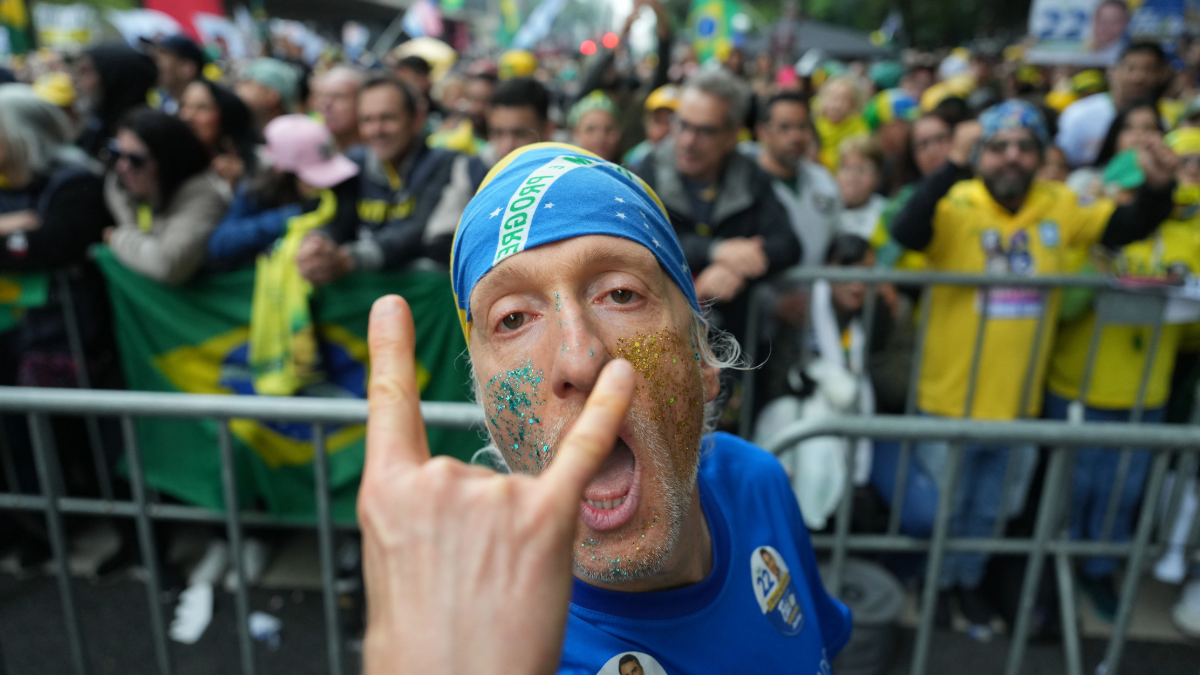
A supporter of opposition presidential candidate Flavio Bolsonaro attends an Independence Day event the month before the general election in São Paulo, Monday, Sept. 7, 2026. (AP Photo/Andre Penner)
Last Wednesday, Meta briefly disabled Brazil President Luiz Inácio Lula da Silva’s campaign page from running political ads. The company said the restriction occurred because “some of its activities don’t follow our rules”, but did not specify which activities, or which rules. Lula’s Workers’ Party lodged an appeal with the company, and the restriction has since been lifted.
Lula is running for reelection against Flávio Bolsonaro, a senator and the eldest son of former President Jair Bolsonaro, who is now serving a prison sentence for an attempted coup d’état. “In practice, this is not only about the incalculable damage to the candidate and the elections, but the favoritism of his political opponents in the electoral process,” wrote the Workers’ Party campaign in its appeal to Meta. Tech Policy Press reached out to Meta for comment on the incident, but received no response by the time of publication.
The restriction on Lula’s campaign page followed another concerning content moderation decision by Meta on the same day. Last Wednesday morning, Meta took down an Instagram profile that had just the day before published a viral explainer video about alleged connections between Flávio Bolsonaro and political scandals, including ties to a banker being investigated for the largest financial fraud in Brazilian history.
Revelando Brasil, which operates the Instagram profile that was taken down, is a project led by Calma Urgente, a weekly podcast hosted by journalists Alessandra Orofino, Bruno Torturra and Gregorio Duvivier, together with two other independent news organizations.
Meta gave no explanation for the takedown, stating simply that the video violated its community guidelines, according to Revelando Brasil. After hours of public outcry and backlash against the company, the profile came back online in the middle of the afternoon. In response to an earlier set of questions sent by Tech Policy Press about this incident, Meta said only that “after internal review, the account mentioned in the report was restored. We apologize for the inconvenience.”
These two moderation decisions involving high profile candidates come amid a flurry of other concerning news about potential foreign interference in the elections by outside actors. Last Tuesday, the newspaper Folha de S. Paulo reported that a group of right-wing influencers connected to United States President Donald Trump, including former Republican congressman Matt Gaetz, have been paying to promote posts showing Flávio Bolsonaro taking a lead in Polymarket bets. Although Polymarket is prohibited in Brazil, Bolsonaro and right-wing allies have been publicly pushing the predictions as proxy polls.
Two weeks ago, the Workers’ Party also requested an investigation from the Electoral Court on potential involvement of Rockbridge, a group of wealthy conservative donors co-founded by Vice President J.D. Vance, in Flávio Bolsonaro’s campaign. On the sidelines of the United Nations General Assembly last week, Trump also asked allied countries to designate 24 criminal groups, including two Brazilian factions, as foreign terrorist groups, as Flávio Bolsonaro had petitioned Trump to do.
Cries of censorship
The action against Lula’s campaign page prompted many of his supporters to raise concerns around censorship. And one of the removed Instagram video’s authors called Meta’s decision—just 12 days before Brazilians head to polls to choose their next president—a form of censorship. Others, like left-wing candidates running for Congress, called it an act of foreign interference in Brazil’s electoral process.
The video posted on Instagram was a short teaser, linking to the full 30-minute video hosted on YouTube, which had reached the top of the ‘Hype’ ranking in less than 24 hours and was not removed. As of Thursday morning, the two teaser videos on Instagram had nearly 25 million views.
“The video script was the result of rigorous work from journalists, researchers, fact-checkers and a legal department,” Bruno Torturra, the editor at Calma Urgente and Revelando, told Tech Policy Press. He added that the takedown was not preceded by any warnings, with a standard message sent after the profile had already been excluded.
“The video was not a campaign, it was not libel, not guesswork, it was a list of facts, all amply reported by the press and explained in an accessible format to everyone,” said Fábio Porchat, a comedian from the group Porta dos Fundos who featured in the explainer, on a separate Instagram video posted after the page came back online.
“We showed the narrow relationships that exist between politicians like Flávio Bolsonaro, Nikolas Ferreira, the Lagoinha Baptist Church, Daniel Vorcaro and the Supreme Court of Justice,” he said. “After lots of pressure, the page came back online, but we don’t know for how long.”
In May, The Intercept Brasil published a bombshell investigation about Bolsonaro’s connections to Vorcaro, a banker currently under investigation for what has been dubbed as the biggest financial fraud of the country’s history. Since then, other media outlets have published new stories connecting other politicians, including federal deputy Nikolas Ferreira and multiple Supreme Court Justices to the banker. Many of these connections can be traced back to Lagoinha, a baptist church in the state of Minas Gerais.
Immediately after the Revelando profile was taken down by Meta, there was outcry from Brazilian users, including artists, journalists, activists and left-wing politicians, with many calling Meta’s decision censorship. Many also raised questions about whether this episode can be considered foreign interference. The episode has sparked questions about sovereignty, freedom of expression, and the limits of big tech’s decisions amid electoral processes.
“Beyond the story told in the video, this case reveals another scandal: Meta’s arbitrary, opaque, and disproportionate power over the national media landscape”, said Torturra. “It also highlights a central issue for the State and society to consider: can we speak of freedom of expression on social media without algorithmic transparency? Is the press truly free when subject to unwritten rules? To codes over which we have absolutely no editorial control or influence? To the whims of nameless executives?” he added.
Torturra said the group is now working on a script for an upcoming video about platforms, digital sovereignty and the privatization of freedom of expression.
Investigation under consideration
Last Wednesday afternoon, Ctrl+Z, a Brazilian nonprofit organization focused on big tech accountability, requested the Federal Prosecution Service to investigate Meta and demand the company detail the reasons behind the removal of the Instagram account. (Tatiana Dias, a program director at Ctrl+Z, is a fellow at Tech Policy Press.) The case was distributed to the Regional Prosecutor's Office for Citizens' Rights in São Paulo and a prosecutor has been assigned to it, according to confirmation from the press office.
“The removal of an established journalistic profile—with a track record, an audience, and editorial partnerships—without specifying the particular rule allegedly violated runs counter to the duty of transparency and due process that the Supreme Federal Court’s own jurisprudence has come to require of platforms, and it frustrates the right of the user and the public to know and contest the grounds for such a severe measure,” Ctrl+Z wrote in its request.
In addition to Ctrl+Z, federal deputy Orlando Silva, the former rapporteur of Brazil’s Fake News Bill, also requested the Federal Prosecution Service investigate Meta over its decision to shut down the profile.
Meta’s takedown of the Revelando Brasil profile is not an isolated event, explained Luã Cruz, director of strategic litigation at Ctrl+Z. Over the past few months, the organization has been tracking cases of censorship to newsrooms and individual journalists.
“We understand this is another action by Meta like others that have been happening, and more strongly after Trump took power, after Zuckerberg changed Meta’s content moderation policies, with the use of AI, and the lack of explanation to users who have their accounts taken down or banned,” said Cruz.
If this weren’t a case involving famous actors, with wide media coverage, it would likely fall “into the limbo,” like many other businesses, he pointed out.
“We can't have this ‘black box’ situation where content of such great importance goes offline—without us knowing why—and then comes back online—again, without us knowing why, or how it returned, what the decision or reason was, or what the process was that caused the account to be taken down and subsequently restored,” he added.
Authors