Soccer's Tech Revolution Has a Labor Chain
Tatiana Dias / Jul 17, 2026Tatiana Dias is a fellow at Tech Policy Press.
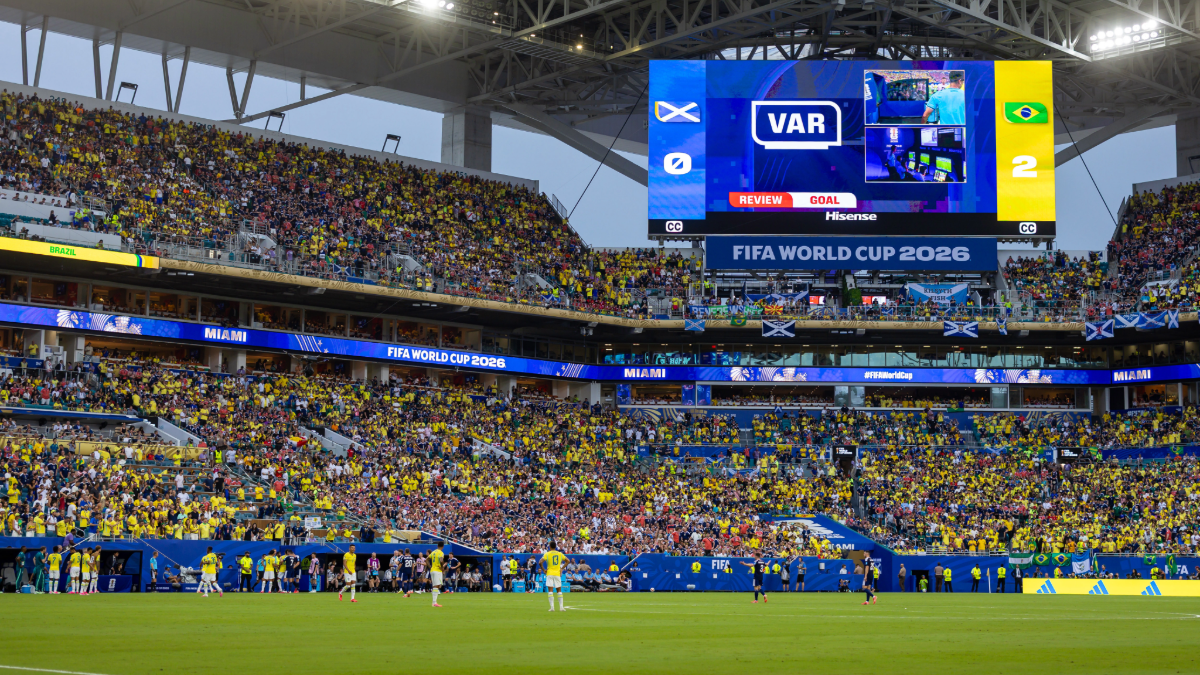
Miami, June 24, 2026: WORLD CUP, BRAZIL vs. SCOTLAND. General view of the VAR screen at the Miami stadium for the match between Brazil and Scotland in the 2026 World Cup. Photo: Rodolfo Buhrer/AGIF
At this World Cup, a spectacle of sensors, cameras and AI has made technology part of the sport's appeal. The AI-powered World Cup has been celebrated for narrowing the gap between smaller and bigger teams, and for making the tournament "smarter” and “more inclusive, more accessible" as Lenovo CEO Yuanqing Yang announced at CES 2026.
Lenovo is FIFA's technology partner, and the provider of the technology that is becoming increasingly part of the games. Players' bodies have been rendered as 3D avatars. We can see them on screen, when the VAR system is analyzing a player’s position. Every team has an AI assistant at its disposal: drawing on thousands of data points collected during a match, the Football AI Pro platform, launched by FIFA with Lenovo, produces real-time tactical reports and strategic recommendations.
The Adidas match ball carries motion sensors that record everything and transmit it in real time to the VAR system. The sensor data is combined with player positions and video to review incidents on the pitch. The promise is a more precise, faster officiating.
The effects can be seen on the field— and in the results. Croatia was knocked out by Portugal after a goal was disallowed because the ball detected a touch by a player in an offside position by a VAR review. Iran fell in the group stage when a goal was ruled out for a millimetric offside also identified by VAR. Later, Egypt was the one eliminated by Argentina after VAR detected a fault committed by an Egyptian player before his knock to the goal.
So far, there have been more than 100 VAR interventions at the World Cup — an increase FIFA anticipated. It was a decision by Pierluigi Collina, chairman of the FIFA Referees Committee, to reduce time lost during matches. Meanwhile, criticism has also grown that soccer — a sport defined by creativity and improvisation — is turning too much into a game of precision.
The World Cup most bedazzled by technology is also the most lucrative in history. And the two phenomena go hand in hand in soccer's datafication.
Yet this World Cup's techno-solutionist spectacle is part of something larger. Beyond the familiar complaints that technology is killing subjectivity and improvisation in soccer — can anyone imagine Maradona's Hand of God surviving a VAR review? — this process is building a new and profitable industry that is transforming modern soccer, powered by sensors, AI, betting and — crucially — invisible labor.
The political economy of soccer data
For Rafael Grohmann, a professor at the University of Toronto, the conversion of soccer into data is "a striking example of how financialization and datafication travel together." Grohmann recently set out to research the world of tech workers in soccer.
In his 2022 book Expected Goals, journalist Rory Smith describes one of the starting points of soccer's datafication: the founding of the data analysis company StatDNA in 2009. Its founder, Jaeson Rosenfeld, was also the co-founder of Digital Divide Data, a company that outsources data and tech work in Laos and Cambodia aiming “to help the world’s poorest benefit from information technology by creating sustainable social enterprises,” and provided workforce to StatDNA.
According to a 2014 story in The Guardian, Digital Divide Data workers watched footage of matches, coding it into specific data, like the position of the goalkeepers and the striker’s favorite foot. In 2012, StatDNA was bought by Arsenal, the English club that pioneered the adoption of data analysis.
Jaeson Rosenfeld now serves as an advisor to FIFA on advanced analytics.
According to Grohmann, over the past decade, as transfer fees exploded and England's Premier League became the richest league in the world, the process consolidated — accompanied by an influx of American money into Europe's major leagues. Today, more than half of Premier League clubs are majority-owned by US individuals or firms.
Soccer's datafication is creating a new industry — one that follows the model of the global AI industry: lucrative, concentrated and unequal. Most clubs lack the capacity to collect and process data the way Arsenal did, which makes the data vendors the profitable end of this industry.
Companies such as Hudl, SkillCorner and Sportradar promise to develop “winning strategies,” "empower smarter decisions" and "increase fan engagement" through AI-powered soccer, and count among their clients national teams, as well as clubs, federations, media companies, and the gambling and prediction markets.
Physical data generation is dominated by Sony, which owns a series of sensor, wearable and computer-vision companies — among them Hawk-Eye, the operator of technologies deployed at this World Cup, including VAR.
As with that pioneering company, Grohmann's early research shows that soccer's datafication follows the same inequality logic as the global AI supply chain: wealthy countries capture the money, while Eastern Europe, Africa, South Asia and Southeast Asia are left with the poorly paid work of data annotation.
The stories the data doesn't tell
On his first day of work as a soccer data annotator, Ashley Flores of the Philippines faced a task: watching the semifinal of the 2014 World Cup – the one in which Germany crushed Brazil, playing at home, 7–1. Flores wanted to be a soccer player, but the chances of that in the Philippines are slim. So he became a "tagger," a data labeler feeding the new and profitable industry of datafied soccer.
Flores's story appears in the introduction to Expected Goals, Rory Smith's 2022 book. Behind what some see as a technological revolution lies an economic and labor chain that reveals a great deal about how a subjective, human process as soccer is converted into quantifiable data.
At the company where Flores worked — Packing Sports, the Manila subsidiary of the German firm Impect — the data labelers spent their days watching matches and logging every movement. They were trained with the 7-1 game, counting how many opponents were bypassed, whether by a dribble or a quick pass.
That is because Brazil's historic defeat was not a typical match. Considered apart from the scoreline, the numbers suggest two evenly matched sides — and even a slight edge for Brazil, which had 52% possession and more corners and shots than Germany.
"It was the first game that really highlighted the difference between our data and what you normally see," explains Lukas Keppler, managing director of Impect, whose clients include Bayern Munich and Paris Saint-Germain, in Expected Goals.
So instead of traditional match statistics, Impect offers “Packing,” a metric “that measures the value of actions and events in football games.” With the promise of better data, annotators are trained to count the opponents between the ball and the goal, to judge the distance between players and their markers, and to estimate the degree of pressure on the player in possession.
On the back of this human work of collecting match data, Impect offers more than 1,200 ways to evaluate a player. The information is organized into detailed analyses that can be used for tactical decisions, player signings, team selection, investment strategy or betting, according to their website.
According to Rafael Grohmann, in the UK, the rise of online betting was one phenomenon that fueled soccer's transformation. "It was betting in England that drove greater investment in soccer data science," Grohmann explains. Nowadays, the betting market and prediction platforms such as Kalshi and Polymarket are part of this industry.
"It's pretty clear that the data I record is for betting," a data annotator in Rio de Janeiro told Rest of World. Speaking anonymously, he said he is paid around €60 per match to log the action — money he considers reasonable. "They need real-time data to adjust their odds throughout the match," the worker said. "So I cannot send the data late, or I risk losing part of the payment."
The technology spectacle on display at this World Cup promises to remove human error from the game. But it does not remove the human; it relocates and hides them, while transforming the game into monetized data.
This is not soccer's peculiar fate. It is the general trajectory of many industries – turning behavior into data, converting that data into a priced asset, and sending the bill for the conversion to the Global South. Soccer simply had the misfortune, or the luck, of being the place where the operation became a spectacle, broadcast to billions, with commentary and replay.
Authors