The EU's AI Boom Could Undermine its Own Chip Strategy
Joana Soares / Jul 27, 2026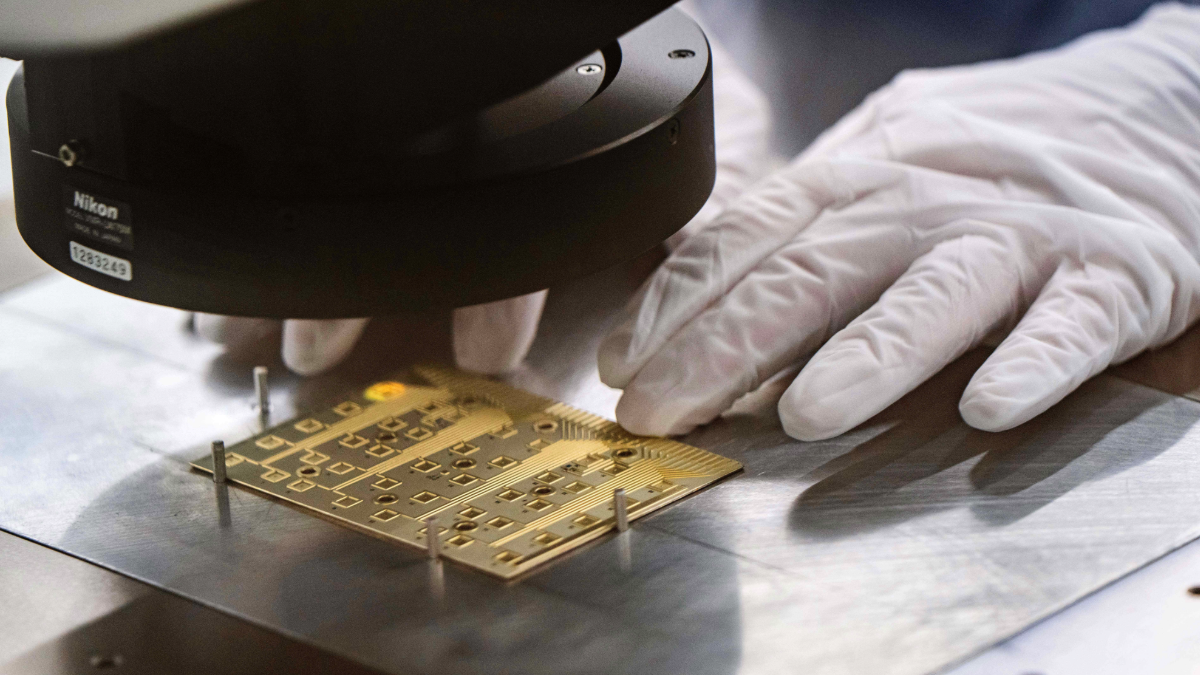
(AP Photo/Jeffrey McWhorter)
The European Union's push for technological sovereignty faces an uncomfortable contradiction.
As Brussels rolls out AI factories, gigafactories and new data centers, it is creating a surge in demand for the advanced semiconductors that underpin artificial intelligence. Yet Europe produces fewer than 10% of the world's chips and remains heavily dependent on US designers and Asian manufacturers for the most advanced processors.
That tension sits at the heart of Chips Act 2.0, the European Commission's planned overhaul of its flagship semiconductor strategy.
The original Chips Act, adopted in 2023, sought to raise Europe's share of global semiconductor production to 20% by 2030. But the European Court of Auditors has warned that target is unlikely to be met, while the Commission's own projections put Europe's market share at about 11.7%.
Brussels now wants to correct what officials see as a major weakness in the first law: it focused on expanding supply without doing enough to stimulate demand. To address that gap, Chips Act 2.0 is expected to introduce demand-side measures, including public procurement tools, demand accelerators and closer coordination between semiconductor producers and industrial users. The Commission's calculation is straightforward: stronger domestic demand will encourage companies to invest in designing and manufacturing chips in Europe.
But the strategy carries a paradox. The AI infrastructure Brussels hopes will anchor a European semiconductor ecosystem will initially rely almost entirely on advanced processors designed by American companies and manufactured in Asia.
"Key positions are held by a small number of firms, mostly outside Europe," Claire Godfrey, executive director of the Balanced Economy Project, told Tech Policy Press.
AI factories create a demand trap
Brussels AI Continent plan's ambitions include 19 AI Factories, plans for up to five AI gigafactories, and a proposal to at least triple the bloc’s data center capacity within five to seven years under the Cloud and AI Development Act. That expansion will require a large supply of advanced AI processors.
The Center for European Policy Studies (CEPS) estimates each planned AI factory site requires up to 25,000 advanced chips, and a gigafactory requires at least 100,000.
Almost all of those processors are expected to come from Nvidia. The company supplies most of the graphics processing units (GPUs) deployed in Europe, while its proprietary CUDA software underpins much of the AI software ecosystem. CEPS warns this could create what it describes as an "Nvidia dependency trap,” where computing infrastructure is physically located in Europe but remains technologically dependent on a single American supplier.
Recent AI infrastructure projects in Europe illustrate the problem. Mistral has lined up 13,800 Nvidia GPUs for a data center near Paris; Deutsche Telekom’s Munich Industrial AI Cloud is being built with nearly 10,000 Nvidia Blackwell GPUs; and Nscale says its Sines deployment for Microsoft will start with more than 12,600 Nvidia Blackwell Ultra GPUs before expanding to more than 66,000 from 2027.
Europe still doesn't control the chip supply chain
The challenge extends well beyond Nvidia. Even if Europe succeeds in expanding semiconductor manufacturing, the industry's global supply chain limits how much autonomy any single region can achieve.
“Europe depends on both the United States and Asia, but at different stages of the value chain,” Toni Roldán-Monés, economist and Assistant Professor of Public Policy at IE University, told Tech Policy Press.
“The United States maintains a dominant position in areas such as chip design, intellectual property, and certain frontier equipment. Meanwhile, the manufacturing of the most advanced semiconductors is highly concentrated in Asia, especially in Taiwan and South Korea, while China plays a fundamental role in various materials, industrial processes, and critical minerals,” said Roldán.
Europe’s reliance on third countries is more evident in some parts of the chip value chain. In fabrication, Taiwan produces around 90% of the world’s most advanced chips. In packaging, assembly and testing, the EU holds just 4% of the market and remains highly dependent on Asia, according to Laith Altimime, President of SEMI Europe.
"No top 20 assembly, test and packaging company is headquartered in the EU," Godfrey said. "There is also the materials issue. China dominates several inputs used in key parts of the semiconductor and advanced electronics supply chain."
Europe nevertheless retains important advantages.
The region is home to ASML, the Dutch company that dominates the market for extreme ultraviolet lithography systems, and Belgium's imec, one of the world's leading semiconductor research centers. Europe also remains a key supplier of specialist materials and power electronics.
Those strengths, however, do not amount to strategic autonomy across the semiconductor value chain. "They do not translate into autonomy across the semiconductor value chain," Roldán-Monés said.
Sovereignty means resilience, not self-sufficiency
Few experts believe complete semiconductor self-sufficiency is achievable.
"It is not conceivable that one country can rebuild the supply chain. Global collaboration is key," said Laith Altimime, president of SEMI Europe.
Instead, the goal should be to reduce strategic vulnerabilities rather than eliminate international interdependence. “It is not conceivable that one country can rebuild the supply chain. Global collaboration is key,” Altimime told Tech Policy Press. Europe is projected to meet only about 68% of its semiconductor demand through domestic production by 2028, according to SEMI forecasts.
“The challenge is to reduce dependencies that could become geopolitical vulnerabilities,” argues Roldán. “The sensible approach is to strengthen critical parts of the value chain, diversify suppliers, protect sensitive data, and develop domestic capabilities in strategic sectors. That can coexist perfectly well with foreign suppliers: the objective is not to expel them, but to avoid excessive dependence on a single country, company or technology.”
That distinction is especially relevant for Europe's sovereignty ambitions. As Claire notes, “European firms are building around Nvidia hardware, CUDA, cloud infrastructure and the software choices that come with them. That leaves Europe with two problems. It relies on Asian manufacturing and materials chokepoints. It is also at risk of trying to address that exposure by tying itself more closely to US-controlled AI and cloud infrastructure. The Chips Act 2.0 needs to deal with both, or it will miss a large part of the problem.”
Roldán-Monés said Europe's greatest vulnerability is dependence on partners willing to use global supply chains for geopolitical leverage. Whether Chips Act 2.0 reduces that risk, experts say, will depend on whether it diversifies suppliers rather than shifting dependence from Asian manufacturers to US technology companies.
Authors