The FTC’s AI Preemption Authority is Limited
Andy Jung / Feb 6, 2026Andy Jung is associate counsel at TechFreedom.
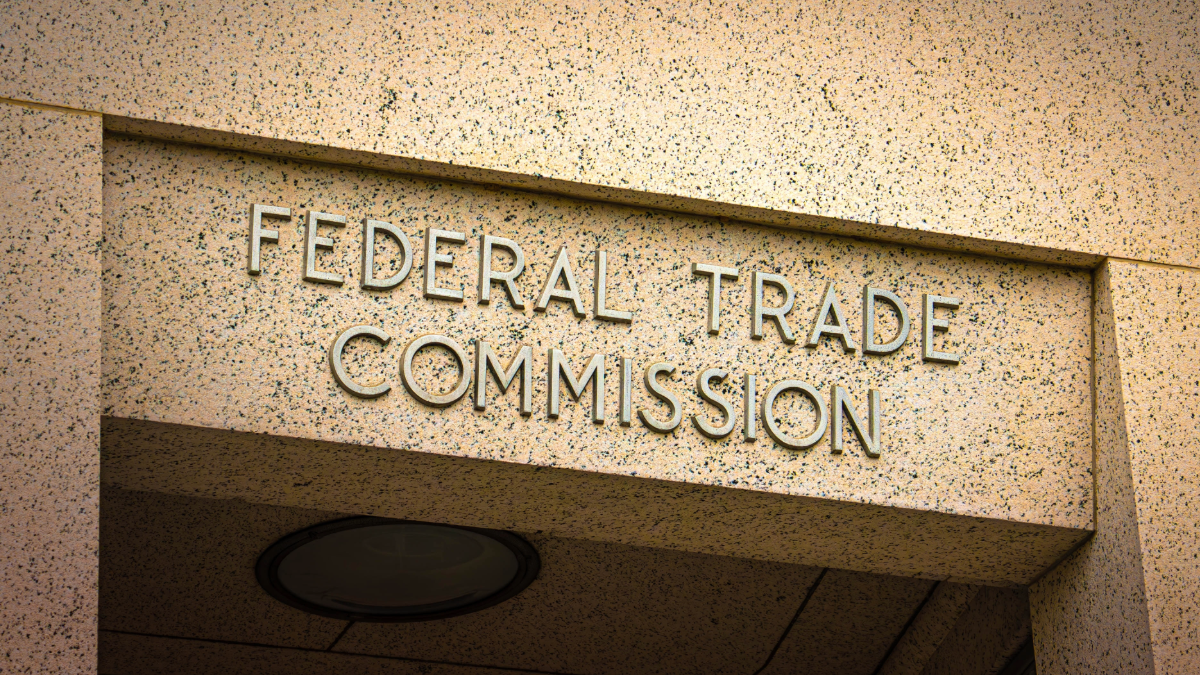
Sign on a doorway at the Federal Trade Commission in Washington D.C. Shutterstock
Can the Trump administration preempt state consumer protection laws governing AI? The Federal Trade Commission (FTC) will soon try, but the agency’s authority to preempt state laws is limited.
Last December, President Trump issued an Executive Order (EO) titled “Ensuring a National Policy Framework for Artificial Intelligence.” The EO directs the Chairman of the FTC to issue a policy statement “explain[ing] the circumstances under which State laws that require alterations to the truthful outputs of AI models are preempted by the Federal Trade Commission Act’s prohibition on engaging in deceptive acts or practices affecting commerce.” Pursuant to the order, the agency has until March 11 to issue the statement.
Section 5 of the FTC Act prohibits unfair or deceptive acts or practices in commerce. The EO focuses on deception, defined as a misrepresentation, omission, or other practice that misleads a consumer acting reasonably in the circumstances, to the consumer's detriment. For example, false advertising misrepresents the quality or usefulness of a product, tricking consumers into buying it.
The EO claims some states have enacted laws “requiring entities to embed ideological bias within [AI] models.” This follows an earlier order banning so-called “woke AI” from the federal government—that is, models with built-in “social agendas” that “distort the quality and accuracy of the output.” Accordingly, the new order asserts that it is inherently deceptive for state AI laws to force companies to train their models to lie or mislead users regarding politically charged topics.
Ironically, the EO itself is deceptive: there are no such laws currently in effect. Grievances about woke AI—notably, Gemini’s generation of an all-black roster of founding fathers—reflect training decisions by the AI companies themselves, not state laws. The First Amendment protects such design choices, if made independent of government, from both state and federal regulation.
Any preemption effort must clear several hurdles. The first is federalism.
The doctrine of federal preemption flows from the US Constitution’s Supremacy Clause, which mandates that federal law is “the supreme Law of the Land.” Accordingly, federal law supersedes—i.e., preempts—conflicting state laws.
The federal government can preempt state law in several ways. The simplest is for a federal statute or regulation to contain explicit preemptive language. The federal government can also impliedly preempt state law by passing a federal law that occupies an entire field of regulation, like nuclear safety.
The FTC Act does neither: Section 5 neither explicitly preempts state law nor occupies the entire field of consumer protection regulation. To the contrary, every state has its own consumer protection laws, and the FTC frequently collaborates with states on enforcement.
That leaves the FTC with only one option: conflict preemption. Federal law preempts state law when it is impossible to comply with both. Section 5 prohibits “deceptive acts or practices in or affecting commerce.” In theory, a state law that required companies to deceive consumers would conflict with Section 5 because it would be impossible to both abstain from and engage in deceptive business practices.
Courts, however, are unlikely to accept Section 5 as a basis for conflict preemption. When assessing preemption claims, the Supreme Court follows a “presumption against preemption,” under which federal law does not supersede state law “unless that was the clear and manifest purpose of Congress.” Section 5, in contrast, “was deliberately framed in general terms” and provides no specific prescriptive rule.
Thus, to preempt state authority over AI, the FTC is required to issue a rule and accordingly must comply with both the Administrative Procedure Act and its own heightened rulemaking procedures under the Magnuson-Moss Act. Those procedures require an advance notice of proposed rulemaking that precedes a notice of proposed rulemaking, each accompanied by adequate opportunities for public comment. Next, the agency issues a preliminary regulatory analysis, resulting in a final regulatory analysis, and likely concluding with hearings on disputed issues of material fact. The FTC must also show that the deceptive conduct in question is “prevalent” by either issuing cease and desist orders or pointing to “information” that “indicates a widespread pattern.” The process could easily take multiple years.
Any rulemaking undertaken pursuant to the EO would be required to specify how state AI laws might conflict with Section 5. The EO itself points to only one example: Colorado’s Artificial Intelligence Act, which has not taken effect, and whose practical impacts are unclear.
According to the EO, Colorado’s prohibition on “algorithmic discrimination” could “force AI models to produce false results in order to avoid a ‘differential treatment or impact’ on protected groups.” But that provision aims to prevent AI from replicating existing bias in training data sets, like “historical decisions about hiring or lending.” Colorado would likely argue that its law, far from forcing “false results,” instead requires models to avoid replicating existing distortions. Whether such laws might ultimately result in consumer deception is difficult to answer in the abstract. The FTC would have to identify and target a rule to address clear cases of conflict.
Critically, Section 5 bars deception only “in or affecting commerce.” The FTC polices business practices, not publishing. For example, it would be deceptive for generative AI to include ads in its outputs without disclosing that the added content is advertising, potentially deceiving users about matters of commerce. The EO, however, directs the FTC to weigh in on issues beyond commerce, like “ideological bias” and “truthful outputs.” Just as newspapers publish opinion-based answers to questions from readers, non-commercial model outputs are often subjective. These outputs are not business practices and therefore fall outside the FTC’s deception authority.
Ultimately, the FTC’s ability to preempt state AI laws is limited, requiring a lengthy, complex rulemaking process. A policy statement simply will not suffice.
Authors