‘The Greatest Capitalist In History’? A Review of Alex Gibney’s ‘Musk’
Paul M. Barrett / Oct 27, 2026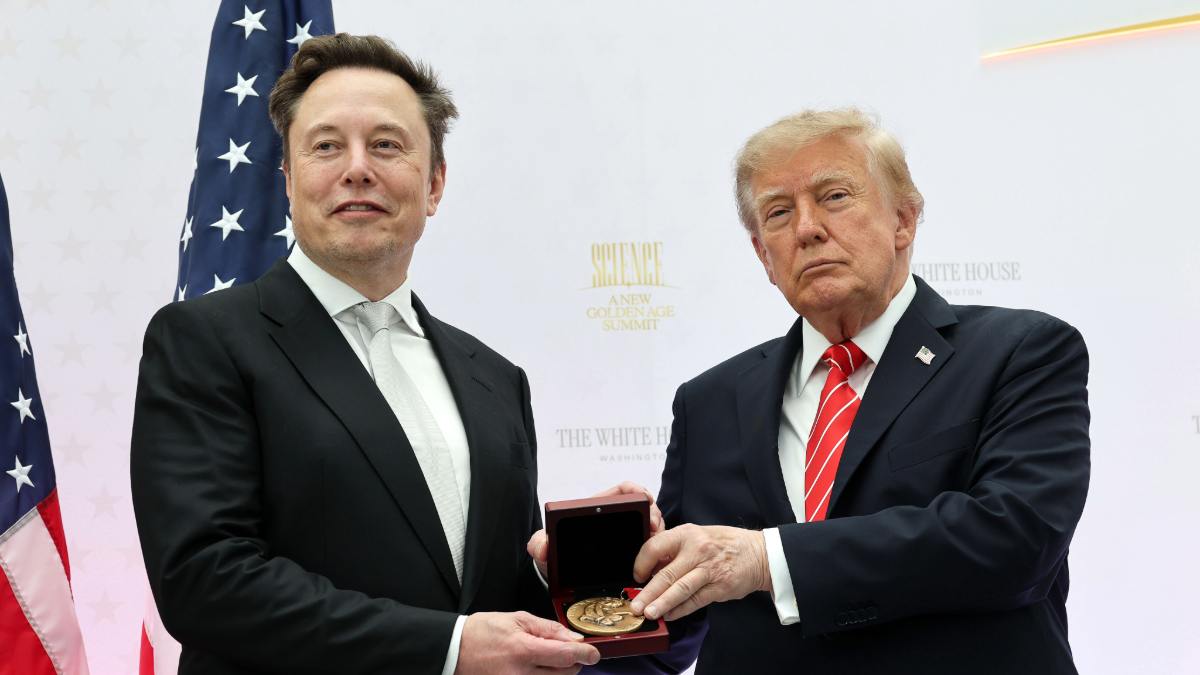
Tesla and SpaceX CEO Elon Musk receives the National Medal of Science from US President Donald Trump during the Golden Age of American Innovation Summit at the Institute of Peace on October 08, 2026 in Washington, DC. (Photo by Win McNamee/Getty Images)
Early in Alex Gibney’s new documentary, “Musk,” the Silicon Valley mogul is introduced to a MAGA rally as “the greatest capitalist in history.”
However one regards Elon Musk — electric vehicle and space pioneer, drug-addled chaos agent, fascist enabler, megalomaniac, all of the above — this movie makes a convincing case that he is not a “great capitalist,” let alone the greatest ever. On the business front, he has combined an uncanny ability to hoover up government subsidies and contracts with a P.T. Barnum-level talent for hucksterism. From this mixture, he built an historic fortune based on the value of the stock of one company, Tesla. A master of the free market or an exemplar of rugged individualism, Musk is not.
He is powerful, though, as the Gibney documentary also demonstrates. Musk has used a small fraction of his now roughly trillion-dollar fortune to become the single most influential political financier of his generation — more specifically, the single most important underwriter of Donald Trump and the MAGA movement. This financing, in turn, bought him unique, if brief, access to direct political power early in the second Trump administration — the DOGE episode — which Musk used to cripple or destroy several federal agencies, including those with the authority to investigate and regulate his companies Tesla and SpaceX. When it comes to artificial intelligence, the hottest button in tech policy at the moment, Musk’s ambitions are inscrutable, but there is no reason to assume they are benign. Just one illustration: his Grok chatbot’s affection for Hitler.
Simultaneously, he has exploited the deterioration of the US government-led space program to transform SpaceX into the world’s dominant satellite-launching operation. This has made him the private citizen with the most influence over American foreign policy, now and probably ever. Repeatedly, he has interfered with Ukraine’s drone defenses in its war against Russia, a conflict that could determine the balance of power throughout Europe. Responding to the prospect of Democrats retaking control of Congress in the November 3 midterms and launching investigations of his role in Ukraine, among other matters, Musk in late October threatened to “come for” those “who pick fights with me.”
So, Gibney’s “Musk” is timely; its subject, consequential. In the 2025-26 midterm election cycle, he is once again MAGA’s lead financier, ponying up an astounding $442 million for Republican candidates — that we know about. In the dark money era, such estimates are suspect and likely on the low side. It matters urgently what the man says, does, and thinks.
Musk, for what it’s worth, did not enjoy “Musk.” On his social media platform, X, he wrote: “Gibney just assembled a hit list of people who either have an axe to grind or don’t even know me (but still have an axe to grind). He has ZERO integrity. Horrible human.”
Here, I’m going to offer a micro-review of “Musk,” followed by a brief discussion of some of the personal issues the movie raises, and then an analysis of several of the more important aspects of Musk’s role in business and politics.
Bloated, “traumatizing,” but also instructive
Gibney won an Academy Award for “Taxi to the Dark Side,” a 2007 documentary about US interrogation and torture practices in Afghanistan, and has directed many other excellent nonfiction films. With “Musk,” sadly, he got carried away. It’s nearly four hours long and feels longer. Bloated and repetitive, it lacks a fresh interview of Musk, who refused to cooperate, and instead relies on numerous “comments” from a creepy AI-generated version of Musk. On top of that, Gibney has interwoven actual archival footage and contemporary interviews with jangly video game imagery meant to suggest Musk’s manic behavior and thinking. The movie “is traumatizing because he is a traumatizing figure,” Gibney has explained. “In certain narrative, thematic, and formal ways, I’m trying to put ourselves inside his head.” Fair enough, but a lot less of these theatrics would still have gone a long way.
Despite these flaws, Gibney’s film contributes to our understanding of its subject. “Musk” offers an instructive portrait of a deeply unsettling figure with the ability to impose his warped ideas on US society and the world at large. The juxtaposition of his shady business practices, increasingly fascistic political agenda, and personal weirdness underscores just how dangerous he has become. Gibney provides a service merely by compiling decades’ worth of Musk snickering through podcasts, hopping around on various political stages, and, in one instance, shooting straight-arm Nazi-esque salutes at a 2025 Trump rally.
Among the filmmaker’s most intriguing interviewees are mothers of some of Musk’s children, women who testify to his capacity for personal cruelty, narcissism, and dishonesty. These aren’t necessarily the traits that have the broadest public policy implications, but they do shed light on Musk’s psychology and character.
Justine Wilson, who was married to him from 2000 to 2008, eloquently describes his nonstop histrionic manner and the devastating way he declared one of their six children “dead” — “killed by the woke mind-virus” — after she transitioned to being a woman. To Wilson, it’s a doubly painful description; another of their children literally died in infancy. Musk has claimed he was holding the baby and “felt his last heartbeat.” Wilson says that’s not true; she was holding the child when he died. Throughout his life and career, the documentary shows, Musk has taken credit he hasn’t deserved.
Ashley St. Clair, a former right-wing influencer and mother of another child with Musk, speaks about his unusual proclivity for procreation — there are 14 publicly known Musk offspring — which apparently is tied to his anxiety about existential threats to the future of humankind. St. Clair says that he once told her that they should have a “legion of children before the civil war.”
Another piece of the psychological puzzle comes from Musk’s father, Errol, who tells Gibney about how his son was bullied and beaten up as a boy in their racially polarized homeland of South Africa. Errol also blandly recounts how he once shot and killed three Black intruders, watching them slowly bleed to death. How all of this fits together, Gibney doesn’t explain, perhaps wisely, as a unified diagnosis may be impossible.
Profits with help from the government
After an intermission, the second half of the documentary shifts to Musk’s career and political role. In this realm, Gibney illustrates that Musk’s talent lies in identifying ways to profit from government infrastructure and anticipating public policy shifts, ranging from the privatization of national security in the wake of 9/11 to subsidies for “green” industry during the same time frame. In their 2026 book, Muskism: A Guide for the Perplexed, which I reviewed recently for Tech Policy Press, authors Quinn Slobodian and Ben Tarnoff note that “Musk has always had an instinct for putting his entrepreneurial energies into sectors that could benefit from the munificence of Uncle Sam.”
Late-1990s directory and financial-services businesses Musk started and sold relied heavily on publicly funded internet infrastructure available to dot-com founders at no cost. His first two companies never made a profit, but he cashed out for a total of more than $200 million based on frothy expectations of future growth. With that initial haul, he started SpaceX and invested in Tesla, which he later took over, claiming disingenuously to be the EV company’s “founder.”
While Gibney questions whether his subject is really the “engineer” he claims to be — as opposed to a marketer and big-picture guy, roughly on the model of Steve Jobs at Apple — the filmmaker acknowledges that Musk helped spur the electric vehicle market and accomplished space breakthroughs like deployment of reusable rockets. As a cash-strapped NASA atrophied, SpaceX effectively became the American space program, by 2025, accounting for 85% of all orbital launches in the US and more than half of all launches globally.
Musk did this with taxpayer dollars. Both SpaceX and Tesla wobbled on the edge of failure in the 2000s and survived only as a result of an array of government grants, credits, and other assistance. The federal government awarded SpaceX more than $500 million in grants in its early years. When the company was still almost out of cash in 2008, it received a then-unprecedented $1.6 billion contract from NASA.
For its part, Tesla had sold fewer than 2,000 cars by January 2010. Then it received a whopping $465 million low-interest loan from the Department of Energy, which was crucial to the development of its first major success, the Model S sedan. Tesla survived to launch an IPO and paid back the loan with proceeds from an additional sale of stock. In another example of government largesse, a $7,500 tax credit for EV buyers allowed Tesla and other car makers to sell US-made electric vehicles at higher prices than otherwise would have been feasible; these credits totaled some $3.4 billion by the time the perk ended in 2019. Yet another program allowed Tesla to sell “emission credits” to non-EV car makers that accounted for nearly 25% of Tesla’s revenue in 2008. It wasn’t until 2021 that Tesla was able to post a profit without the boost from green credit sales.
Propping up the nascent EV industry and privatizing US space endeavors may or may not have been wise public policy choices. But without these government initiatives, Gibney convincingly argues, Elon Musk likely wouldn’t be anywhere close to as rich as he became.
The extent of that wealth depends on Tesla’s stock price, and Gibney alleges that Musk has goosed the value of his shares by misleading the public about the cars’ range, the feasibility of a long-defunct battery-swapping program, and the safety of self-driving features. Like the government subsidies, none of these constitute revelations original to “Musk,” but the movie consolidates them in a way that demythologizes the supposedly “greatest capitalist in history.”
What may be fresh insight for some viewers is Gibney’s point that Musk’s depredations under the banner of DOGE did far more than destroy the US Agency for International Development and, by some estimates, endanger the health and lives of hundreds of thousands of aid recipients around the world. By haphazardly slashing budgets and firing or otherwise causing the departure of more than 300,000 career civil servants, DOGE severely weakened a range of other agencies charged with regulating Musk’s business activities. These include the National Highway Safety Administration, Federal Aviation Administration, Securities and Exchange Commission, Environmental Protection Agency, National Labor Relations Board, and Equal Employment Opportunity Commission. Viewed from this perspective, Musk’s spending so much on the midterms to try to keep Congress under Republican control appears to be a campaign to preserve the misdeeds of DOGE.
A mogul’s foreign policy
The scariest of Musk’s exertions of influence is seen in his attempt to tilt the war over Ukraine in Russia’s favor. “Musk” explains how he became the dominant global satellite launcher, and recent reporting by The Wall Street Journal and others has revealed that Musk “ordered the slowdown of a military-grade version of Starlink [one of his satellite-based networks] relied on by Ukraine, a decision that sparked panic in Kyiv and confusion inside the Trump administration.”
Leaving aside the ambiguities still surrounding the precise balance of power between the US president and his chief financier, Trump and Musk have both sided with Russian ruler Vladimir Putin and criticized Ukraine for attacking Russian oil refining capacity.
Gibney doesn’t clarify what drives Musk’s foreign policy stance beyond his affinity for illiberal forces ranging from Putin’s autocracy to right-wing political movements in Germany, the UK, and elsewhere. On this question, it helps to recall Musk’s roots in apartheid South Africa, which may help explain his animosity toward practically everyone outside of his Caucasian, European-descended, technology-gated ecosystem. “If tolerance means the end of Western Civilization,” he posted to his 225 million X followers in August 2025, “then we cannot be tolerant.”
The authors of Muskism offer what might be the best theory on how to understand the mogul’s overall agenda. He thinks he can cajole or pressure everyone to do business with him and boost his power and bottom line. The pitch, they write, is that “in an increasingly unstable world, both states and individuals can fortify their self-reliance by plugging into [Musk’s] infrastructures.”
That’s not a brave new world where I, for one, want to live.
Authors