The Life and Death Stakes for Africa of a World That Doesn't Agree on the Truth
Alison Gillwald / Sep 23, 2026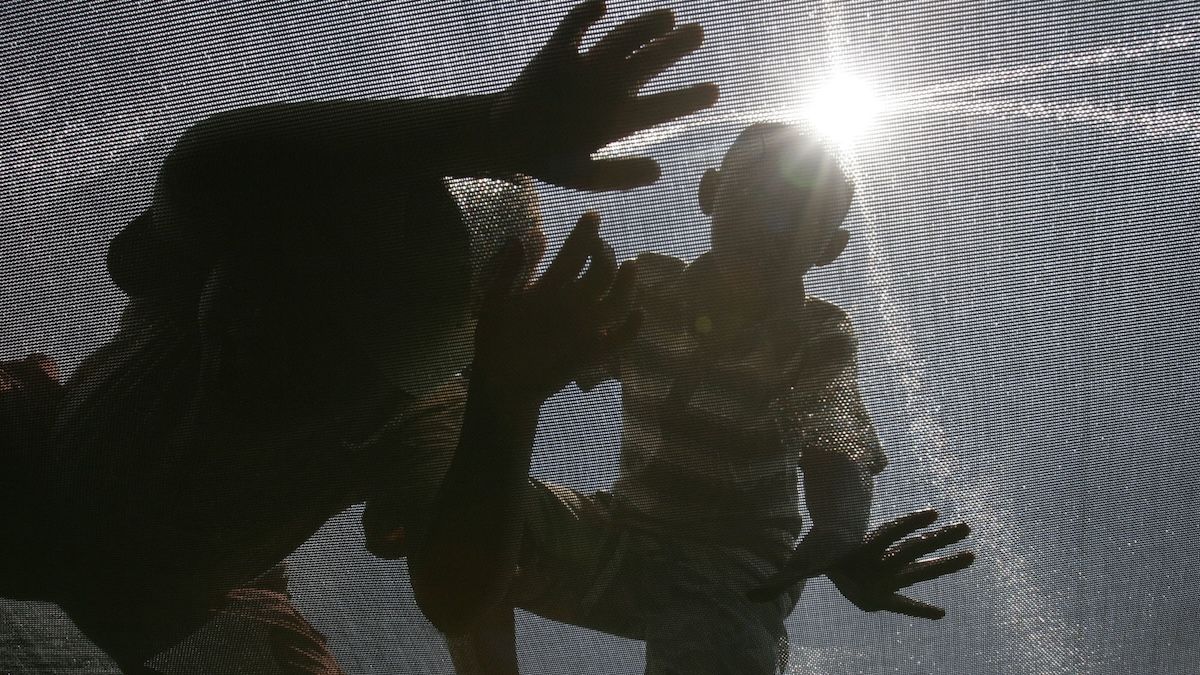
A photo from 2008 of children playing on a trampoline at the Soweto Hospice in South Africa, which was funded by the US President’s Emergency Plan for AIDS relief, PEPFAR. (AP Photo/Denis Farrel)
Earlier this month, the United States was derided for being the only country to vote against the UN General Assembly’s “Correct the map” resolution, which encourages the global adoption of map projections that show Africa’s true size. It echoed the ridicule directed at the US Department of State on social media following a presentation at a global AIDS conference in Brazil in July showing an AI-watermarked map of Africa, with seven countries displayed wildly out of place, shape and size.
That the US still hasn’t even worked out how to use 16th century Mercator navigational charts became a standing joke; that its hegemonic hold over the international order persists regardless, is not. Washington dismissed the UN’s resolution to switch to the Equal Earth projection as a “radical ideological project,” linking it to an earlier resolution passed in March that condemns slavery as the gravest crime against humanity and calls for reparations.
Technically, officially, even scientifically, it is not: a cartographic correction of the distortions in Mercator maps corresponds to what the world already understands as fact — which is why, in the increasingly Alice-in-Wonderland world of US geopolitics, with its arbitrary renaming of international waterways and lakes, Washington’s opposition to a scientifically supported correction is preposterous.
But it is certainly also political. The resolution highlights the non-neutrality of so-called ‘objective’ scientific instruments, contending that diminishing Africa geographically, “affects education, public understanding, culture, geopolitics, development narratives and perceptions of Africa’s scale and potential” — linking accurate mapping to cognitive justice, historical recognition and equitable representation. As Togo’s representative put it, “A fair map does not change the geography of the world; it changes how we see the world.”
This was evident not a month before in Washington’s glib acknowledgement of the entirely incorrect location of all seven African states in the presentation outlining its future HIV response. A State Department spokesperson called it “an unfortunate error,” adding that the department takes “full responsibility for the confusion and misrepresentation it caused for attendees, including our African partners.” Whose responsibility could it otherwise have been — the AI’s?
Africans, inured to this kind of condescension as routine in international aid and trade relations, responded with disappointment officially, but with humorous derision online. Nonetheless, the error raises sharper questions about the integrity of the data behind much vaunted AI systems that UN agencies and sovereign donors and private philanthropies are pushing to the rest of the world — as well as the data behind Washington’s much-diminished AIDS program.
It also raises concerns about the integrity of the media — and the international media in particular — whose reporting on the map debacle in July amounted to little more than the State Department’s own apology.
Only Reuters followed up — identifying the invisible OpenAI watermarks and getting African government and HIV organisations on record. The substantive story broke on Substack, where AIDS expert Emily Bass revealed it as part of a much greater deception by the State Department’s Bureau of Global Health Security and Diplomacy. It was not just fabricating maps of Africa, but rewriting the history of PEPFAR, the imperfect but massively impactful US President’s Emergency Plan for AIDS Relief. Among the more striking omissions, Hess points out, was the reason for the failure of DATIM, the system tracking HIV data, in the Bureau’s rationale for new in-country data systems that, as Bass notes, already existed.
“DATIM went offline because of the stop-work order in 2025,” Bass writes — not a systems failure, but a system that “went offline during a lethal, haphazard and shocking termination of US foreign aid for global health.” The consequences were not abstract: “People died and will keep dying horrible, painful deaths from undiagnosed HIV, without being counted or, better yet, helped” — because Washington froze, then reinstated, data collection without the staff needed to capture and validate it, or allow for any public review.
“There is no chance of a constructive, productive future for an American global health strategy that has such a loose relationship to the facts,” Bass said.
Why does this matter for technology policy, media and democracy? What’s notable here is the inversion of traditionally authoritative sources of official information — accountable government and the Fourth Estate’s role in obtaining and scrutinising that information. More credible, fact-checked accounts increasingly come not from official or establishment media but from specialists, researchers, and independent journalists on platforms as far from Big Tech’s reach as they can manage.
The implications go beyond AI or social media, to the broader erosion of democracy. Social networks that once gave a multiplicity of voices direct access to global audiences, have been co-opted or bought out by Big Tech, or have become instrumental to the AI race to build unassailable leads on the back of unregulated data-extractive oligopolies. Dominant browsers, social media platforms, and now unavoidable AI chatbots, have hollowed out local media.
In Africa, barely a handful of independent, non-state outlets are left to cover increasingly weaponised trade and aid, which has tied reduced US funding for HIV healthcare to long-term data and pathogen-provisioning deals, and even made it subject to rare-earth rights that several African countries have recently rejected. Establishment media has not fared much better internationally, as they are bought or sold out to tech oligarchs who declare, in public manifestos, the need to rid society of democracy or have techno-nationalist doctrines of firms building and deploying dual-use, defense AI — while nominally ‘public interest’ broadcasters report on genocide through the lens of its perpetrators, and the UN looks on.
The more authoritarian and anti-humanist the worldview, the more room the broligarchy seems to be given in establishment media it hasn’t yet bought or broken. In a July exchange with Elon Musk, The Economist’s editor-in-chief, Zanny Minton Beddoes, lobbed questions so weak she conceded almost as soon as they were asked. Musk was left free to construct his own fabrication of the record. To her suggestion that DOGE’s cuts to USAID food and health programs had caused hardship and loss of life, his response was categorical: “Zero people died. Zero died because of DOGE… Zero point zero.” Her reply: “Well, that’s what I would take issue with… the pace and the suddenness with which it happened will almost certainly have caused unnecessary suffering and deaths.”
Almost certainly?
A five-minute search would have given her an arsenal of facts and figures very far from “Zero point zero”. An estimated 750,000 people died unnecessarily from the DOGE cuts to USAID and other health and food programs before June, with the toll potentially reaching up to 14 million over five years if the trajectory holds. This is supported by a growing number of academic studies. More than 83 percent has been cut from USAID’s 2023 $42.4 billion budget, alongside disruption to PEPFAR and reduced UK overseas aid. Modelling suggests the USAID cuts alone will contribute to an additional 15.2 million AIDS deaths, 2.2 million tuberculosis deaths, 7.9 million child deaths and 40 million to 55 million unintended pregnancies between 2025 and 2040.
Rather than press the point, Beddoes let Musk pivot repeatedly — from the US accounting for humanitarian outcomes, to DOGE having saved the country from USAID fraud, to blaming the Gates and MacKenzie Scott foundations for failing to deploy the $50 billion they sit on to shore up the USAID deficit. “Fair point,” she offered.
Sitting in Tesla’s Texas Gigafactory, a Tesla parked behind them, she did try to push back, briefly: “Not everyone functions as fast as you do… if funding is cut off for antiretrovirals overnight, people will die” — before undercutting herself: “Let’s be practical… I don’t want to have an argument.” She noted many health programs across Africa had shut down, but still failed to counter Musk’s dismissal: “These claims are false. They’re nonsense. Absolute nonsense.”
That an outlet with The Economist’s resources could go into an interview this unprepared — common neoliberal ground notwithstanding, to which both parties are of course entitled — is an indictment of the publication but also symptomatic of the loss of integrity and credibility of establishment journalism.
Information integrity is one of seven critical issues in the Preliminary Report of the UN’s Independent Scientific Panel on AI released in July at the Global Dialogue on Artificial Intelligence. It warns that AI can erode shared reality and civic participation through “epistemic erosion,” the gradual wearing away of society’s ability to distinguish truth from falsehood. Opening the Dialogue, the UN’s secretary-general, António Guterres, tied that erosion directly to the viral and exponential nature of advanced data driven technologies: “A machine-enabled lie can now persuade as effectively as the truth, and authentic evidence can be dismissed as fake.”“A society that cannot agree on what is real cannot defend itself,” Guterres said.
And yet he did not reference the threat of AI to amplify inequality, unless governed effectively. Instead, Guterres casts AI as “the great equaliser of the 21st century ” achievable by developing countries on the technology fast-track through safe systems that honor human rights, with real transparency about labor and planetary impacts. Getting this right, he said, is “at the heart of our common future.”
Yet the Panel’s Report, subtitled as an “evidence-based assessment of the opportunities, risks and impacts of AI” provides no evidence that AI will be a ‘great equaliser’. On the contrary, despite its curious ‘balancing’ of every claim with a counter claim, the heavily referenced report actually demonstrates far more evidence of the negative consequences of AI, while doing very little to support claims that AI will help in the achievement of the UN’s Sustainable Development Goals. Regardless, this did not stop the ‘great equaliser’ mantra from being repeated by numerous member states and heads of multilateral bodies who subsequently addressed the forum.
In fact the report highlights the lack of — and unevenness of — evidence, including on some of the big ticket items: productivity gains, labor market effects, value-chain impacts, and importantly, which governance arrangements might actually work best.
That absence of evidence should trouble anyone who is serious about AI governance. It should trouble Africa most of all. A continent whose true size still has to be legislated back onto the map, whose HIV data can be switched off and on again without explanation or accountability, and whose dead can be waved away on a public stage with an emphatic “Zero point zero,” has the most to lose from a world in which the loudest, best-resourced voice always gets to define reality.
Authors