The Paris Raid on X Shows How Far the US and Europe Have Drifted on Tech Rules
Mark Scott / Feb 5, 2026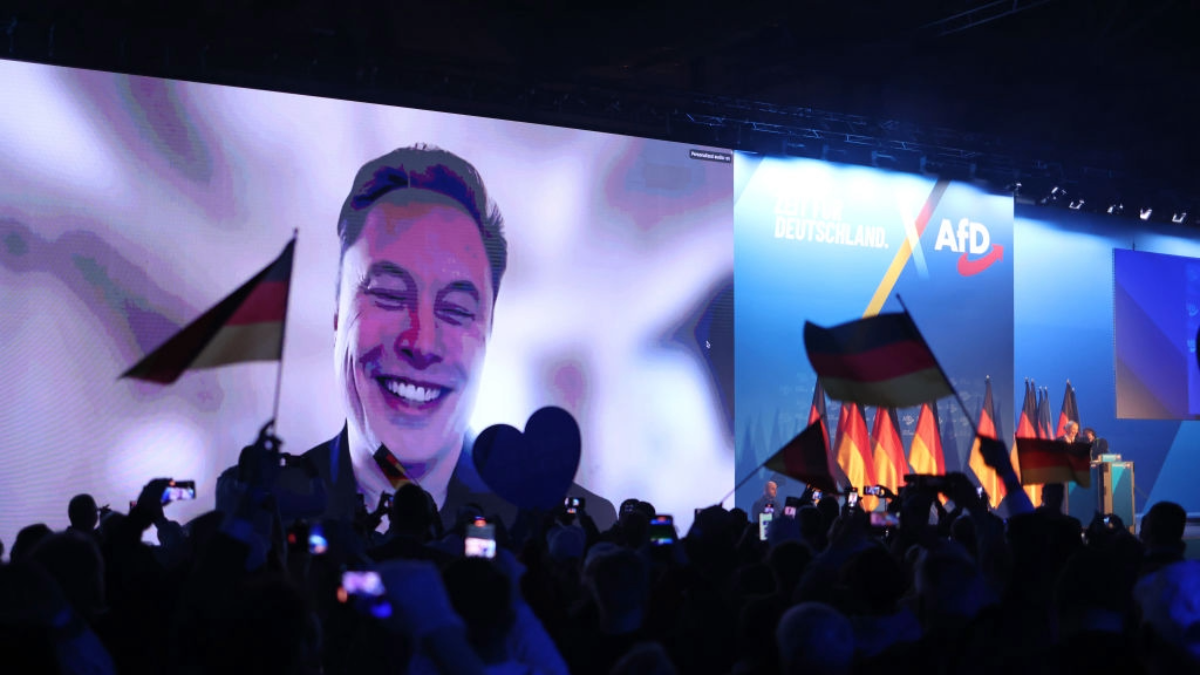
Tech billionaire Elon Musk speaks live via a video transmission during a speech by Alice Weidel, chancellor candidate of the far-right Alternative for Germany (AfD) political party, at the AfD election campaign launch rally on January 25, 2025 in Halle, Germany. (Photo by Sean Gallup/Getty Images)
If anyone needed a demonstration of how differently the US and Europe view platform governance issues, then the brewing spat between Elon Musk’s X and the Paris Public Prosecutor’s Office is another timely reminder.
After French police raided the local offices of X — and asked the billionaire to appear for voluntary questioning related to an expanded local criminal investigation — the American social media giant pushed back hard.
“Today’s staged raid reinforces our conviction that this investigation distorts French law, circumvents due process, and endangers free speech,” the company said in a statement on X. It denies claims that X’s algorithm may have been used to sway political opinion in France, as well as accusations that the tech giant is complicit in the distribution of child pornography.
Within an hour, Musk doubled down. “This is a political attack,” he wrote to his more than 220 million followers on X.
Two hours later, France’s foreign ministry clapped back. “Investigating child sexual abuse material isn’t controversial,” the ministry wrote to its significantly smaller number of X followers. “Turning it into political theater is manipulation. Maybe that logic flies on some island. Doesn’t fly in France.”
The feud highlights what has become an ever-growing divide between long-standing transatlantic allies.
Where some Republicans and their corporate allies see attempts to censor American voices online, Europeans view efforts to boost accountability for some of the world’s largest companies.
Where Washington sees European meddling in global free speech rights, Europeans view American interference in how the 27-country bloc implements its own rules.
And where some in Congress see the European Union attempting to undermine Silicon Valley’s economic prowess, Europe views legitimate efforts to make online spaces safer for its more than 500 million citizens.
That latest dispute — epitomized by the tit-for-tat responses from X, Musk and the French foreign ministry — does not take away from the independent French criminal investigation that is not connected to the EU’s Digital Services Act.
In a statement published on Feb 3, the local prosecutor’s office said that it was now expanding its year-long probe to include how Grok, an AI chatbot embedded within X, shared holocaust-denying statements, which are illegal in France, and created sexual deepfake images of children and women without their consent.
The creation and sharing of non-consensual intimate images and child sexual abuse material are illegal in the US as much as they are in Europe.
“The conduct of this investigation is currently part of a constructive approach, with the objective of ultimately ensuring the compliance of the X platform with French law,” according to the Paris Public Prosecutor’s Office, which announced it would also be leaving X.
Yet as US lawmakers gathered on Feb 4 in Washington for another hearing into allegations that Europe’s online safety rules unfairly censor Americans’ free speech rights, this disconnect between both sides of the Atlantic was fast becoming a culture wars wedge issue in the fraying transatlantic alliance.
For many in Washington, the stated objective of boosting accountability and transparency for some of Silicon Valley’s biggest names — baked into both the EU’s Digital Services Act and the United Kingdom’s Online Safety Act — just doesn’t pass the smell test.
They refer to efforts by European regulators to urge American tech companies to rid their platforms of “illegal content” — in the form of terrorist content, hate speech and child sexual abuse material — as the thin end of the wedge to unproven claims that rightwing voices are being demoted online worldwide.
Some US officials and lawmakers similarly equate these online safety regimes as free speech-busting attempts to promote Europe’s allegedly progressive agenda, including forcing US tech giants to adopt the bloc’s digital rulebook throughout their global empires.
That viewpoint is not shared across the Atlantic.
Across Europe — despite the rise of some political voices that equate these rules to illegal censorship — policymakers and politicians refer to how both the EU’s Digital Services Act and the UK’s Online Safety Act have specific provisions to uphold individual free speech rights. That includes requiring platforms to balance the need to keep users safe online with other individuals’ rights to express themselves online.
For these officials, the online safety regimes are more a mundane exercise to ensure tech companies live by their own terms of service, all of which have provisions to remove illegal content, such as terrorist content, or counterfeit goods.
That includes recent commitments from China’s AliExpress to clamp down on the sale of illegal products, as well as the European Commission’s $140 million fine against X for failing to comply with the bloc’s transparency requirements within the Digital Services Act.
Within that context, the dueling EU-US narratives around the raid on X’s offices in Paris and the request for Musk to travel to France for voluntary questioning are unexpected.
But at a time when the transatlantic alliance is under more strain than at any other time since World War II, it’s a reminder that questions about platform governance — as well as individuals’ free speech rights online – can have a knock-on effect in the real world.
Authors